No doubt you guys may have heard about Bush and Blair discussing international affairs, and the poor fellas didn't realise that a live microphone was picking up their words. The language with which Bush spoke about the Middle East crisis was fruity to say the least. One would have thought that both men were school prefects presiding over a petulant playground spat. The classic line is of course, "...to get Syria, to get Hizbullah to stop this shit and it's over." It almost equates to "tell Johnny to to tell Bobby to stop throwing stones, and no windows will be broken anymore." And "yo, Blair"? Is that Ali G underneath a Bush mask? International Diplomacy for Dummies:
Bush: Yo, Blair. How are you doing?
Blair: I'm just...
Bush: You're leaving?
Blair: No, no, no not yet. On this trade thingy ...[inaudible]
Bush: Yeah, I told that to the man.
Blair: Are you planning to say that here or not?
Bush: If you want me to.
Blair: Well, it's just that if the discussion arises ...
Bush: I just want some movement.
Blair: Yeah.
Bush: Yesterday we didn't see much movement.
Blair: No, no, it may be that it's not, it may be that it's impossible.
Bush: I am prepared to say it.
Blair: But it's just I think what we need to be an opposition...
Bush: Who is introducing the trade?
Blair: Angela [Merkel, the German chancellor].
Bush: Tell her to call 'em.
Blair: Yes.
Bush: Tell her to put him on, them on the spot. Thanks for [inaudible] it's awfully thoughtful of you.
Blair: It's a pleasure.
Bush: I know you picked it out yourself.
Blair: Oh, absolutely, in fact [inaudible].
Bush: What about Kofi? [inaudible] His attitude to ceasefire and everything else ... happens.
Blair: Yeah, no I think the [inaudible] is really difficult. We can't stop this unless you get this international business agreed.
Bush: Yeah.
Blair: I don't know what you guys have talked about, but as I say I am perfectly happy to try and see what the lie of the land is, but you need that done quickly because otherwise it will spiral.
Bush: I think Condi is going to go pretty soon.
Blair: But that's, that's, that's all that matters. But if you ... you see it will take some time to get that together.
Bush: Yeah, yeah.
Blair: But at least it gives people ...
Bush: It's a process, I agree. I told her your offer to ...
Blair: Well ... it's only if I mean ... you know. If she's got a ... or if she needs the ground prepared as it were ... Because obviously if she goes out, she's got to succeed, if it were, whereas I can go out and just talk.
Bush: You see, the ... thing is what they need to do is to get Syria, to get Hizbullah to stop doing this shit and it's over.
Blair: Syria.
Bush: Why?
Blair: Because I think this is all part of the same thing.
Bush: Yeah.
Blair: What does he think? He thinks if Lebanon turns out fine, if we get a solution in Israel and Palestine, Iraq goes in the right way ...
Bush: Yeah, yeah, he is sweet.
Blair: He is honey. And that's what the whole thing is about. It's the same with Iraq.
Bush: I felt like telling Kofi to call, to get on the phone to Assad and make something happen.
Blair: Yeah.
Bush: We are not blaming the Lebanese government.
Blair: Is this...? (at this point Blair taps the microphone in front of him and the sound is cut.)
Thanks to the Guardian for the transcript.
Tuesday, July 18, 2006


Thursday, July 13, 2006
Why do they do it?
The phone rings, I don't recognise the number. Maybe it's an incredible job opportunity, perhaps Larry King has retired. But no, it's long lost family. My dad's cousin to be precise. Apparently it's amazing to know that my father has a manchild lurking in some corner of the earth. So after all, little ADC's loins were not solely for weeing by the huge iroko tree in the village square at night when nobody was watching. The ultimate act of rebellion in a pre-independence Nigerian village. Pee on the iroko tree, and the gods will make certain body parts fall off. You can see the attraction for a young rebel.
Little ADC's loins brought forth a child, many in fact, of which African Shirts is one. She was incredulous. She didn't tell me any of the weeing story, but she might as well have. I'd have blushed, and chuckled, and smiled, without uttering a word. Maybe the occasional "really!" Long lost family know how to make a grown man feel like sucking his thumb, and assuming the foetal position. You feel yea high.
A few years ago, on holiday in Washington DC, I had one such encounter. Nigerian wedding party setting, you know the type: abuse of dollars, abuse of gold, abuse of rims, abuse to make P Diddy skulk in inferiority. Who's the handsome (allow me artistic licence) young man with the funny accent? ADC's son. You don't mean it! So this woman asked me, sorry, told me, to dance with her. She'd known my dad since when men had lots of inches of hair and lots of inches on their shoe soles, the collars were large, and the trousers were tight. Except for the excess left-over material they added to the feet. Flares, they called it.
She was also emotional at seeing me, staring at me funny. Too many thoughts were in my head. "Dad, I hope you dumped her in the politest way possible," I thought. I wasn't ready for the sins of my father to be visited upon me with a handbag to the head. She had given no indication of any liaison with my dad whatsoever, but my doubly inflated ego (one ego for me, the other for Dad) was working overtime. As I boogie to whatever was playing, the deejay decides to go all highlife on us. My dad likes highlife, and I vicariously put on a few moves. Deadly moves, you're talking blood on the dancefloor moves. Suddenly she stops dancing. This is after she's been staring at me curiously throughout the dancing. "I can't believe it," she quips. "You even dance like your father."
Apples falling. Tree standing. Distance between them. None. So Daddy Was a Good Dancer. Song title of the year. Someone record it.
As a brief aside. I have an uncle in Nigeria who tells this one story every single time. "Nkem, you don big now o! I fit remember that time wey you piss for my hotel bed for London." When I have children, I will not be taking them to visit that particular uncle lest he embarrass me to death. No siree, I ain't having that.*
The thing that always makes me want to curl up and hide under a shrub is the frightful, "Ina nu kwa Igbo?" Do you understand Igbo? Strictly speaking, the answer is no. But because I know five Igbo phrases, I say "obele, obele." Small, small. I know "je waru" - go and bath, "je chi eze" - go and brush your teeth, "ina nu nte" - your ears don't hear (or something like that). Basically, issues of bedtime discipline. Quite how this is useful in adult conversation, I don't know. I'll brush my teeth when I damn well please. In fact, I won't brush 'em. Cane me if you dare. Yes that's three phrases, and in case you're wondering what the other two are, well, each "obele" counts as one individual phrase. Sue me.
However, the fact that you even say "obele, obele" is cue enough to start rattling away in Olumo Rock solid Igbo. Once they've started, that's the end. How do I tell them I haven't got a clue what they're on about? I listen in, trying to pick out words. It's like playing linguistic Su Doku on zen master level.
So my dad's cousin has insisted on speaking to me in Igbo. I should be visiting her soon. It will be an interesting conversation, as I have all my (English) responses worked out. No, Yes, I don't know. And for variation in Igbo, Mba, Ee (can't spell it), Amarom. Six responses in two different languages which mean just three things, for just one conversation. Chomsky, eat your heart out.
*caveat. I was a baby when this hotel bed thing happened...
Little ADC's loins brought forth a child, many in fact, of which African Shirts is one. She was incredulous. She didn't tell me any of the weeing story, but she might as well have. I'd have blushed, and chuckled, and smiled, without uttering a word. Maybe the occasional "really!" Long lost family know how to make a grown man feel like sucking his thumb, and assuming the foetal position. You feel yea high.
A few years ago, on holiday in Washington DC, I had one such encounter. Nigerian wedding party setting, you know the type: abuse of dollars, abuse of gold, abuse of rims, abuse to make P Diddy skulk in inferiority. Who's the handsome (allow me artistic licence) young man with the funny accent? ADC's son. You don't mean it! So this woman asked me, sorry, told me, to dance with her. She'd known my dad since when men had lots of inches of hair and lots of inches on their shoe soles, the collars were large, and the trousers were tight. Except for the excess left-over material they added to the feet. Flares, they called it.
She was also emotional at seeing me, staring at me funny. Too many thoughts were in my head. "Dad, I hope you dumped her in the politest way possible," I thought. I wasn't ready for the sins of my father to be visited upon me with a handbag to the head. She had given no indication of any liaison with my dad whatsoever, but my doubly inflated ego (one ego for me, the other for Dad) was working overtime. As I boogie to whatever was playing, the deejay decides to go all highlife on us. My dad likes highlife, and I vicariously put on a few moves. Deadly moves, you're talking blood on the dancefloor moves. Suddenly she stops dancing. This is after she's been staring at me curiously throughout the dancing. "I can't believe it," she quips. "You even dance like your father."
Apples falling. Tree standing. Distance between them. None. So Daddy Was a Good Dancer. Song title of the year. Someone record it.
As a brief aside. I have an uncle in Nigeria who tells this one story every single time. "Nkem, you don big now o! I fit remember that time wey you piss for my hotel bed for London." When I have children, I will not be taking them to visit that particular uncle lest he embarrass me to death. No siree, I ain't having that.*
The thing that always makes me want to curl up and hide under a shrub is the frightful, "Ina nu kwa Igbo?" Do you understand Igbo? Strictly speaking, the answer is no. But because I know five Igbo phrases, I say "obele, obele." Small, small. I know "je waru" - go and bath, "je chi eze" - go and brush your teeth, "ina nu nte" - your ears don't hear (or something like that). Basically, issues of bedtime discipline. Quite how this is useful in adult conversation, I don't know. I'll brush my teeth when I damn well please. In fact, I won't brush 'em. Cane me if you dare. Yes that's three phrases, and in case you're wondering what the other two are, well, each "obele" counts as one individual phrase. Sue me.
However, the fact that you even say "obele, obele" is cue enough to start rattling away in Olumo Rock solid Igbo. Once they've started, that's the end. How do I tell them I haven't got a clue what they're on about? I listen in, trying to pick out words. It's like playing linguistic Su Doku on zen master level.
So my dad's cousin has insisted on speaking to me in Igbo. I should be visiting her soon. It will be an interesting conversation, as I have all my (English) responses worked out. No, Yes, I don't know. And for variation in Igbo, Mba, Ee (can't spell it), Amarom. Six responses in two different languages which mean just three things, for just one conversation. Chomsky, eat your heart out.
*caveat. I was a baby when this hotel bed thing happened...
Man with urges
Emmanuel Milingo has absconded again. Why doesn't he just confess that he has urges, and he can't deal with them?
Seven Eleven
 Conspiracy theories are the stuff of cranks, bored geeks, and the Daily Express (which prints Diana conspiracy theories till this day). But some things are too obvious to overlook. Yesterday, July 11, 2006, the Indian city of Mumbai had to deal with a simultaneous bombing of its municipal rail network.
The first thing I noticed was the date, which was similar to three previous Al-Qaeda related bombings. First, the New York and Washington attacks took place on September 11, 2001. When the trains in Madrid were attacked on March 11, 2004, it was noted that it had happened exactly two and a half years after the Twin Towers went down.
And then came London, July 7, 2005. After July 7, I wondered what Al-Qaeda's obsession was with dates ending in "en". There was 9/11, 3/11, 7/7, and now, in Mumbai, a perfect date of 11/7. Or to use non-US date writing style, 7/11, cornershop par excellence Stateside. What does this all mean? Absolutely nothing. There have been other bombings on drab and ordinary dates, so these aren't necessarily part of an overarching pattern. If they were, I'm sure the authorities would have sussed it by now, and Al-Qaeda would be looking for different bombing patterns. On the first of the month, every third Tuesday, or some such pattern.
However, I also noticed that the first time Al-Qaeda came to wider world attention was on August 7, 1998. I was back in Nigeria for a long and memorable summer holiday when the US embassies in Nairobi and Dar es Salaam were gutted by truck bombs. That was the first time I heard of Osama bin Laden and his not-so-merry band of followers. The Lewinsky scandalised Clinton reacted with cruise missile strikes on a possible dual use factory in Sudan, a factory the Sudanese said was a pharmaceutical plant. These strikes caused Mr bin Laden to up sticks from Sudan and move to Afghanistan, where he probably remains to this day. Or does he?
My theory is that Osama bin Laden is in Nigeria. He's in a Shari'ah state somewhere in the north of the country, probably in Jigawa or Yobe. Nigeria does have its Taliban, self-styled on the resurgent former regime in Afghanistan. People in a country like Nigeria (land of many names) choosing to call their children Osama, should also count for something. Bin Laden also cites Nigeria as one of those countries that are "most qualified for liberation". Any sensible person really should agree with bin Laden, with a caveat of course. We pray "deliver us from evil", but we don't presume that we'd be delivered into a different kind of evil. Mr bin Laden, if you want a chance for a rebuttal stating that you won't deliver us into evil, drop me an email. I'm sure we can work something out.
The feeling that Nigeria is on the brink of Islamist implosion is shared by some think tanks and journalists. Jeffrey Tayler, writing in April's Atlantic magazine, implies that Nigeria is potentially worse than Iraq... I know. I felt disdain after reading the article, and I won't respond to it until I've got the disdain out of my system.
Back to Mumbai. I've been to Mumbai before, and it is a poverty stricken city. It might be India's financial hub, but the world's largest democracy still has a long way to go. One of the sadder elements of these attacks on countries like India and the US embassies in East Africa, is that these are the very countries that do not have the resources to deal with terrorism. But they are the countries constantly being attacked. A country needs sophisticaed technology, human intelligence gathering, man hours to prevent such attacks. But when (rather than if) an attack takes place, one at least needs an emergency operation system to swing into action. Once people have been treated and bodies have been removed from the wreckage, you now need to catch the culprits. Nigh on impossible.
Even though the West is in a perpetual state of panic over terrorist attacks, most of them occur in the developing world. The Indonesian resort of Bali has been bombed twice in three years, in Egypt, Sharm el-Sheikh was bombed in 2005 (shortly after July 7 in London), Dahab was bombed this year, and Sinai was bombed in 2004 (October 7). These are just countries that have had to deal with multiple attacks, but there's still Istanbul, Lebanon, and Iraq. Compare this to the three attacks in the West (New York, Madrid, and London), and compare the responses of the emergency services to these tragedies.
In Mumbai, the scenes were of utter chaos, meanwhile in July last year, I distinctly remember a police squad car being filmed by BBC News 24. The car was arriving at one of the bomb scenes; it looked for a space to park, and then reverse parked into a space it found. Parallel parking? You'd be hard pressed to find any calmer, mundane, and organised behaviour under such circumstances anywhere in the world.
Islamist terrorism has its roots in the developing world, and anyone who's serious about tackling it needs to look to these regions. The bombers of July 7 may have been "homegrown", but Mohammed Siddique Khan and Shehzad Tanweer both went to Pakistan, possibly for training. The Hamburg cell of September 11, had its roots in the Middle East, the Madrid bombers had ties to the Casablanca bombers. How do we solve this problem? I have no idea. But we know where to look.
Tuesday, July 11, 2006
Sunday, July 09, 2006
Zidane ruined the World Cup
 This was supposed to be his swansong, his sign-off, his final defining moment. It started off being his defining moment, but the reasons changed after the headbutt. He had scored an audacious penalty, threatened a repeat of the 1998 final when Buffon saved his header from point black range in extra time. He bestrode the pitch like a colossus, along with Henry, and Malouda, who played his best game of the tournament. The previously impenetrable Italian defence kept being carved open Christmas turkey style by France, and Zidane looked like doing it again.
And then the red mist descended. What did Materazzi say to him? One hopes that he insulted his mother, father, children, spat on the tricolour, and called him an Algerian camel to boot. But hold on a second, even that isn't enough. When you hear the phrase "unprovoked attack", you automatically think of a street thug assaulting an innocent person going about their daily business. Today, Zidane was that thug, and his attack on Materazzi was an arrestable offence. If that incident had happened anywhere other than on that pitch, he'd have been clapped in the stocks by the German Polizei.
On the day, France deserved to win, but in the grand scheme of the World Cup, Italy deserved victory. But what was shaping up to be the best World Cup final since 1986, ended as a ruined final, and probably ruined the World Cup for me. The most anticlimactic day of my life. More than a billion people were watching that madness on television. If he wasn't already retiring, he'd have been banned for a long long time. I was kicking myself for not making it to the match in Berlin because of a paucity of media tickets, but afterwards, I was glad not to have been there. I'd have been too downcast.
The World Cup was incredible, but I fear Zidane's behaviour might have ruined it for me. Zidane has showed his madness in the past - suspended for a stamping incident in 1998, suspended for the final group game against Togo this year, after picking up two yellows. Jean Marie Le Pen must be thinking, "I told them not to let that Algerian racaille play for Les Bleus". But Zidane is fallible. Zidane is a mere mortal. If he wasn't fallible, he wouldn't be human - he'd be God. Alas, no man is God. Congratulations to Italy, but what happened on that pitch?
Thabo Mbeki fancies me
Forgive the in-your-face red-top tabloid headline, but a sensational story requires a sensationalist telling. Like I said in my previous post, the unveiling ceremony was heaving with football glitterati, but if you look at the picture, you’ll see that the African politerati were there. (Do you like the “-rati” theme?) Alpha Oumar Konare, Chariman of the AU Commision, Kofi Annan, UN Secretary General, and Thabo Mbeki, President of South Africa.
The event was organised by the South African LOC, and it’s obvious that they were trying to stress that SA 2010 will be a decidedly African affair. Hence they trotted out the who’s who of African politics today. There should have been a concert later in the evening which would have been graced by Madiba (via satellite link), but the concert was called off due to a freak storm. Wyclef Jean, Youssou N’Dour, Sean Paul and a few others would have performed. I was gutted personally, because it would have been my one opportunity to be starstruck. I would have grabbed Wyclef by the leg, and not let go, until some burly bodyguards shot me with a taser gun. Good thing the heavens opened up and saved him.
Sepp Blatter. The Twit. Blatter’s introduction/speech was first. Blatter is a twit. I used to think that FIFA was the guardsman of football’s conscience, but after this World Cup, I’m forced to think again. During his speech he looked directly at Thabo Mbeki and said, “the market trusts Africa”. How does the market trust Africa? Well according to Blatter, “the contracts we have already signed are higher than the contracts for 2006 in Germany by about 25%”.
The BBC has done some calculations on the figures, and this puts SA already on £443m, while Germany secured contracts worth just £376m. I don’t have an MBA, and I’m not sure how he’s pulled this off. Several things don’t tally. The majority of the expenditure will be on transport, stadiums, and security. My worry is of personal safety and security in SA, but four years is a long time, so we'll see. South Africa has 4 times the area of Germany, but has half as many railway lines, and the same goes for paved roads. The GDP per capita of Germany is £18,409 while that of South Africa is £2,768. This automatically means that South Africans don’t have as much spending power as Germans. It isn’t cheaper to buy steel in South Africa than it is in other parts of the world. Labour costs for building railways and roads might be cheaper, but by no means cheap enough to compensate for the expense of commodities. How will the investors recoup their money? Surely they don’t expect to get everything back within the one month of the World Cup. Mbeki rejects the notion that his countrymen are too poor to make the World Cup in SA a success.
Blatter has also admitted that this World Cup was too commercial, evidenced by the truckloads of corporate spectators coming into the stadiums to watch games. FIFA will regain control of ticket allocation from 2010, as this year's was dealt with by the German LOC. Sponsors were allocated 16%, while corporate hospitality got 12%. Compare that to the mere 8% given to the teams playing. Teams such as England would have appreciated extra tickets when you consider that when England played Trinidad in Nuremberg, there were 70,000 fans in the city, and 70,000 in Frankfurt. FIFA will apparently reduce its corporate partnerships from 15 to 5 for 2010. Since the 5 partners for 2010 have coughed up more money than they did before, they will surely demand more power. In that case, one might as well give them the keys to Union Buildings in Pretoria. See what happened when Bavaria breweries tried ambush marketing. If Coke is one of the remaining partners, you’ll be looking at a situation where Pepsi would be banned from the airport as you land.
The condescending Blatter then went on about how the World Cup in Africa will be about “the drums” and “the music” in his annoying Swiss accent, shimmying for emphasis. And he kept referring to the dignitaries wives as “his woman”. “Kofi Annan and his woman”. His chauvinism is nothing new - in 2004, he said women footballers should play in "more feminine clothes." Imagine. I felt like getting up on stage and slapping his bald pate, but I wasn’t brave enough to withstand a potential Peter Tatchell from his minders.
Kofi Annan. The Diplomat. He delivered what was effectively his article in the International Herald Tribune of 9 June. Not terribly exciting, which might explain why he’s a diplomat. Unduly exciting a warring faction during disarmament talks couldn’t possibly be a good idea.
Issa Hayatou. The Disappointment. Like the embodiment of the disorganised CAF that he heads, didn’t have a speech ready. And this is the man, who’s about to oversee the greatest show on earth. He did okay winging it (in French), but on such an occasion, one cannot afford to slack. And he slack he did. Blatter even managed a sly dig at him, saying he had been CAF President since forever (1988).
Alpha Oumar Konare. The Orator. He was the most impressive of all. It is easy to see how this former president of Mali became AU Commision Chairman. Remove all negative connotations associated with demagoguery and you have Konare. His speech in French was buoyant, rousing, and emotive, all at once – a layered gateau of a speech.
Thabo Mbeki. The Statesman. The president promised that SA would host the best World Cup ever. This is no faint promise, but there were many journalists there, so he knows he’ll be quoted. However, in 2010, it’s likely that Jacob Zuma will be in his seat, taking all the heat. He was calm and assuring, and for me, possibly the clincher in convincing me that SA can do it.
On to the reason for the title of this post, if you’re still reading. After they gave their speeches, they was a question and answer session with journalists. The grandees were on stage answering questions, while the World Cup ambassadors (former players) were doing up close and personal interviews with cameras and mics shoved in their faces. The type of which I’ve become expert in the past month.
At this point a journalist has to choose what to do. Does he get a proper interview with the lesser mortals, such as the players? Or does he ignore the former players, raise his hand to ask the grandees a question which will have them quaking in their kaftans? Also considering that there might be too many hacks trying to ask questions, their turn may never come.
Here’s what we did. We talked to the players first. Since we’re doing television, exclusivity is important. One player talking to our camera is worth more than a public sit-down chinwag, where one can’t even tell where the questions are coming from because of the great media junket. After the grandees finished their an audience with, it was time for them to leave. At this point we stand in front of the stage, trying to get Mr Mbeki’s attention. Hopefully, he’ll thrown some words towards our way. But as he headed for the exit, his bodyguards set up suited, mobile ear-pieced rugby scrum around him. Nobody would touch Mr President. We kept getting shoved along as he walked, stopping to shake the odd hand. I tried to shout, “Mr President, Mr President”. “You’ve had your chance”, the bodyguard would bark.
We’d almost been squished like little moths, when I made a final attempt to get his attention. “Mr President, for Nigerian tv!” At which point he turned towards me, and I blurted out a question. For the life of me, I cannot remember what I asked him. It was all a blur. Thabo Mbeki then came to me, shook my hand, and gave me a lengthy answer (while still holding my hand). I said, “Thank you, Mr President.” “Thank you, my brother”, he smiled. And the scrum continued.
I felt like a billion rand. Still do. In that moment, when he stopped to grant me a few words, it felt like I was floating on something. The next time a mother faints when Bill Clinton kisses her baby, I’ll understand what she’s experienced. Thabo is no Bill, but power is an aphrodisiac, and when harnessed right, it could create supernovas. Afterwards, someone asked if I was related to Thabo Mbeki, because he'd given me so much attention. Well, we did go to the same university. But that wasn't it - he fancied me. That brief moment was a flirtation of sorts, and I was tooken.
The emblem. I like the emblem. It’s better than the one for this year. It is very organic, represents South Africa, Africa, football, and even more specifically, the vibrancy of African football. I spoke to a German woman at the launch who didn’t like the man, saying it was a default clichéd symbol used to depict Africa all the time. As far as she was concerned, if there was any time to avoid stereotypes, this was it. But the image transcends clichés. Rock art is as old as art itself, and South African heritage is connected to those early depictions of man. If the world didn’t already know that, now is their chance to learn. South Africa in 2010? It can happen.
The event was organised by the South African LOC, and it’s obvious that they were trying to stress that SA 2010 will be a decidedly African affair. Hence they trotted out the who’s who of African politics today. There should have been a concert later in the evening which would have been graced by Madiba (via satellite link), but the concert was called off due to a freak storm. Wyclef Jean, Youssou N’Dour, Sean Paul and a few others would have performed. I was gutted personally, because it would have been my one opportunity to be starstruck. I would have grabbed Wyclef by the leg, and not let go, until some burly bodyguards shot me with a taser gun. Good thing the heavens opened up and saved him.
Sepp Blatter. The Twit. Blatter’s introduction/speech was first. Blatter is a twit. I used to think that FIFA was the guardsman of football’s conscience, but after this World Cup, I’m forced to think again. During his speech he looked directly at Thabo Mbeki and said, “the market trusts Africa”. How does the market trust Africa? Well according to Blatter, “the contracts we have already signed are higher than the contracts for 2006 in Germany by about 25%”.
The BBC has done some calculations on the figures, and this puts SA already on £443m, while Germany secured contracts worth just £376m. I don’t have an MBA, and I’m not sure how he’s pulled this off. Several things don’t tally. The majority of the expenditure will be on transport, stadiums, and security. My worry is of personal safety and security in SA, but four years is a long time, so we'll see. South Africa has 4 times the area of Germany, but has half as many railway lines, and the same goes for paved roads. The GDP per capita of Germany is £18,409 while that of South Africa is £2,768. This automatically means that South Africans don’t have as much spending power as Germans. It isn’t cheaper to buy steel in South Africa than it is in other parts of the world. Labour costs for building railways and roads might be cheaper, but by no means cheap enough to compensate for the expense of commodities. How will the investors recoup their money? Surely they don’t expect to get everything back within the one month of the World Cup. Mbeki rejects the notion that his countrymen are too poor to make the World Cup in SA a success.
Blatter has also admitted that this World Cup was too commercial, evidenced by the truckloads of corporate spectators coming into the stadiums to watch games. FIFA will regain control of ticket allocation from 2010, as this year's was dealt with by the German LOC. Sponsors were allocated 16%, while corporate hospitality got 12%. Compare that to the mere 8% given to the teams playing. Teams such as England would have appreciated extra tickets when you consider that when England played Trinidad in Nuremberg, there were 70,000 fans in the city, and 70,000 in Frankfurt. FIFA will apparently reduce its corporate partnerships from 15 to 5 for 2010. Since the 5 partners for 2010 have coughed up more money than they did before, they will surely demand more power. In that case, one might as well give them the keys to Union Buildings in Pretoria. See what happened when Bavaria breweries tried ambush marketing. If Coke is one of the remaining partners, you’ll be looking at a situation where Pepsi would be banned from the airport as you land.
The condescending Blatter then went on about how the World Cup in Africa will be about “the drums” and “the music” in his annoying Swiss accent, shimmying for emphasis. And he kept referring to the dignitaries wives as “his woman”. “Kofi Annan and his woman”. His chauvinism is nothing new - in 2004, he said women footballers should play in "more feminine clothes." Imagine. I felt like getting up on stage and slapping his bald pate, but I wasn’t brave enough to withstand a potential Peter Tatchell from his minders.
Kofi Annan. The Diplomat. He delivered what was effectively his article in the International Herald Tribune of 9 June. Not terribly exciting, which might explain why he’s a diplomat. Unduly exciting a warring faction during disarmament talks couldn’t possibly be a good idea.
Issa Hayatou. The Disappointment. Like the embodiment of the disorganised CAF that he heads, didn’t have a speech ready. And this is the man, who’s about to oversee the greatest show on earth. He did okay winging it (in French), but on such an occasion, one cannot afford to slack. And he slack he did. Blatter even managed a sly dig at him, saying he had been CAF President since forever (1988).
Alpha Oumar Konare. The Orator. He was the most impressive of all. It is easy to see how this former president of Mali became AU Commision Chairman. Remove all negative connotations associated with demagoguery and you have Konare. His speech in French was buoyant, rousing, and emotive, all at once – a layered gateau of a speech.
Thabo Mbeki. The Statesman. The president promised that SA would host the best World Cup ever. This is no faint promise, but there were many journalists there, so he knows he’ll be quoted. However, in 2010, it’s likely that Jacob Zuma will be in his seat, taking all the heat. He was calm and assuring, and for me, possibly the clincher in convincing me that SA can do it.
On to the reason for the title of this post, if you’re still reading. After they gave their speeches, they was a question and answer session with journalists. The grandees were on stage answering questions, while the World Cup ambassadors (former players) were doing up close and personal interviews with cameras and mics shoved in their faces. The type of which I’ve become expert in the past month.
At this point a journalist has to choose what to do. Does he get a proper interview with the lesser mortals, such as the players? Or does he ignore the former players, raise his hand to ask the grandees a question which will have them quaking in their kaftans? Also considering that there might be too many hacks trying to ask questions, their turn may never come.
Here’s what we did. We talked to the players first. Since we’re doing television, exclusivity is important. One player talking to our camera is worth more than a public sit-down chinwag, where one can’t even tell where the questions are coming from because of the great media junket. After the grandees finished their an audience with, it was time for them to leave. At this point we stand in front of the stage, trying to get Mr Mbeki’s attention. Hopefully, he’ll thrown some words towards our way. But as he headed for the exit, his bodyguards set up suited, mobile ear-pieced rugby scrum around him. Nobody would touch Mr President. We kept getting shoved along as he walked, stopping to shake the odd hand. I tried to shout, “Mr President, Mr President”. “You’ve had your chance”, the bodyguard would bark.
We’d almost been squished like little moths, when I made a final attempt to get his attention. “Mr President, for Nigerian tv!” At which point he turned towards me, and I blurted out a question. For the life of me, I cannot remember what I asked him. It was all a blur. Thabo Mbeki then came to me, shook my hand, and gave me a lengthy answer (while still holding my hand). I said, “Thank you, Mr President.” “Thank you, my brother”, he smiled. And the scrum continued.
I felt like a billion rand. Still do. In that moment, when he stopped to grant me a few words, it felt like I was floating on something. The next time a mother faints when Bill Clinton kisses her baby, I’ll understand what she’s experienced. Thabo is no Bill, but power is an aphrodisiac, and when harnessed right, it could create supernovas. Afterwards, someone asked if I was related to Thabo Mbeki, because he'd given me so much attention. Well, we did go to the same university. But that wasn't it - he fancied me. That brief moment was a flirtation of sorts, and I was tooken.
The emblem. I like the emblem. It’s better than the one for this year. It is very organic, represents South Africa, Africa, football, and even more specifically, the vibrancy of African football. I spoke to a German woman at the launch who didn’t like the man, saying it was a default clichéd symbol used to depict Africa all the time. As far as she was concerned, if there was any time to avoid stereotypes, this was it. But the image transcends clichés. Rock art is as old as art itself, and South African heritage is connected to those early depictions of man. If the world didn’t already know that, now is their chance to learn. South Africa in 2010? It can happen.
Saturday, July 08, 2006
South Africa 2010
 The circus moves on. I went to the unveiling of the South Africa 2010 emblem in Berlin yesterday. You couldn't move for football glitterati: Hadji, Abedi Pele, Roger Milla. If you haven't seen the emblem yet, that's what it looks like (right). I'll write down my thoughts on the event later today, but my initial reaction (after much scepticism) is that South Africa can pull it off.
Thursday, July 06, 2006
Theo's Diary
Woke up this afternoon after getting an overnight train from France v Portugal in Munich, and saw this in my inbox. A tad harsh on Sol Campbell perhaps, but such is the nature of satire.
What I did on my summer holiday
By Theo Walcott Esq aged 8 1/2
I went to a place called Germany with my Uncle Sven and some other grown ups. It is a country in Europe where a bad man called Adolf used to live with his nazties, he does not live there anymore, Uncle Owen does live there, and the grown up's say I can't talk about the bad man as it will make Uncle Owen cry if I do. In Germany there are lots of castles and some mountains. We are staying in a place called Baden Baden that's a silly name, Uncle Frank has the same name as his dad, that's silly too, his mum must get their underpants mixed up all the time.
On the airplane Uncle Sol sat next to me, he got me some toffee and wants to be my friend, he works at the place where I do my YTS, so does Uncle Freddy but him and Uncle Sol are not best friends anymore.
Uncle Owen met us at the airport, he talks foreign, Uncle Wayne, Uncle Steven and Uncle David also talk funny, my mum says Uncle David talks like Orville, he is a duck, Uncle Sol say's uncle David wears dresses and knickers, and asked me if I had ever worn them. Uncle Sol got me some pop.
In Germany the grown ups are going to play football, my granddad says we beat them in the olden days before my mum was born. That is a long time ago.
While the grown up's went to play football so I went shopping with Auntie Vicky and some other girls she bought me a big ice cream and got herself a little one but she said she was full before she had eaten any and threw it away. She bought lots of shoes and handbags and let me play with Brooklyn. She say's she used to be in a pop band and sang me one of her songs, I think she was telling fibs.
I told Uncle Sol about my day out with Vicky and he sulked, then he bought me an even bigger ice cream with lots of hundred's & thousands on it.
All the other grown up's have a girlfriend except Uncle Sol so he plays with me while they go out. Uncle Sven says I must keep Uncle Sol happy, that's why I got taken on holiday.
The grown up's went to play Football against somebody called Sweden, Uncle Sol was crying as Uncle Freddy played for them and would not talk to him. Uncle Sol bought me lots of toffee today and some crisps. Uncle Sven is from Sweden and I heard him on the phone to their boss last night. Uncle Michael hurt his knee and had to go home to his mum for a plaster. Uncle Peter is a giant, a proper giant like you see in books, he is rubbish at football though.
Uncle Wayne had a sore toe at the start of out holiday but it got better so they let him play football. Uncle Sol got me a present but I do not like it. He says all Germans wear leather underpants and I should while we are here, they are too tight for me.
All the grown up's started to call Uncle Wayne a potato head who stood on somebody’s spuds. He got shouted at by the referee. They are all saying that we have to go home now. Uncle Sol was crying again and I had to sit on his knee to make him stop. He had his mobile phone in his pocket, I think.
What I did on my summer holiday
By Theo Walcott Esq aged 8 1/2
I went to a place called Germany with my Uncle Sven and some other grown ups. It is a country in Europe where a bad man called Adolf used to live with his nazties, he does not live there anymore, Uncle Owen does live there, and the grown up's say I can't talk about the bad man as it will make Uncle Owen cry if I do. In Germany there are lots of castles and some mountains. We are staying in a place called Baden Baden that's a silly name, Uncle Frank has the same name as his dad, that's silly too, his mum must get their underpants mixed up all the time.
On the airplane Uncle Sol sat next to me, he got me some toffee and wants to be my friend, he works at the place where I do my YTS, so does Uncle Freddy but him and Uncle Sol are not best friends anymore.
Uncle Owen met us at the airport, he talks foreign, Uncle Wayne, Uncle Steven and Uncle David also talk funny, my mum says Uncle David talks like Orville, he is a duck, Uncle Sol say's uncle David wears dresses and knickers, and asked me if I had ever worn them. Uncle Sol got me some pop.
In Germany the grown ups are going to play football, my granddad says we beat them in the olden days before my mum was born. That is a long time ago.
While the grown up's went to play football so I went shopping with Auntie Vicky and some other girls she bought me a big ice cream and got herself a little one but she said she was full before she had eaten any and threw it away. She bought lots of shoes and handbags and let me play with Brooklyn. She say's she used to be in a pop band and sang me one of her songs, I think she was telling fibs.
I told Uncle Sol about my day out with Vicky and he sulked, then he bought me an even bigger ice cream with lots of hundred's & thousands on it.
All the other grown up's have a girlfriend except Uncle Sol so he plays with me while they go out. Uncle Sven says I must keep Uncle Sol happy, that's why I got taken on holiday.
The grown up's went to play Football against somebody called Sweden, Uncle Sol was crying as Uncle Freddy played for them and would not talk to him. Uncle Sol bought me lots of toffee today and some crisps. Uncle Sven is from Sweden and I heard him on the phone to their boss last night. Uncle Michael hurt his knee and had to go home to his mum for a plaster. Uncle Peter is a giant, a proper giant like you see in books, he is rubbish at football though.
Uncle Wayne had a sore toe at the start of out holiday but it got better so they let him play football. Uncle Sol got me a present but I do not like it. He says all Germans wear leather underpants and I should while we are here, they are too tight for me.
All the grown up's started to call Uncle Wayne a potato head who stood on somebody’s spuds. He got shouted at by the referee. They are all saying that we have to go home now. Uncle Sol was crying again and I had to sit on his knee to make him stop. He had his mobile phone in his pocket, I think.
Wednesday, July 05, 2006
Soccer-punch
Before France played Brazil, I told my mum that France would win. I was proved right. And before Germany played Italy, I told her that Italy would win. Why did I think a scandalised Italian team would beat an invigorated Germany? Because the Italians are the kings of the soccer punch, pun intended. The Italians are the most ruthless in world football, and if any team would beat Germany in Dortmund where the German team had never lost before, it would be Italy. They might not have the Ronaldinhos or the Zidanes of this world, but boy they can make an opponent cry.
In Dortmund, the Azzuris sang the national anthem like no other team at this competition. To them, the words weren't just sweet nothings about how they love their country, but a battle cry to smother the Teutons to the north. It was difficult to believe the vast majority of the 65,000 capacity crowd were supporting the other team. They were so brazen. Cannavaro did what he's done all tournament, defended like his life depended on it. He organised the defence like Caesar would have organised onslaughts on the rest of Europe. His tackling and presence must have been intimidating for the German team.
And then there was Pirlo. Pirlo ran. And ran. And ran. The man was a dynamo with the Energizer Bunny cranking his internal wheels. We had to leave the stadium before the final whistle, so we didn't see anyof the goals. But we could feel the sigh when Germany lost. 2-0. 119th and 120th minute. Ouch. "Shaizer Italien" replaced "Fahre nach Berlin" (going to Berlin), which has become the chanson du jour. Instead, they fahre nach Stuttgart for the third place play-off match. A bit of despondence, but nevertheless a proud nation. The flags kept flying and a song was never far from their lips. And after a four weeks of the German Woodstock, the clichés trickle in. It's only football. You can't win them all. We'll be back. All good things must come to an end.
In Dortmund, the Azzuris sang the national anthem like no other team at this competition. To them, the words weren't just sweet nothings about how they love their country, but a battle cry to smother the Teutons to the north. It was difficult to believe the vast majority of the 65,000 capacity crowd were supporting the other team. They were so brazen. Cannavaro did what he's done all tournament, defended like his life depended on it. He organised the defence like Caesar would have organised onslaughts on the rest of Europe. His tackling and presence must have been intimidating for the German team.
And then there was Pirlo. Pirlo ran. And ran. And ran. The man was a dynamo with the Energizer Bunny cranking his internal wheels. We had to leave the stadium before the final whistle, so we didn't see anyof the goals. But we could feel the sigh when Germany lost. 2-0. 119th and 120th minute. Ouch. "Shaizer Italien" replaced "Fahre nach Berlin" (going to Berlin), which has become the chanson du jour. Instead, they fahre nach Stuttgart for the third place play-off match. A bit of despondence, but nevertheless a proud nation. The flags kept flying and a song was never far from their lips. And after a four weeks of the German Woodstock, the clichés trickle in. It's only football. You can't win them all. We'll be back. All good things must come to an end.
Monday, July 03, 2006
World United...
 In 1969, during the Nigerian Civil War in
 Thursday, June 29, 2006
Murder Kemi wrote
Saw this story in yesterday's Guardian. Kemi Adeyoola, was clearly intelligent, and privileged - so why she ended up commiting such a heinous crime, we'll never know. It raises the usual questions of whether people are born evil, or if it's their surroundings which matter more.
I question the father saying that she had been obsessed with money from an early age. He lost contact with her when she was 11, an age at which a father should still be able to instill discipline and values in a child. If she had any obsessions with mammon from before then, he would have had the responsiblity of curbing that desire. Alas, he wasn't there in her formative years, and now, without an ounce of guilt, he says the signs were always there.
The fact that he is a rich man, can't possibly help his argument. If anyone could tell her about love, money, roots, and evil, he would be that person. But once again, he wasn't there. Is he to blame for how she turned out? No. She's responsible for her own actions. Do his comments betray a certain culpability in the path that led to her actions. Perhaps.
In my youth I used to think all people were born good, and that society made them evil. But when I feel more cynical, I tend to think that all people are born evil, and goodness needs to beaten into them - the rod speaketh. Neither position is true, and the reality is probably somewhere in between. This case raises those questions. A close look at the case shows shows not an obsession with money, but a thirst for the acclaim which leads to getting money. A desire to be an author, being an escort with a friend shadowing her, James Bond-like, a plotted murder. All the actions of a thrill seeker. Like I always say, it's a thin line between insanity and genius.
I question the father saying that she had been obsessed with money from an early age. He lost contact with her when she was 11, an age at which a father should still be able to instill discipline and values in a child. If she had any obsessions with mammon from before then, he would have had the responsiblity of curbing that desire. Alas, he wasn't there in her formative years, and now, without an ounce of guilt, he says the signs were always there.
The fact that he is a rich man, can't possibly help his argument. If anyone could tell her about love, money, roots, and evil, he would be that person. But once again, he wasn't there. Is he to blame for how she turned out? No. She's responsible for her own actions. Do his comments betray a certain culpability in the path that led to her actions. Perhaps.
In my youth I used to think all people were born good, and that society made them evil. But when I feel more cynical, I tend to think that all people are born evil, and goodness needs to beaten into them - the rod speaketh. Neither position is true, and the reality is probably somewhere in between. This case raises those questions. A close look at the case shows shows not an obsession with money, but a thirst for the acclaim which leads to getting money. A desire to be an author, being an escort with a friend shadowing her, James Bond-like, a plotted murder. All the actions of a thrill seeker. Like I always say, it's a thin line between insanity and genius.
Wednesday, June 28, 2006
We're still Ghanaian (and partly Brazilian)
The Black Stars acquitted themselves well, but they suffered from the perennial African disease of non-scoring-itis. Brazil, on the other hand were clinical, and 3-0 was a flattering score. Fat Ronaldo scored after being written off by the media, and he has now scored the most World Cup goals ever. Ghana missed Michael Essien desperately, because he would have been the one to check Brazil's marauding midfielders. He must have been bitterly disappointed.
I should be sad and depressed at Ghana's loss, but I'm not - for several reasons. When you follow Nigeria's progress at international competitions, you get used to heartbreak. And over time you build up resistance to crushing defeats and upsets. Ghana's loss was nothing compared to being hammered 4-1 by Denmark in 1998, or losing to Cameroun on penalties in the 2000 African Cup of Nations. In Nigeria, we live in hope. All. The. Time.
I was able to conduct four interviews with Marcel Desailly (born in Ghana), Leonardo (World Cup winner in 1994), Frank Lebeouf (former Chelsea and France defender), and Patrick Barclay, who writes fot the Sunday Telegraph. Missed out on Mick McCarthy and Graham Taylor due to stretched resources. One camera can't be in two places at one. But we live and learn. So on a personal front, a good outing.
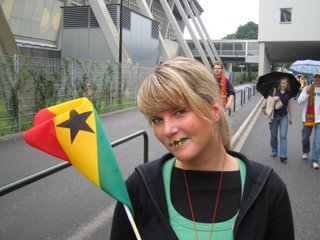
The German public were fiercely partisan in favour of Ghana (see picture above). Brazil even got booed, and constant shouts of "Ghana" echoed through the stadium. Ghana might have been underdogs going into the game, but it didn't feel that way. Ghana is now firmly on the football map, but I'm sure their World Cup perfomance will lead to even greater tourist awareness. Ghana Tourism should expect an influx.
And finally, after leaving the stadium, we bumped into some Brazilian fans sashaying to some samba rhythms from Rio (below). How could I stay upset? I said to myself, "Thank goodness women are not one of my vices". Then I thought, "actually, that could easily be fixed".
I should be sad and depressed at Ghana's loss, but I'm not - for several reasons. When you follow Nigeria's progress at international competitions, you get used to heartbreak. And over time you build up resistance to crushing defeats and upsets. Ghana's loss was nothing compared to being hammered 4-1 by Denmark in 1998, or losing to Cameroun on penalties in the 2000 African Cup of Nations. In Nigeria, we live in hope. All. The. Time.
I was able to conduct four interviews with Marcel Desailly (born in Ghana), Leonardo (World Cup winner in 1994), Frank Lebeouf (former Chelsea and France defender), and Patrick Barclay, who writes fot the Sunday Telegraph. Missed out on Mick McCarthy and Graham Taylor due to stretched resources. One camera can't be in two places at one. But we live and learn. So on a personal front, a good outing.

The German public were fiercely partisan in favour of Ghana (see picture above). Brazil even got booed, and constant shouts of "Ghana" echoed through the stadium. Ghana might have been underdogs going into the game, but it didn't feel that way. Ghana is now firmly on the football map, but I'm sure their World Cup perfomance will lead to even greater tourist awareness. Ghana Tourism should expect an influx.
And finally, after leaving the stadium, we bumped into some Brazilian fans sashaying to some samba rhythms from Rio (below). How could I stay upset? I said to myself, "Thank goodness women are not one of my vices". Then I thought, "actually, that could easily be fixed".
Tuesday, June 27, 2006
Africa - still second class
Ghana play Brazil in Dortmund today. This has got to be the most anticipated game on the African continent since Turkey beat Senegal in the 2002 quarter-final. In preparation for the game, yesterday we went to Bergisch Gladbach, just outside Cologne, to a Brazilian press conference and open training session. How many African media representatives were present? One. Us. As the only black man there who wasn't obviously Brazilian, they kept asking me if I was Ghanaian so that they could conduct an interview. They had to make do with a Nigerian television substitute.
After leaving Bergisch Gladbach, we went to watch Switzerland vs Ukraine. At the Rheinenergie Stadion in Cologne, I saw Jean Pierre Kongue-Esso, who I first met at the African Cup of Nations in January. He had been at the Brazilian training ground the day before, writing a report for Camfoot, (which you should check out). And guess what? He was the only African there. The day before Ghana play their biggest football game ever, and there's no African representative nobody to ask the opponents about how they plan to deal with Stephen Appiah (which I asked BTW), or if Ghana's reputation as the roughest team (most fouls commited) at the tournament is justified. Our resources are overstretched, but we still sent out a crew 75 kilometres away to do Ghana's camp, which was running at the same time as Brazil's.
This is something I've seen time and again at this competition. African media have been barely visible, and moreso in broadcast. A country as football obsessed as Nigeria should be covering the World Cup to the hilt. But they have to make do with us, a six man crew working round the clock to produce a daily 15 minute show. The simple fact is that Africa can't compete in the global media market.
To do justice to a tournament like the World Cup, you need to have broadcasting rights. Very few African media houses have the loot to buy the rights. FIFA might be a money sucking monolith, but even they can predict much more than a riot if they prevent Nigerians from watching the World Cup. So they have the LiM Group, which oversees distribution of media rights to the empty chest broadcasters in Africa. Infront Sports and Media, deal with FIFA's media rights, and you can see the World Cup rights allocation in this pdf. If you look at the African broadcasters, you'll see that almost every country's free-to-air station is affiliated to LiM. The national carriers can't afford it.
LiM is no television charity which drops broadcasting rights from the sky into football starved homes of Africans - they have control of advertising. After all, they've got to eat, right? LiM give the carriers the right to broadcast, but can only give them the barest minimum package, any extras are at the IBC arbitrators discretion. In all honesty, this package doesn't require the national carrier to even have anyone in Germany. The package allows NTA, say, to show the football, and then the official press conference, (there's a general media one after the FIFA one). This package doesn't allow the "money shot" of a studio presenter at the stadium, on the pitch, or in the mixed zone (where media and players mix). What viewers get is bland, identity-less coverage. Imagine the BBC doing football without Motty and Lawro being in the stadium to commentate.
The BBC World Service has a package which allows them to broadcast only 90 seconds of material from inside the stadium. After the match, you find reporters rushing for the gates so that they can file their reports outside the stadium gates. The World Service still had to pay for its measly 90 seconds. When Ghana beat USA, there was us, SABC, and Ghana's Metro TV, as the few African representatives. Metro TV have a similar package to ours, but do have priority for matches involving Ghana. SABC have a tiny crew here, but not nearly enough for a broadcaster that will probably be one of the host carriers in 2010.
That said, much can be done without being in the stadium, and that's what we've done. Globo TV of Brazil built a studio at the Brazil training ground. But Globo is the world's largest maker of Portuguese language programming, with 80 million daily viewers. NTA could be an African equivalent, but alas...
I understand that not every country can have a representative at every match, but the paucity of African media representatives is worrying. There would have been some matches with no African television media in attendance. Paying for the rights would be a great expense for any television station willing to take on the task, but having people on ground in the host country would be even more daunting. To make it work, you need immense television broadcast expertise. Outside broadcasts are the most complicated and expensive things in broadcast media, and very few African national carriers have the resources to do it justice.
Africa has had very little to shout about by way of qualification for the second round. Off the pitch, behind the cameras, Africa hardly exists. Here's to hoping that Ghana deal a blow for the millions of people watching soulless football coverage from their television sets in the shebeens, beer parlours, and shisha bars of the continent.
After leaving Bergisch Gladbach, we went to watch Switzerland vs Ukraine. At the Rheinenergie Stadion in Cologne, I saw Jean Pierre Kongue-Esso, who I first met at the African Cup of Nations in January. He had been at the Brazilian training ground the day before, writing a report for Camfoot, (which you should check out). And guess what? He was the only African there. The day before Ghana play their biggest football game ever, and there's no African representative nobody to ask the opponents about how they plan to deal with Stephen Appiah (which I asked BTW), or if Ghana's reputation as the roughest team (most fouls commited) at the tournament is justified. Our resources are overstretched, but we still sent out a crew 75 kilometres away to do Ghana's camp, which was running at the same time as Brazil's.
This is something I've seen time and again at this competition. African media have been barely visible, and moreso in broadcast. A country as football obsessed as Nigeria should be covering the World Cup to the hilt. But they have to make do with us, a six man crew working round the clock to produce a daily 15 minute show. The simple fact is that Africa can't compete in the global media market.
To do justice to a tournament like the World Cup, you need to have broadcasting rights. Very few African media houses have the loot to buy the rights. FIFA might be a money sucking monolith, but even they can predict much more than a riot if they prevent Nigerians from watching the World Cup. So they have the LiM Group, which oversees distribution of media rights to the empty chest broadcasters in Africa. Infront Sports and Media, deal with FIFA's media rights, and you can see the World Cup rights allocation in this pdf. If you look at the African broadcasters, you'll see that almost every country's free-to-air station is affiliated to LiM. The national carriers can't afford it.
LiM is no television charity which drops broadcasting rights from the sky into football starved homes of Africans - they have control of advertising. After all, they've got to eat, right? LiM give the carriers the right to broadcast, but can only give them the barest minimum package, any extras are at the IBC arbitrators discretion. In all honesty, this package doesn't require the national carrier to even have anyone in Germany. The package allows NTA, say, to show the football, and then the official press conference, (there's a general media one after the FIFA one). This package doesn't allow the "money shot" of a studio presenter at the stadium, on the pitch, or in the mixed zone (where media and players mix). What viewers get is bland, identity-less coverage. Imagine the BBC doing football without Motty and Lawro being in the stadium to commentate.
The BBC World Service has a package which allows them to broadcast only 90 seconds of material from inside the stadium. After the match, you find reporters rushing for the gates so that they can file their reports outside the stadium gates. The World Service still had to pay for its measly 90 seconds. When Ghana beat USA, there was us, SABC, and Ghana's Metro TV, as the few African representatives. Metro TV have a similar package to ours, but do have priority for matches involving Ghana. SABC have a tiny crew here, but not nearly enough for a broadcaster that will probably be one of the host carriers in 2010.
That said, much can be done without being in the stadium, and that's what we've done. Globo TV of Brazil built a studio at the Brazil training ground. But Globo is the world's largest maker of Portuguese language programming, with 80 million daily viewers. NTA could be an African equivalent, but alas...
I understand that not every country can have a representative at every match, but the paucity of African media representatives is worrying. There would have been some matches with no African television media in attendance. Paying for the rights would be a great expense for any television station willing to take on the task, but having people on ground in the host country would be even more daunting. To make it work, you need immense television broadcast expertise. Outside broadcasts are the most complicated and expensive things in broadcast media, and very few African national carriers have the resources to do it justice.
Africa has had very little to shout about by way of qualification for the second round. Off the pitch, behind the cameras, Africa hardly exists. Here's to hoping that Ghana deal a blow for the millions of people watching soulless football coverage from their television sets in the shebeens, beer parlours, and shisha bars of the continent.
Sunday, June 25, 2006
New Age Ghana
One of the brilliant things about being abroad, but still being in Europe, is that I can still read British newspapers. A little kiosk down the road sells all the broadsheets, and the main train station has everything including the tabloids. In the mornings I walk down to the kiosk, get a bottle of apple juice, of the "freshly pressed apples" variety, not the "from concentrate" diabetes-inducing type - and I pick up a Guardian, or an Observer.
Yesterday, there was a double page spread on the Black Stars in the Observer's sports pages:
Senegal, January 1992. At the end of Ghana's seventh African Nations Cup final Abedi Pele's emotions are scrambled. The captain and three times African Player of the Year had been pivotal in Ghana's efforts, scoring against Nigeria in the semi-finals and being voted player of the tournament. read on...
Yesterday, there was a double page spread on the Black Stars in the Observer's sports pages:
Senegal, January 1992. At the end of Ghana's seventh African Nations Cup final Abedi Pele's emotions are scrambled. The captain and three times African Player of the Year had been pivotal in Ghana's efforts, scoring against Nigeria in the semi-finals and being voted player of the tournament. read on...
Scandal on Leopoldstrasse and other tales
 So there I am in the middle of Leopoldstrasse in Munich, doing a "piece-to-camera", when two girls plant simultaneous kisses on my cheeks, and then disappear as quickly as they appeared. I giggle like a little girl whose teacher has just asked her to sit beside a boy she fancies. I'm busy trying to make an honest living, but meanwhile, there are German frauleins involving me in a lip smacking plot. How is a man to survive, I ask? Whenever there's a match, Leopoldstrasse (a major thoroughfare) becomes a street carnival of song, dance, beer, and of course, kisses. There's no better place to be than in the city that has just witnessed their Mannschaft qualify for the quarterfinals of the World Cup.
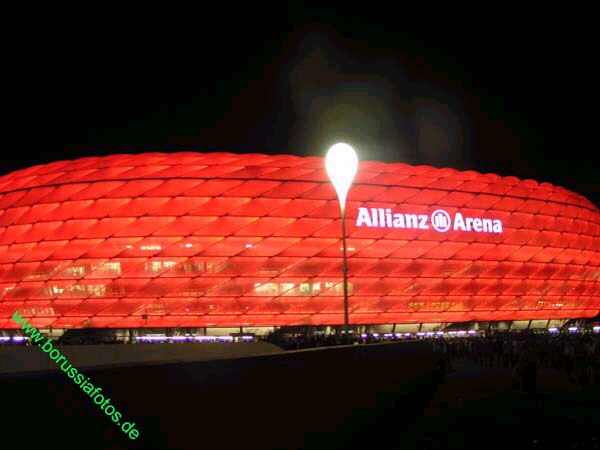
The Allianz Arena, otherwise known as the Schlauchboot (German for "inflatable boat"), is truly breath-taking. It looks like some kind of space wheel which has fallen off The Michelin Man. It was daylight when Germany beat Sweden so I didn't see it in its nighttime glory, which sees it change colours (see picture). I sat on the very first row, which doesn't have a very good view of the pitch because of the sideways, rather than overhead view. But if you ever want to grab Miroslav Klose's bottom, or tell Freddie Ljunberg face-to-face that he's a prissy pretty boy, it's as close to the action as a spectator can get. In fact, the ball once came to where I was sitting, and I artfully punched it towards the ball boy. I could spy Klinsmann from the corner of my eye - the poor fella had an envious "if only he were a Deutschlander" look.
Today, we take it easy. England play, but we have no guaranteed tickets for the match. There is more media following England than following the host nation. As Nigeria aren't in the competition, so NTA is way down the pecking order. If England loose, the fans will get drunk and smash up Stuttgart, and if they win, they'll probably get drunk and smash up Stuttgart. I shall look for a church, seek peace from the madness of multi-city travelling, and give thanks for tiny mercies. Then Italy and Brazil training sessions beckon. Azzuri, or the Boys from Brazil? Only one is possible, as they are both held several kilometres apart at pretty much the same time. Might do Brazil. Might do Italy. Dunno. Choices, choices...
On the day Ghana beat USA, we went to a Ghanaian joint in Frankfurt called "Heart of Africa - Kenkey House". I had eaten plantain there last week, and needed another fix, so I ordered fish and plantain - I drooled throughout the meal. Eating it brought back the most improbably memories. It reminded me of school dinners. And in the split second that I recognised the taste, I realised how privileged I was at school. Most people think of school dinners with puke inducing disgust, but I was eating at a home-from-home bar/restaurant, and I thought of Mr Prosper's cooking. It now seems obvious that our diet was predominantly Ghanaian. The kenkey, the rice and beans, the way the plantain was fried, the fufu, the okra - all Ghana.
Witnessing the Ghanaian community here has made me respect immigrants even more than I already did. The Ghanaians here are among the most prominent of the black communities in Germany, with two members of the German World Cup squad (Gerald Asamoah and David Odonkor) of Ghanaian origin. It is a sign of bravery that they would chose to emigrate to an alien German language and culture, rather than an Anglophone one readily available in Britain. The quest to make a better life for oneself has no limits, and I applaud those who put in the hard work. More power to your elbow.
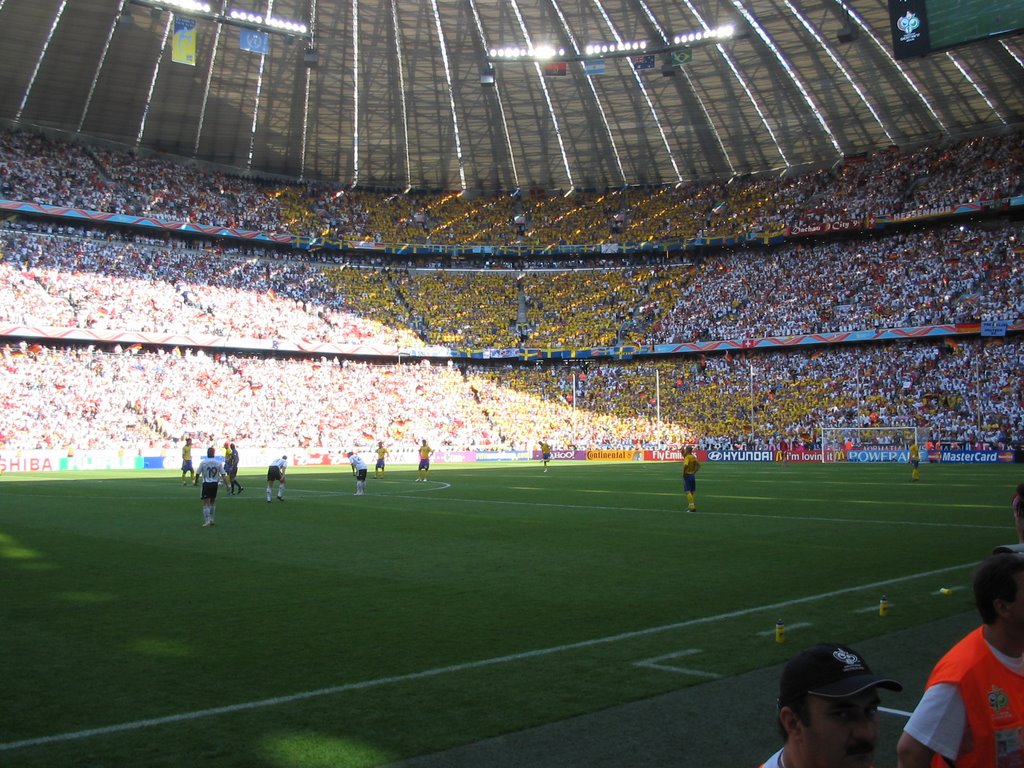 Swathes of yellow-clad Swedish fans in the corner.
The stadium after the final whistle, look at all the flags. Oliver Bierhoff walking past.
 All team coaches have mottos on them. Team USA coach, United they lose. But United nonetheless.
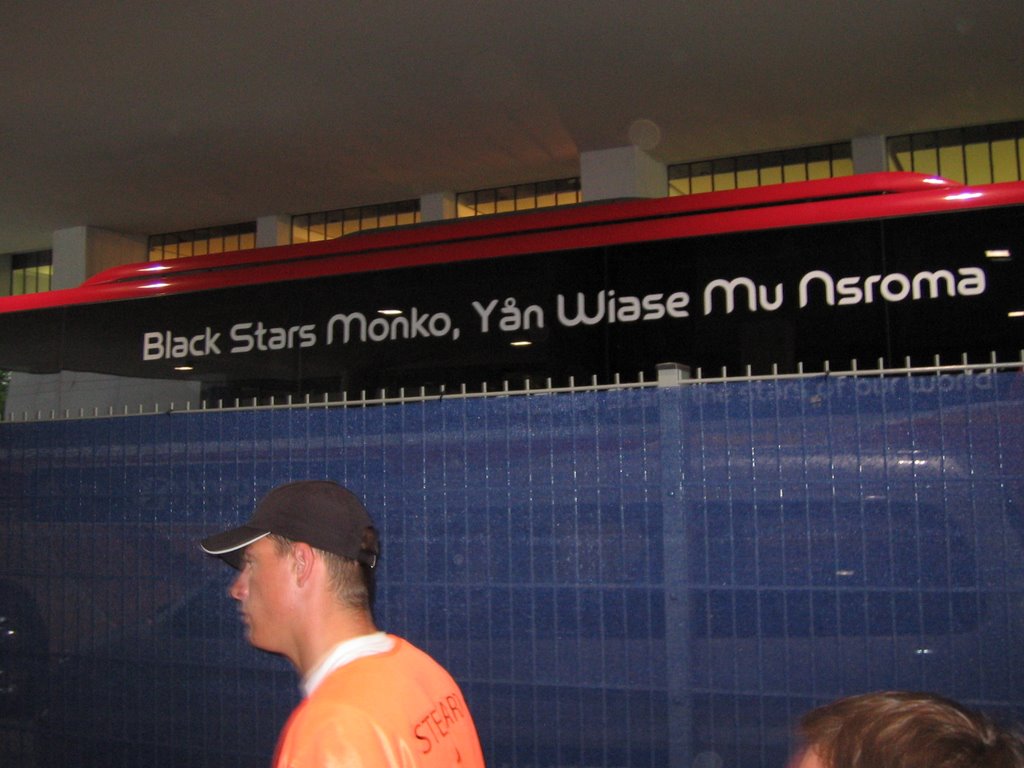 Ghana coach, with motto in Twi. Translation would be appreciated.
Thursday, June 22, 2006
Yay, Ghana oh, Yay, Ghana oh, Yay'yay!
This is now the familiar cry of victorious Ghanaians the world over. They occupied just a small part of the grounds, but the rhythms sent shockwaves through the ground, into the distance. Vesuvius has nothing on Ghanaian fans. Ambrosia dancing, gyration of the gods, trance-like response to a spherical leather thing crossing a white painted line. Who needs syringes of adrenalin when you have goals. "Bring on Brazil, bring on Brazil", they chanted fearlessly.
The Americans had just the one unimaginative cry, "USA, USA". And when the referee gave Ghana the penalty, "bullshit" they bellowed. The Black Stars of Ghana shone bright. The star spangled USA were Black Star struck. This was a historic win for Ghana, like when David's sling and rock felled the mighty Goliath. I heard that Lagos was in a frenzy, imagine what Accra, Kumasi, and Cape Coast would have been like - ablaze with ecstasy.
In retrospect, I'm slightly ashamed of my behaviour. I couldn't cage my glee at Ghana's victory. Impartiality was defenestrated. People kept coming up to me and congratulating me. Kofi might be a name given to me by an over-enthusiastic father, I might know Kokrobite, and might have once had a haircut in Kumasi, but I'm still not Ghanaian. The top I had on certainly didn't help. The day after the Twin Towers tragedy, Le Monde ran a piece with the header: "We are all Americans". That solidarity was in a time of tragedy, but today our solidarity is held in unfettered joy. Today, we are all Ghanaians.
The usually shy Michael Essien even had time to talk to us. The self belief was palpable, one could almost touch it. Ransford Abbey, an eloquent spokesman of the Ghanaian FA was proud of the GFA's achievement. Simple formulae: people who understand the modern game, long-term planning, reducing reliance on the sports ministry. Nigeria, are you listening?
"You'’re working for Nigerian television? But Nigeria isn'’t here, what happened to you guys? You should be here!" If I had a euro for every time someone said this to me, I'd be dining with Gates and Branson, having tea with Her Majesty, turning left when boarding a plane rather than right. In other words, I'd be rich - I've heard it too many times for comfort.
The experts here will tell you that Nigeria should have learned her lesson, and will surely qualify next time. My greatest and most plausible fear is that she hasn'’t. Right now, the country has no FA. Nigeria will sleepwalk into qualification for the major tournaments before South Africa in 2010. As usual, they'll be favourites, and and as usual they'’ll come third (which many feel should be patented to Nigeria). When they should have been giving the players practice (like Cameroon and Senegal) by playing pre-World Cup friendlies, the FA and Sports ministry were squabbling.
Saidu Sambawa is a twit, and I'd like to be quoted on that. He had to leave his post as Sports Minister earlier this month, and it'’s because of his interference that FIFA threatened to suspend NFA. Good riddance. I only hope his sucessor doesn'’t continue the nonsense tradition of bribing journalists. Okay, it'’s not blatantly a bribe, but stop giving journos money. And journos, stop taking money, broke though you are.
But on to more pleasant thoughts. In the 1920s and 1930s, Hitler held rallies in Nuremberg, a clarion call for the National Socialist cause. In 2006, about a mile from where the original rallies were held, a Black nation triumphs against the odds. Hitler must be turning in his grave. Let's hope he keeps turning. We are all Ghanaian now.
Above, Ghana fans after scoring: Highlife/hiplife and any other life versus Samba and Joga Bonito.
The Americans had just the one unimaginative cry, "USA, USA". And when the referee gave Ghana the penalty, "bullshit" they bellowed. The Black Stars of Ghana shone bright. The star spangled USA were Black Star struck. This was a historic win for Ghana, like when David's sling and rock felled the mighty Goliath. I heard that Lagos was in a frenzy, imagine what Accra, Kumasi, and Cape Coast would have been like - ablaze with ecstasy.
In retrospect, I'm slightly ashamed of my behaviour. I couldn't cage my glee at Ghana's victory. Impartiality was defenestrated. People kept coming up to me and congratulating me. Kofi might be a name given to me by an over-enthusiastic father, I might know Kokrobite, and might have once had a haircut in Kumasi, but I'm still not Ghanaian. The top I had on certainly didn't help. The day after the Twin Towers tragedy, Le Monde ran a piece with the header: "We are all Americans". That solidarity was in a time of tragedy, but today our solidarity is held in unfettered joy. Today, we are all Ghanaians.
The usually shy Michael Essien even had time to talk to us. The self belief was palpable, one could almost touch it. Ransford Abbey, an eloquent spokesman of the Ghanaian FA was proud of the GFA's achievement. Simple formulae: people who understand the modern game, long-term planning, reducing reliance on the sports ministry. Nigeria, are you listening?
"You'’re working for Nigerian television? But Nigeria isn'’t here, what happened to you guys? You should be here!" If I had a euro for every time someone said this to me, I'd be dining with Gates and Branson, having tea with Her Majesty, turning left when boarding a plane rather than right. In other words, I'd be rich - I've heard it too many times for comfort.
The experts here will tell you that Nigeria should have learned her lesson, and will surely qualify next time. My greatest and most plausible fear is that she hasn'’t. Right now, the country has no FA. Nigeria will sleepwalk into qualification for the major tournaments before South Africa in 2010. As usual, they'll be favourites, and and as usual they'’ll come third (which many feel should be patented to Nigeria). When they should have been giving the players practice (like Cameroon and Senegal) by playing pre-World Cup friendlies, the FA and Sports ministry were squabbling.
Saidu Sambawa is a twit, and I'd like to be quoted on that. He had to leave his post as Sports Minister earlier this month, and it'’s because of his interference that FIFA threatened to suspend NFA. Good riddance. I only hope his sucessor doesn'’t continue the nonsense tradition of bribing journalists. Okay, it'’s not blatantly a bribe, but stop giving journos money. And journos, stop taking money, broke though you are.
But on to more pleasant thoughts. In the 1920s and 1930s, Hitler held rallies in Nuremberg, a clarion call for the National Socialist cause. In 2006, about a mile from where the original rallies were held, a Black nation triumphs against the odds. Hitler must be turning in his grave. Let's hope he keeps turning. We are all Ghanaian now.
Above, Ghana fans after scoring: Highlife/hiplife and any other life versus Samba and Joga Bonito.
Monday, June 19, 2006
How would Jesus surf?
And I don't mean of the Waikiki variety surfers for Jesus. If Jesus were here today and he didn't nick unlocked wireless broadband, then he'd do the next best thing and encourage the needy of internet to be fed. Out of the blue popped up this open wireless internet connection in Frankfurt. So I'll probably post more often. Herr Schmidt, I'm sorry, but I'm sure you have one of those unlimited downloads at 10 terrabytes per second for €2 a month packages. Ta.
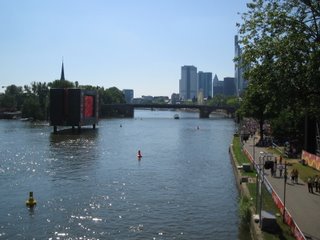
Have a look at some of these pictures.
Remember the screen on the River Main? People sitting to the right, Frankfurt skyline in the background.
I'll put some up as and when. Must dash, the sun rises.
Have a look at some of these pictures.
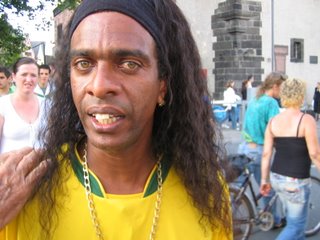
Below is Ronaldinho's uncle, complete with teeth.

Remember the screen on the River Main? People sitting to the right, Frankfurt skyline in the background.
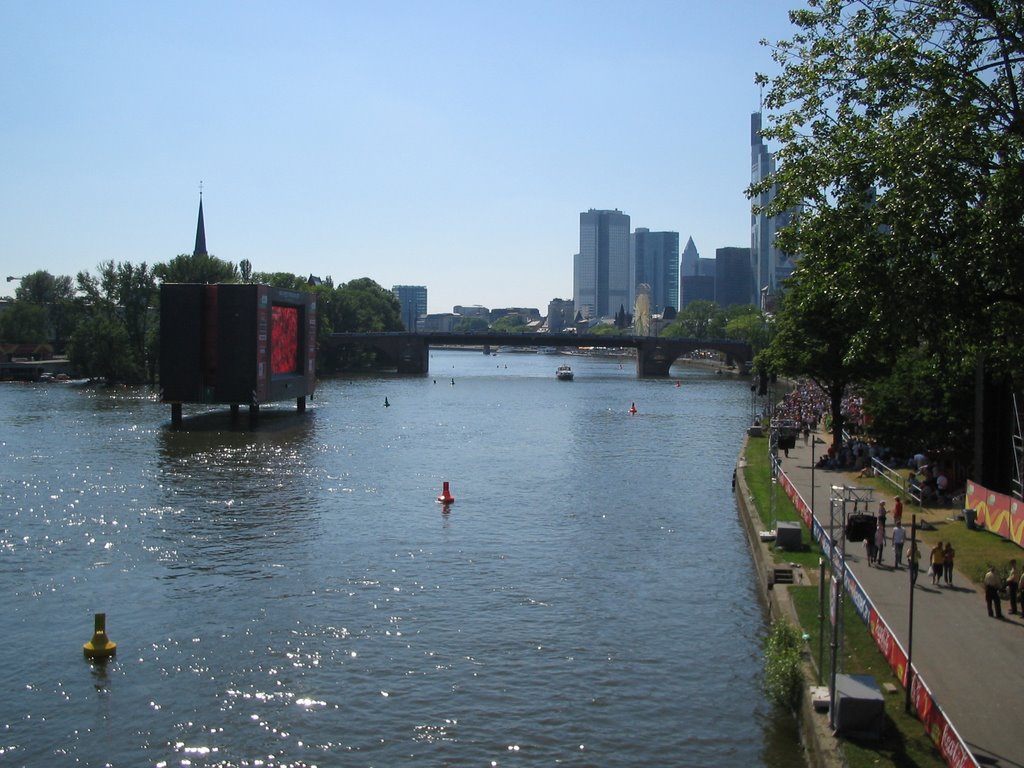
I'll put some up as and when. Must dash, the sun rises.
Sunday, June 18, 2006
No rest
Sunday. A day of rest. Not on your nelly. 4-hour train journey to Munich, where Oz face Brazil. I'm tired... but will I stop? Will I heck. I'll need a holiday after this.
Wednesday, June 14, 2006
Football and identity
Football is a religion, the stadium is the temple, and the fans are the worshippers. There is no other way to explain what happens when people gather in one place in the name of football. I’m gradually building a catalogue of cultural stereotypes: the Trinis are party animals, the Aussies are crazy party animals, and the South Koreans are good natured crazy party animals (see video).
Frankfurt was painted a sea of red as South Korea defeated Togo 2-1. The city rang out to sounds of “Daehan Minguk” followed by a rhythmic clap. The South Korean song has been by the far the catchiest, due to it simplicity. If you shout “Daehan Minguk” (which is traditional name of the country) to anybody in Frankfurt, they are sure to respond automatically with the now familiar clap.
When the Aussies beat Japan a few days ago in Kaiserslautern, some Japanese fans were crying. That was how much a first round game in the World Cup meant to them. I’m having to reassess my views on nationalism and pride for one’s country. I tend to question pride for one’s country, especially as nobody chooses where they are born.
CNN showed images of Seoul, the people drunk with delirium over the win. It means a lot to people for their country to win in football. Are there any psychologists out there who can explain this? The excitement is contagious, but I’m having to experience it second hand, vicariously through the people we film and interview. If Nigeria were here, it would have become a personal obsession.
In the past, I’ve found it difficult to refer to Nigeria in the first person plural “we”, plumping instead for the dispassionate third person: “Nigerians tend to be…” as opposed to, “we tend to be...” I am passionate about Nigerian football, and this could be the medium through which I learn to appreciate my Nigerian roots and culture all over again. Should football be the catalyst for this? I don’t know.
Germany is filled with people from all over the world, here to support their teams. Mexican American Angelinos are here to support USA, and cheer for Mexico on behalf of their parents. Ecuadoreans from Oz fly more than half way across the world to watch Oz and Ecuador. Germans who once lived in Togo scream, “Allez Togo”. The world, as far as football fans are concerned, is jumbled up in a blend of nationalities, allegiances both false and true, and despite the (harmless) nationalism, it becomes an acknowledgement of our oneness as human beings.
I’m not exactly sure what I’m trying to say, because it’s a nebulous one. I haven’t pinned it down to some grand narrative which encompasses all that’s in my head. How does one combine football, nationalism, humour, culture, heritage, passion into a single thought process – it’s a difficult one. Do you know what I mean?
Frankfurt was painted a sea of red as South Korea defeated Togo 2-1. The city rang out to sounds of “Daehan Minguk” followed by a rhythmic clap. The South Korean song has been by the far the catchiest, due to it simplicity. If you shout “Daehan Minguk” (which is traditional name of the country) to anybody in Frankfurt, they are sure to respond automatically with the now familiar clap.
When the Aussies beat Japan a few days ago in Kaiserslautern, some Japanese fans were crying. That was how much a first round game in the World Cup meant to them. I’m having to reassess my views on nationalism and pride for one’s country. I tend to question pride for one’s country, especially as nobody chooses where they are born.
CNN showed images of Seoul, the people drunk with delirium over the win. It means a lot to people for their country to win in football. Are there any psychologists out there who can explain this? The excitement is contagious, but I’m having to experience it second hand, vicariously through the people we film and interview. If Nigeria were here, it would have become a personal obsession.
In the past, I’ve found it difficult to refer to Nigeria in the first person plural “we”, plumping instead for the dispassionate third person: “Nigerians tend to be…” as opposed to, “we tend to be...” I am passionate about Nigerian football, and this could be the medium through which I learn to appreciate my Nigerian roots and culture all over again. Should football be the catalyst for this? I don’t know.
Germany is filled with people from all over the world, here to support their teams. Mexican American Angelinos are here to support USA, and cheer for Mexico on behalf of their parents. Ecuadoreans from Oz fly more than half way across the world to watch Oz and Ecuador. Germans who once lived in Togo scream, “Allez Togo”. The world, as far as football fans are concerned, is jumbled up in a blend of nationalities, allegiances both false and true, and despite the (harmless) nationalism, it becomes an acknowledgement of our oneness as human beings.
I’m not exactly sure what I’m trying to say, because it’s a nebulous one. I haven’t pinned it down to some grand narrative which encompasses all that’s in my head. How does one combine football, nationalism, humour, culture, heritage, passion into a single thought process – it’s a difficult one. Do you know what I mean?
Tuesday, June 13, 2006
Aussies are mental (and fairly chiselled)
I haven't got much time to post. But below is a video which shows that the Aussies are mental, and rather chiselled. Never seen so many bare chested men who didn't induce vomiting as soon as you saw them shirtless. Yesterday, we were in Kaiserslautern, where Australia had just beaten Japan, in what was one of the more insignificant games of the tournament. Not for these guys. If Guus Hiddink works his magic as he did with South Korea in 2002, parts of Australia will disappear after being drowned in beer. Look out for the guy in his underpants immitating Mil Mascaras - jumping from the top rope. Stay chiselled.
Sunday, June 11, 2006
I'm moving to Trinidad
My Nigerian tv debut had to be delayed because of a technical problem. I think the problem has the technical term, "NTA", but enough sniping. I'm not sure when we'll start properly, but hopefully from Monday, we'll be on everyday. We still haven't got internet at the flat, so I have to make the daily trip to the internet cafe to post these. Very frustrating. Thanks for the advice, I shall be giving my mum advance warning.
 Trinidad and Tobago (above) might be the smallest country to ever qualify for the World Cup, but to compensate for being a small country, they brought the biggest party machine ever. After their 0-0 draw against Sweden, one could be forgiven for thinking that they had won the World Cup. The Caribbean rum company Angustora has organised a few free events centred around Trinidad games. And after the Sweden match, fans of all hues and colours converged on downtown Dortmund, and threw possibly the biggest party since Borussia Dortmund won the Champions League.
The Trini fans held a mini-carnival. Actually, they held a proper carnival. The stage had massive sound systems and booming speakers, along with customary toaster shouting “jump, jump, jump, jump, jump”. The women and girls where doing some escandaloso dances which surely cannot be legal before dusk. Blonde Swedes and a kilted contingent from Scotland joined the Trini fans in the partying, downing rum and gyrating to the alien but seductive rhythms of the Caribbean. So as not leave out any carnival detail, a costumed temptress performed a dance of such move-your-body-like-a-snake-ma-ishness, that jaws were being scraped of the floor. If I was Catholic, I'd be looking for the nearest confession booth (below).
Even though I was supposed to be working, interviewing fans and some of the stars they brought to perform – Dekstra and Maximus Dan – I couldn’t help but down tools and do a jig every chance I got. The mixture of people was astounding, a colour palette of jet blacks, royal whites, fuschia pinks, wooded maroons, verdy greens, all with the same finish, same accent. Dulux has nothing on Trinidad. It reminded me of my Trinidadian friend from school, who was always talking about his friend back home, whose name was "Rastaman Clint". Would you believe that Rastaman Clint was Chinese? Exactly.
We got back to Frankfurt at 2am, but didn't go to sleep until about 5am. I'm posting this at 9.30, all dressed up and ready to go to Cologne for the day. This job ain't easy, but someone's got to do it, right?:-)
Friday, June 09, 2006
Disaster
Disaster! When disasters strike, they arrive like buses – in twos or threes. In my case, 25 disasters. I was going to grace the Nigerian television screens resplendent in African shirts for each of the 25 days on screen, but, it turns out that patterned shirts are rubbish for television. They create a dizzying effect, and can cause fits in epilepsy sufferers, or so I’m led to believe. My suitcase is packed with African shirts, enough to open a shop, is now useless. I brought two plain tops, two!
I will be forced to wear boring plain shirts, or I might have to invest in football related tops. Why can’t someone invent a camera which is compatible with African shirts? It would do people like me a whole lot of good.
Anyway, I went to do my first shoot today. We started off by going to Römer, a square just near the River Main, which runs through Frankfurt. The Germans are kings of technology. There is a fans viewing area with large screens to watch the games. But the coup de grace is a hugenormous (pronounced "huge-normous")screen which is in the middle of the river. Fans can sit on either side of the river bank to watch the game. The word is “espectaculo”. I didn’t get any chance to take pictures, because I was busy working. There’s still a month to go, so I’ll be sure to get some before I leave.
Today was a day of making discoveries, happy ones, and not so happy ones. The happy discovery was getting to the stadium to sort out accreditation and finding out that England were going to be training about half an hour after we got there. Off we went to set up and capture the England stars playing, Rooney kicking at the ball like one of those vicious kick-boxers on Bravo, Crouch surprisingly subdued and not sparking any new dance crazes. I also bumped an old journalist friend from Egypt, who has just published a book on his football journeys in Eastern Europe.
A not so happy discovery was a small bout of self doubt, that I think I’m slightly rubbish on television. I know, it’s not the most auspicious time to find out. They can’t exactly fire me now, it’s too late. It must have been rustiness, as I haven’t done any proper camera stuff since last year. Never fear, underdog is here. As time went on, it got better. Even though it's not blarney stone material, it’s okay. I hate watching myself on screen and I hate listening to myself on screen. It might appear that thinking all these things and still carrying on with it is masochistic. I agree, it is. But there’s nothing like a bit of self harm, ya know?.
I make my Nigerian television debut tomorrow. My mum and all her friends are going to be watching. The question now is: to tell or not to tell? Yep, it’s the hair again. I have cornrows, and I’m about to go on national television, but my mother doesn’t know. She will receive a shock when she sees it, but I could lessen the shock by giving her advance warning. Or, out of principle, I could refuse to tell her, and expect to be open-minded and tolerate my hair. The latter option is looking more likely as I type this. She’ll be shocked, and then she’ll have to explain to her friends that Nkem is still a good boy. That his hair doesn’t mean he does drugs or is an irresponsible person. The irresponsibility thing is a bit debatable, but she doesn’t know that.
Last night, I didn’t dream of San Pedro, but we had a little quartet outside our flat (above), playing a little chanson. The area is all middle class families riding their bikes, walking their dogs, and drinking beer on broad sidewalks. It’s called Merianplatz, which is the heart the German Green Party. The former Foreign Secretary, Joschka Fischer has his parliamentary seat here. Our fixer, Knut, described it as “a little bit liberal, a little bit left wing”. Think of an upmarket Edgware Road, with the quietude of Bayswater. The local authorities appear to have had a guilty conscience with regard to tree planting. After churning out a few gas guzzling Mercs and BMWs, they had to atone for their sins by planting whole rainforests in their neighbourhoods. At night, the streets are so dark because the lights have been blocked out by broad, tall trees.
Frankfurt is a centre of convergence for all the fans, and this is probably because it’s also the main hub for Lufthansa. One rather curious moment was when we interviewed a few Neo-Nazis. One of them turned out to be very knowledgeable about Nigeria, asking if we were from Lagos or Abuja, and then wishing Nigeria luck in qualifying for the next World Cup. Harmless little puppies they were. They might have had grand gothic tattoos, and invited us smoke grass with them, but harm us? They were as soft as Andrex.
I will be forced to wear boring plain shirts, or I might have to invest in football related tops. Why can’t someone invent a camera which is compatible with African shirts? It would do people like me a whole lot of good.
Anyway, I went to do my first shoot today. We started off by going to Römer, a square just near the River Main, which runs through Frankfurt. The Germans are kings of technology. There is a fans viewing area with large screens to watch the games. But the coup de grace is a hugenormous (pronounced "huge-normous")screen which is in the middle of the river. Fans can sit on either side of the river bank to watch the game. The word is “espectaculo”. I didn’t get any chance to take pictures, because I was busy working. There’s still a month to go, so I’ll be sure to get some before I leave.
Today was a day of making discoveries, happy ones, and not so happy ones. The happy discovery was getting to the stadium to sort out accreditation and finding out that England were going to be training about half an hour after we got there. Off we went to set up and capture the England stars playing, Rooney kicking at the ball like one of those vicious kick-boxers on Bravo, Crouch surprisingly subdued and not sparking any new dance crazes. I also bumped an old journalist friend from Egypt, who has just published a book on his football journeys in Eastern Europe.
A not so happy discovery was a small bout of self doubt, that I think I’m slightly rubbish on television. I know, it’s not the most auspicious time to find out. They can’t exactly fire me now, it’s too late. It must have been rustiness, as I haven’t done any proper camera stuff since last year. Never fear, underdog is here. As time went on, it got better. Even though it's not blarney stone material, it’s okay. I hate watching myself on screen and I hate listening to myself on screen. It might appear that thinking all these things and still carrying on with it is masochistic. I agree, it is. But there’s nothing like a bit of self harm, ya know?.
I make my Nigerian television debut tomorrow. My mum and all her friends are going to be watching. The question now is: to tell or not to tell? Yep, it’s the hair again. I have cornrows, and I’m about to go on national television, but my mother doesn’t know. She will receive a shock when she sees it, but I could lessen the shock by giving her advance warning. Or, out of principle, I could refuse to tell her, and expect to be open-minded and tolerate my hair. The latter option is looking more likely as I type this. She’ll be shocked, and then she’ll have to explain to her friends that Nkem is still a good boy. That his hair doesn’t mean he does drugs or is an irresponsible person. The irresponsibility thing is a bit debatable, but she doesn’t know that.
Last night, I didn’t dream of San Pedro, but we had a little quartet outside our flat (above), playing a little chanson. The area is all middle class families riding their bikes, walking their dogs, and drinking beer on broad sidewalks. It’s called Merianplatz, which is the heart the German Green Party. The former Foreign Secretary, Joschka Fischer has his parliamentary seat here. Our fixer, Knut, described it as “a little bit liberal, a little bit left wing”. Think of an upmarket Edgware Road, with the quietude of Bayswater. The local authorities appear to have had a guilty conscience with regard to tree planting. After churning out a few gas guzzling Mercs and BMWs, they had to atone for their sins by planting whole rainforests in their neighbourhoods. At night, the streets are so dark because the lights have been blocked out by broad, tall trees.
Frankfurt is a centre of convergence for all the fans, and this is probably because it’s also the main hub for Lufthansa. One rather curious moment was when we interviewed a few Neo-Nazis. One of them turned out to be very knowledgeable about Nigeria, asking if we were from Lagos or Abuja, and then wishing Nigeria luck in qualifying for the next World Cup. Harmless little puppies they were. They might have had grand gothic tattoos, and invited us smoke grass with them, but harm us? They were as soft as Andrex.
Thursday, June 08, 2006
Shoulda Woulda Coulda
We were supposed arrive at base for 10am. I did, but they didn’t. We were supposed to drive. We didn’t. So we got the Eurostar to Brussels. Between Brussels and Frankfurt, we were supposed to pass by Eupen to see Sunday Oliseh (who should be contributing to the programme), which was why we got the train in the first place. We didn’t. So we got the train to Frankfurt via Cologne. Left London at 1413hrs, and arrived Frankfurt at 2300hrs last night, each costing more than 300 euros. Basically, we should have flown. We didn’t.
I’m not too fussed, as I fulfilled a boyhood dream of going on Eurostar. There’s nothing particularly glamorous about it, after all, it’s just British grass, tunnel, French grass. (And to answer that age old question: French cows look just the same as English cows. No baguettes attached to their udders or garlic cloves hanging from their ears). What’s the big deal with the Chunnel? The Channel Tunnel is a boyhood dream turned into reality. The fact that you can go underneath such a huge body of water, and emerge unscathed on the other side is mind boggling. It’s the technological equivalent of schoolboys holding their noses and dipping their heads underwater to see who can hold their breath the longest. The Channel Tunnel does it for 20 minutes, and wins every time.
For the Brits, the Channel Tunnel Rail link is simply the fastest line on the British railway network. What a pity it leads out of the country. As everyone knows the Brits don’t do public transport very well, and sluggish railway lines are the depth of this abyss. Europe has railway travel supremely organised. There are high speed trains between any two major cities, and lateness is an alien word. Contrast this to getting a train from Newcastle to Birmingham, a distance that of merely 200miles, yet the journey becomes the railway trek through the Penines. Plodding along merrily, taking in the scenery, but not getting anywhere very quickly.
In JFK’s brief tenure as American president, he made many speeches which remain iconic even until now. And his Ich bin ein Berliner speech was one of them. He was obviously trying to say, “I am a Berliner”, but his accent was so rubbish that what he said translated as, “I am a donut”. Jackie O would probably agree, given his philandering ways. I type this from internet café in Frankfurt, so like JFK, I should express my solidarity with the people of Frankfurt. You know where this is going right? Ja, ich bin ein Frankfurter, which in a manner of speaking, means, “I am a sausage.” It doesn’t matter too much, as long as I’m a tasty sausage. Tchus.
Ps I notice from the retorts that quite a few readers have thing for German beer. Naughty, naughty.
I’m not too fussed, as I fulfilled a boyhood dream of going on Eurostar. There’s nothing particularly glamorous about it, after all, it’s just British grass, tunnel, French grass. (And to answer that age old question: French cows look just the same as English cows. No baguettes attached to their udders or garlic cloves hanging from their ears). What’s the big deal with the Chunnel? The Channel Tunnel is a boyhood dream turned into reality. The fact that you can go underneath such a huge body of water, and emerge unscathed on the other side is mind boggling. It’s the technological equivalent of schoolboys holding their noses and dipping their heads underwater to see who can hold their breath the longest. The Channel Tunnel does it for 20 minutes, and wins every time.
For the Brits, the Channel Tunnel Rail link is simply the fastest line on the British railway network. What a pity it leads out of the country. As everyone knows the Brits don’t do public transport very well, and sluggish railway lines are the depth of this abyss. Europe has railway travel supremely organised. There are high speed trains between any two major cities, and lateness is an alien word. Contrast this to getting a train from Newcastle to Birmingham, a distance that of merely 200miles, yet the journey becomes the railway trek through the Penines. Plodding along merrily, taking in the scenery, but not getting anywhere very quickly.
In JFK’s brief tenure as American president, he made many speeches which remain iconic even until now. And his Ich bin ein Berliner speech was one of them. He was obviously trying to say, “I am a Berliner”, but his accent was so rubbish that what he said translated as, “I am a donut”. Jackie O would probably agree, given his philandering ways. I type this from internet café in Frankfurt, so like JFK, I should express my solidarity with the people of Frankfurt. You know where this is going right? Ja, ich bin ein Frankfurter, which in a manner of speaking, means, “I am a sausage.” It doesn’t matter too much, as long as I’m a tasty sausage. Tchus.
Ps I notice from the retorts that quite a few readers have thing for German beer. Naughty, naughty.
Wednesday, June 07, 2006
Fur Frau Kouevi
Frau Kouevi was our German teacher in school. We were the first set of pupils in our school to do German, linguistic guinea pigs, effectively. All five of us in the class were only allowed to learn German because we already proficient in another language, French. Those in our group were the doyens of French, which was more or less a second first language to most of us. What could a little bit of Bratwurst and Jugend Arbeiter do to us? Nothing, we thought. Heavens, were we wrong.
Possibly from the very first lesson, Frau Kouevi warned us that German was an incredibly difficult language, and that none of us would ever get above a B. To the suspicious eye, this is but a curse. Our new teacher was dooming us to the nothingness of Bs and Cs, even before an umlaut could be dotted in anger. I wouldn't take such a statement lying down. Over the next three years, right up to GCSEs, I worked harder in German than in any other subject.
And I was the best at it. But I still never got above a B. And in Year 11 when I was good enough to get the school prize for German, I still only got a B for GCSE. At the time I was learning German, I never thought about what use it would be. The only thing on my mind was some obscure polyglot record, which I still haven't broken. After all only Germany, Austria, and Switzerland have German as an official language, it isn't as widely spoken as French or Spanish.
But I'm off to Germany today, for that little thing called the World Cup. And even though an unscrupulous human trafficker might try to sell me, at least I know how to order Black Forest cake in German. Who cares if you don't know how to say, "don't shove me in the lorry, I'm not an illegal immigrant" when I can always tell them, "Ich mochte ein Schwarzwald Kuchen bitte". I might be in a cramped lorry with fifteen Iraqi refugees, but who cares? I'll have a Black Forest gateau, and they won't.
Frau Kouevi, this is for you. Danke schon. Entschuldigung. Nein. Ja. Schwarzwald Kuchen. Bratwurst. Those should last me a month. I'll be fine.
Possibly from the very first lesson, Frau Kouevi warned us that German was an incredibly difficult language, and that none of us would ever get above a B. To the suspicious eye, this is but a curse. Our new teacher was dooming us to the nothingness of Bs and Cs, even before an umlaut could be dotted in anger. I wouldn't take such a statement lying down. Over the next three years, right up to GCSEs, I worked harder in German than in any other subject.
And I was the best at it. But I still never got above a B. And in Year 11 when I was good enough to get the school prize for German, I still only got a B for GCSE. At the time I was learning German, I never thought about what use it would be. The only thing on my mind was some obscure polyglot record, which I still haven't broken. After all only Germany, Austria, and Switzerland have German as an official language, it isn't as widely spoken as French or Spanish.
But I'm off to Germany today, for that little thing called the World Cup. And even though an unscrupulous human trafficker might try to sell me, at least I know how to order Black Forest cake in German. Who cares if you don't know how to say, "don't shove me in the lorry, I'm not an illegal immigrant" when I can always tell them, "Ich mochte ein Schwarzwald Kuchen bitte". I might be in a cramped lorry with fifteen Iraqi refugees, but who cares? I'll have a Black Forest gateau, and they won't.
Frau Kouevi, this is for you. Danke schon. Entschuldigung. Nein. Ja. Schwarzwald Kuchen. Bratwurst. Those should last me a month. I'll be fine.
Monday, June 05, 2006
Cheeky Monkey
Everchange accused me of thinking I'm too cool to accept any tags. I am... a very modest person, and proud of it too. So at the risk of being too "cool for skool", I shall do the "meme" (whatever that is), and do it with gusto. No holds barred. Shame on you Everchange, you cheeky monkey! BTW, this is not a license to tag.
A-Z meme
A-Z meme
Accent – Fake. I have been slated for my accent before, and no doubt after the World Cup I’ll be slated again. It’s been through a few transitions, and in the past, it was described by a friend as a “mid-Atlantic” accent, which is supposed to be mixture of British, Nigerian, and American. Why American, considering I’d never lived there? I never liked having an American accent, and it took me a while to come to terms with it. I had to acknowledge that American popular culture had enormous influence on me through film, and especially music. I don’t have it anymore, dropped it like it was hot. As for how I speak now, this is a post in itself…
Booze – I don’t drink. Not for religious reasons, but I genuinely don’t like the taste of alcohol. Also, I’ve seen how alcohol turned perfectly gentle blue-eyed innocents into ASBO deservers. However, I am rather amenable to Ribena. Many a woman has tried to woo me with it. And succeeded.
Chore I hate – Shopping. Shopping malls are filled with pregnant women and their husbands, family planning having clearly failed, because they also come armed with their little toddlers to torment me and make my few hours in Bluewater a daymare. My idea of hell on earth? Ikea.
Dogs/Cats – Cats. Cats are independent, you don’t have to walk them, and wait for them with a poopa scoop. They come, they eat, they leave, they come. That said, when I when I was in short trousers, we have a French friend, whose cat used to freak me out as a child. During dinner, while sitting at the dining table, Pataboum would jump onto my lap and eat from my plate. Makes me shudder even now.
Essential electronics – Laptop, with wireless internet and webcam, and mobile phone. Laptop has everything on it, and can even record interviews on it with the webcam serving as a microphone. With wireless, I have tv and radio, and of course internet.
Favourite Perfume – 212 by Carolina Herrera.
Gold/Silver – I like my teeth gold, and my piercings silver. But even I couldn’t face down my mum over having those, so neither.
Hometown – What does this mean? I spent the first 13 years of my life in Ebute-Metta, Lagos. My father comes from Umu Onaga village in Awka, Anambra state. My mum comes from Omoku, Rivers State. I’ve been to Awka four times, Omoku a bit more than that. I don’t even speak Igbo or Ogba, so can hardly call either “hometown”. Haven’t lived in Lagos in 13 years, lived in London for only three. Hometown, what hometown?
Insomnia – Not as an ilness, but as a result of readjusting sleeping patterns. Nothing stops me form sleeping.
Job Title – Freelance journalist. Emphasis on the “freelance”, which is a euphemism for the dole queue. But things have looked up recently.
Kids – How many I have now, or wish to have? On how many I have now, none. None that I know of. Hold on, postman ringing – twice… What’s this? Looks like a letter from the child support agency… How much? You’re kidding me. I’m not paying anything until I get the DNA results. On having kids. I have a declaration to make, I don’t think I’ll leave them any inheritance. They should make their own way in the world. Mama, if you’re reading this, don’t choke on your pepper soup.
Living arrangements – Room in a house. But since Prescott has now vacated Dorneywood, who knows?
Most admired trait – If people knew my history well enough, they’d say luck. I’ve had more second and third chances than you can shake a stick at. Yep, He is a God of second chances.
Number of sexual partners – Male or female? Nobody wants to answer this for fear of being judged. I’m not about to be branded as promiscuous, a stud muffin, a prude, or a native of Virginia. Having said that…
Overnight hospital stays – Twice, I think, that I can remember. Once for the first and only time I had malaria. Another time for what the doctors suggested was epilepsy, despite never having shown signs. Looked it up years later, turned out it was a panic attack. Silly Togolese doctors.
Phobia – Mild peeves like grotty Victoria station pigeons, and rain. Like Melissa Elliott once sang, “I can’t stand the rain”.
Quote – “Modesty will get you nowhere, flattery will get you some places, and self-promotion will get you everywhere.” I made that one up.
Religion – Christian. Pentecostal, of the liberal variety. And no, it is not an oxymoron.
Siblings – As they say in Spanish, depende. Single child to my mother. Number two of seven (I think) to my father. Very intriguing story which I won’t blog about, because I intend to make some money from it, by selling the story in future. My family won’t thank me…
Time I usually awake – Depende. Ideally at 7 or at 9. Before 7 is annoying and is an indicator of being a fully paid up member of the rat race. In between 7 and 9, and I’ll miss the Today programme. After 9 is just laziness and/or joblessness – both to which I often subscribe.
Unusual talent – Haven’t found it yet. Gave up looking after the roof incident when I took R. Kelly’s I Believe I Can Fly a bit literally.
Vegetable I refuse to eat – Most. Grass is for cows. Mushrooms are fungi, cooked onions might as well be worms (which are rumoured to be nutritious). I have very unsophisticated palettes, and I get suspicious of any food north of the Sahara. After school once, I went into my mum’s office in tears, for fear that when I got home, “they will give me food”. Only heaven knows how I grew. This explains why my mum calls me a “bush man”.
Worst habit – Procrastination. I am the king of procrastination. I hold a black belt in procrastination, I am the cruiserweight procrastination champion of the world. I’m sure you get the picture. So yah… What was I supposed to be doing again? Blogging? Nah, I’ll do it later.
X-rays – Once, for secondary school. Come to think of it, the earliest traces of my condition (craziness) started then. Who can I sue?
Yummy foods I make – Ah. Fried plantains, of course. Before you sneer, there is an art to frying plantain, and I have it down to a tee. On a deep fat fryer, 170 degrees or just below is perfect. Flip it about 7 minutes in. And, I make what can only be described as badass stew.
Zodiac sign – Taurus. The Bull. Didn’t realise I was stubborn until a couple of years ago. Plus my room looks like a bull just chased a red rag through it.
Friday, June 02, 2006
1966 and all that
 For English people, 1966 means only one thing – when England won the World Cup at Wembley on July 30. For Nigerians though, 1966 was the year Nigeria lost its innocence. In January of that year, it had its first coup d’etat, during which Prime Minister Tafawa Balewa was killed, a coup which was the precursor to the Biafran War of Independence (known in the rest of the country as the Nigerian Civil War). Forty years on, and Nigeria is still reeling from the events of that year. There's still talk of Biafran secession, nobody is quite sure which tribe should produce the next president. 1966 was when it all started, the very beginning. The roots of all Nigeria's problems can be traced to that year.
But this isn't a rant about Nigeria or Biafra, but a couched paean to Wole Soyinka. Yes, I dissed his grandiloquence only a few weeks ago, and my feelings remain staunch. But he is still Africa's greatest dramatist. I came across some New Statesman archive material, in fact, a theatre review of The Trials of Brother Jero, when it debuted at the Hampstead Theatre in 1966. The review opened my eyes to what now seems like a distant past in Nigerian cultural and political life.
To give you an idea of how highly regarded Soyinka's work was, in the review he is compared to Ingmar Bergman (see Magic Flute, and Fanny and Alexander) and Frederico Fellini (see La Dolce Vita, and La Strada), two of the most prominent auteurs of the 20th century. This is no faint praise. The critic then talks about Soyinka's influence on his teacher, Professor Wilson Knight, a well-known critic and academic, and even suggesting that playwright, David Rudkin could learn a thing or two. Soyinka went to on share the inaugural prestigious John Whiting Award with Tom Stoppard that year.
Reading the review makes me want to read the Jero Plays again, glean all its hidden meanings, and draw parallels with modern Nigeria. A character in the play is referred to as an “MP”, which no longer exists, as Nigeria has since switched from the Westminster system of government inherited from the British, to the presidential one it now has. But also, when the play was written in 1964, Nigeria still had a democracy, before General Aguiyi-Ironsi dragged the country into an irreversibly long and deep mire.
DAN Jones mentions ‘neo-colonialism’ and ‘Smith-Wilson collaboration’ in one breath. At the time, the British prime minister, Harold Wilson, was in talks with Zimbabwe’s premier, Ian Smith, to end white minority rule (which didn't happen until 1979). Compare that cosiness with today’s relationship between Blair and Mugabe, which is more or less a war, only missing the bits where bombs and missiles get dropped. One of my favourite phrases is ‘neo-colonialism’, because it aptly describes the state of post-independence developing countries. A friend at university refrained from using terms such as Global South, Third World, or even Developing World, and insisted on calling them ‘Neo-Colonial States’. Debt relief might be one of those things which will hopefully reduce neo-colonialism.
On the cultural front, I’m curious about the actors. It turns out that Robert Serumaga was one of the most prominent pioneers of post-colonial African theatre, an actor and playwright who founded the National Theater Company in Uganda. Jumoke Debayo. Who is Jumoke Debayo? The only online reference I could find was of someone with the same name, and a similar artistic background, opening an exhibition in Brisbane. The last entry on IMDB was in 1984, on British television. And of course there’s Athol Fugard, who’s being rediscovered with the recent Oscar winning adaptation of his novel Tsotsi. Where are these people? These are the holders of the African cultural crucible, yet we don’t know enough about them.
This segues perfectly into the new international Ijinle companies of African theatre, Tiata Fahodzi. Yesterday I got a letter from Tiata Fahodzi, publicising the forthcoming run of Oladipo Agboluaje’s The Estate at the Soho Theatre. I saw The Gods Are Not To Blame last year, and it reminded me of the rich oral tradition in Africa, and how well that tradition lends itself to theatre. It’s once again directed by Femi Elufowoju Jr, who was also direct The Gods, so I’ll be watching it next week before the World Cup starts. To get tickets for £8, call the number on the website, and quote “Tiata Offer”.
The review is taken from the New Statesman, 8 July, 1966. Reproduced with the kind permission of the New Statesman.
Theatre
D. A. N. Jones
We were hoping to see a double-bill by Wole Soyinka among the African plays at the Hampstead Theatre Club. It's a pity the Ijinle Company had to cancel The Strong Breed. This sombre and difficult play concerns the ritual persecution of a scapegoat, like several recent English productions; but Soyinka lives in a society where it's genuinely possible for an ordinary man – a suburban schoolmaster, say – to visit an aunt in the country and suddenly feel himself in the wrong century, among impressive even admirable people doggedly practising a cruel rite. Soyinka's treatment of the situation would be a lesson for our Rudkin blood-kin: the fantasy grows from life.
In the event we have only his short rogue comedy, The Trials of Brother Jero, which may seem a bit trivial to those who recently admired The Road, his more complex study of another sub-Christian prophet. Soyinka has something of an obsession about these people: there's not only 'Professor' in The Road but the haunting Lazarus in his novel, The Interpreters. I would guess that, as with Bergman and Fellini, this interest is connected with an artist's doubts: how much of his work is genuine magic, how much a mountebank's tricks? Brother Jeroboam is Soyinka's most straightforward creation in this line. An admitted charlatan, a Jonsonian 'alchemist', he winks at the audience as he gulls his victims. By making ambiguous promises and thwarting natural desires, he exercises total control: the political analogy is implicit.
In The Golden Labyrinth Professor Wilson Knight acknowledges that his essay on Shakespeare is influenced by his pupil, Wole Soyinka. Possibly the link here is Knight's insistence on the curious authority possessed by rogues and even by seedy solitaries like Shylock and Malvolio. For Brother Jero, that simple crook, has got a kind of 'charisma': his graft breeds exhilaration and his ecstatic flock seem almost justified in the infectious piety of their holy rolling. See him at the play's close, canonised in the eyes of his latest conquest, an ambitious MP who's been wondering Lagos beach rehearsing the oration he's too shy to make. There's an addition here to the printed text: that hopeless speech, hilariously rendered by Robert Serumaga, now deals with neo-colonialism and Smith-Wilson collaboration – a parody designed to cause African politicians maximum offence. This lengthens the brisk play; its pace could be improved by following Soyinka's lighting directions and by bridging gaps with music, as was done so well in the recent Third Programme version of Soyinka's The Lion and the Jewel. The quarrel between the nagging wife and the fish-seller has also been extended, but Jumoke Debayo makes it worthwhile. She's a gorgeous shrew: every gulp and gasp, every slump into what Soyinka calls the woman's 'Kill me!' posture, expresses her incredulity at the possibility of opposition. She's well matched by Euba, her luckless mate – plunging into pidgin under marital or religious stress – but some of the South Africans in Athol Fugard's company must be finding Nigerian style difficult. Cosmo Pieterse has a white-commonwealth accent, almost comparable with Smith's; it works better in the concluding jazz and poetry session.
This deserves a visit in its own right. The verses – English, Afrikaans, Zulu – come from southern Africa, as do most of the musicians, Chris McGregor's Blue Notes. The jazz is exceedingly 'free': the alto, Dudu Pukwana, is an admirer of Ornette Coleman. But there's also much African stuff here – Cape-Malay rhythms, I'm told – and the show does (to use a ruined word) swing. There's something agreeably weird in Pukwana's switch from highbrow American-style flourishes to verbal Zulu interchanges with the poet, Raymond Kunene.
Subscribe to:
Posts (Atom)