Monday, October 16, 2006

It's only a mouse

I've just moved into a new place, and in the process of doing some spring cleaning, I'm finding articles from days of yore. Remember that esure.com advert with Michael Winner (pictured)?

Just when we thought the TV licence van had left our street, and it was once again safe to turn on our television sets, Michael Winner makes us all have three Death Wishes with his esure.com adverts. Some smart advertising exec thought that the best way to make post Little Britain Britain buy that most dastardly of products, insurance, was to put a man dressed as a woman beside the insufferable Michael Winner.

A wonderful idea, except, the esure.com advert isn’t at all funny. This follow up to the, “calm down love, it’s only a commercial” adverts fails because it combines the worst elements of Hollywood (the curse of the sequel), and insurance adverts (the quest for humour).

Insurance is one of the greatest cons of capitalism, and attempting to make us laugh is admirable, but daring to suggest we’ll be gullible enough to latch onto another catchphrase, “calm down love, it’s only a mouse”, is just taking the Michael Winner.

Of course, the main premises of the advert are that women are scared of mice, they know nothing of technology, and sadly only silver haired fox Michael Winner can save the fairer sex. All men will worship Michael Winner for this because it means the road to enlightenment can be found in a bottle of peroxide bleach, and underneath a 7 minute sunbed. Alas, for women, the solutions are the same: rely on Michael Winner to fix animate or inanimate rodent problems.

No doubt some pop culture addled teenagers will latch onto the catchphrase and torment innocent bus passengers with the verbal equivalent of a rusty syringe. Elderly passengers will skirt the fine line between “reasonable chastisement” and maniacal homicide, while more modern adults will ring the ASBO police to act
accordingly. So the next time your granny wakes up in the middle of the night,
be sure to comfort her with the words, “calm down gran, it’s only a nightmare”.

419eater

Article in today's Guardian on the the guy behind 419eater.com; not very interesting if you already know about the website. If you don't, it's worth a look.

Saturday, October 14, 2006

Good week for hip-hop

This week sees the release of Fortywater's My Ghetto Report Card, UK rapper Ty aka Ben Chijioke, releases Closer. If you don't know Ty, his second album, Upwards would be a good place to start. In yesterday's Friday Review, Alexis Petridis writes the most amusing review of P Diddy's new album Press Play. People on the tube must have wondered how a newspaper made me chuckle so much. Here's a taster:
Earlier this year, Sean "P Diddy" Combs expanded the business empire, which has thus far netted him an estimated $364m, with the launch of his own perfume. As with a lot of celebrity-branded scents, Combs's took an adjective as its name. But the word he picked was somehow inappropriate: there is something a little jarring about calling an aftershave Unforgivable. It sounds peculiarly negative in conversation ("She bought me that P Diddy's aftershave for my birthday." "That's Unforgivable."). Matters were not much helped by the great man's gnomic explanation. "Life without passion is unforgivable," he said, thus explicitly linking his product to a life without passion. It's as if he's trying to sell you bottled essence of sexless misery. Read more...

No need

The governor of Plateau state, Joshue Dariye, may be a chiselling little crook. But there's no need to shoot his supporters. Nigerian security authorities need to have lessons in crowd control. In various incidents, the authorities panic and bring in the military to deal with what is essentially a civil order issue. On the other hand, when they use riot police, they act with military force. Where is the balance? The Nigerian police should invest in Alsatian dogs, and horses. Africans are generally scared of animals.

Police horses are not normal horses. Police horses are intimidating Pegasian megaliths; I'm sure they could be bred in the Northern Nigeria where there's a long tradition of horsemanship. Anything that can keep British football hooligans under control deserves to be at least considered. The government should be investing in relatively harmless but effective animals, rather than giving trigger happy police access to guns.

To the average African, dogs are one of two things: vicious guard dogs that eat the newspaper vendor whenever he comes round, or docile stray wusslings to be stoned in the street. A few police Alsatians would have dispersed the crowd sharpish. And there is historical precedence. I seem to remember reading somewhere that Zairians were offended by George Foreman when he arrived in Kinshasa for the Rumble in the Jungle. Foreman landed at Kinshasa airport with an Alsatian dog by his side - the very symbol of colonial Belgian oppression. Kind Leopold and his successors controlled the Congo with barks and bites.

Wednesday, October 11, 2006

The Bridge stands... at least for now.

Contrary to the news spreading, the Third Mainland Bridge has not collapsed. The traffic jam was caused by an accident, which LASTMA has now cleared. Please go about your daily activities. Anouncement by the Lagos State Government. Long Live Lagos!

The above is a paraphrasing of what I heard on the Lagos State Radio Service (streaming) at about 1452hrs BST. The bridge lives on, if only for a few days.

Tuesday, October 10, 2006

Couple caught in mosque sex romp

Tried to be as tabloid as possible. Yup, a couple were caught doing the dirty in a mosque in Kenya. Not exactly sure what to say...

One or two...

There've been a few Nigeria related stories surfacing in the British newspapers recently. The one that caught my eye, was the British Chancellor Gordon Brown's proclamation that Nigeria was a breeding ground for religious extremists. When I heard him say it, I remember thinking, "what the heck is he on about?" But on closer examination, his source (Bono) has a point. I always shout about Nigeria's post September 11 Osama baby name craze, and the country's Taliban wannabes as reasons why Gordon Brown's claim is plausible. The Telegraph had a little write-up a couple of weeks ago.

Mark Tran of the Guardian, has written a mini-analysis of the Niger Delta's oil curse.

Wednesday, October 04, 2006

A nation's laziness

No doubt most you have seen the documentary on Nigeria Village Square, the one about General Vatsa's execution at the hands of Babangida's regime. The documentary is called "Babangida and Vatsa: A Widow's Pain, A General's Burden", except that we don't hear about Gen Vatsa until the 29th minute, more than half way through the film.

The scriptwriter/producer made a hash of a job, considering what could have potentially been an entertaining documentary. The casting was good, with the Effiong guy, Vatsa widow and son. But the narrator said "coup d'etats", when it's actually "coups d'etat". I'm obviously quibbling here, and most Nigerians will say I'm commiting hateration. I won't slag it off anymore, but it's disappointing viewing.

What the documentary brought home above all else is how docile Nigerians are. Our armed robbers and vagrants are happy to use violence to get their way. Except that they do it against defenceless civilians, and not to the military governments that terrorised Nigeria in the past. There is no reason for a country with Nigeria's population to be so dominated, even by military power. The men in khakis kept coming back because they Nigerians would do diddly squat.

If you look at the ten most populous countries in the world, none of them have stood, or are standing for the crap we've been dealt. Correct me if I'm wrong:

  1. China. Population of over a billion. How free are they? Not very. However, modern China was founded on Mao's Cultural Revolution, which the Chinese believe/believed in. China is changing rapidly, and the people there are effecting change.
  2. India. World's largest democracy. Free.
  3. USA. Democracy. Free.
  4. Indonesia. General Suharto ruled fo 30 years, before being pushed out in 1998, during the Indonesian Revolution. It took 30 years but the people still did it.
  5. Brazil. Democracy. Even though they had military presidents between 1969 and 1985, Brazilians still had a large say in how they were governed. In 1985, people power put pressure on the government, and the military was sent back to the barracks.
  6. Pakistan. Military dictatorship. General Musharraf came to power in 2001 after the military had been out of power since 1998. Something is brewing in Pakistan. Musharraf is a pro-US, war on teror supporter. The people under him seem to be trying to undermine him, by, say, supporting the Taliban in Afghanistan
  7. Bangladesh. Democracy. Free.
  8. Russia. Democracy-ish. Free-ish. Putin's authoritarian streak is the complaint.
  9. Nigeria. Democracy. Free, but never fought for anything. Military let Nigerians have power, and then gave them their very own civilian military president. Surprise, surprise.
  10. Japan. Democracy. Free.

See my point? Most countries do something, but we're just happy to sit there and let things happen to us. How can you subdue 120 million people? You can't, unless they're Nigerian.

Monday, October 02, 2006

More blood

Militants have attacked an oil facility in the Niger Delta. As at 1954hrs this evening, the latest reports said 14 soldiers (according to AFP) had been killed.

Sunday, October 01, 2006

Independence gloom

Happy Independence day. But things are gloomy up north in Zamfara state where a dam has collapsed and killed 40 people. Read more...

Friday, September 29, 2006

A bit much

Accusing Atiku of financial crimes is one thing, but accusing him of plotting murder is on another level of severity. The fight between OBJ and Atiku couldn't get any uglier. This is stage where court proceedings must start. Either OBJ's posse are taken to court for their inflammatory and possibly libelous remarks, or Atiku is prosecuted for what are clear allegations of criminality.

Clean Duke

Nuhu Ribadu might have just won the presidential nomination for Donald Duke. Revealing that Duke is the only governor not being investigated by the EFCC should put him in good stead for the presidency, should he decide to run. Also, suspending Atiku from the PDP is pure politics. It's a ruthless game, especially when you tango with OBJ.

I'm also curious as to who this world's biggest thief is. Surely it's someone who was formerly in government, as ordinary 419 criminals don't have access to funds as large as those in government coffers. We all have names in our heads, and of course there was that supposed World Bank email which circulated and mentioned a few prominent names and the amounts stolen. But publishing that would be libelous...

Ubuntu

My byline in today's G2.

Thursday, September 28, 2006

Eagle's Throne

Below is a passage taken from an epistolary novel, The Eagle's Throne, by the Mexican writer, Carlos Fuentes. It is a letter written by NicolƔs Valdivia who, now in government, goes to the Old Man for advice. The president has just died, and there's a vacuum and struggle for who will eventually replace him. The Old Man (who always has a parrot with him) is a former president, and has his finger on the pulse. He's telling Valdivia about an elected president, Moctezuma Moro, who was murdered before he could take up office.

The passage is a reminder of how difficult it is for democracy to take hold in the developing world. Mexico was essentially a one-party state until Vicente Fox and his National Action Party (NAP) broke the jinx in 2000. There has been a struggle between the NAP candidate, Felipe Calderón (who won officially), and Andrés Manuel López Obrador, the left winger who has challenged the results - even declaring himself head of a parallel government.

Some things for context. In Mexico, presidents are allowed only one six-year term. The seat of the presidency is called the Eagle's Throne. CƔrdenas refers to LƔzaro CƔrdenas, president of Mexico between 1934 and 1940.


'An honest man,' the Old Man said. 'I can vouch for that. He thought of himself as the Hercules who was going to clean the stables of Mexican politics. And I warned him, "It's dangerous to be really honest in this country. Honesty may be admirable but it ends up as a vice. You have to be flexible in the face of corruption. I know you're honest, TomƔs, but close your eyes - like divine justice - in the face of the corruption of the rest of them. Remember, firstly, that corruption lubricates the system. Most politicians, government employees, contractors, etc, won't have another opportunity to get rich once the six-year presidential term is over. They'll go back to oblivion. But they want to be forgotten, so that nobody accuses them of anything, and rich, so that nobody bothers them. Then another gang of villains will turn up, but denying them the chance to pocket anything would be a mistake.

'"What you need," I told TomƔs, "is to surround yourself with scoundrels, because you can control the corrupt. It's the pure man who's the problem, the one who gets in your way. In Mexico there should be only one honest man, the President, surrounded by a lot of tolerated and tolerable scoundrels who in six years' time will disappear from the political map.

'"The bad thing about you," I said to TomƔs Moctezuma Moro, "is that you want the map and the land to match. Look, live at peace in the centre of the map and let the labourers of corruption cultivate the land.'"

The Old Man sighed and I could almost feel a tremor in the hand that was pressing down on mine with incredible strength.

'He didn't listen to me, Valdivia. He proclaimed his redemptive intentions right, left and centre. That way, he believed, he'd gain the greatest popular support. And he was acting out of conviction, without a doubt. He was going to put an end to corruption. He said it was the lowest form of stealing from the poor. That's what he said. The thieves were going to jail. The poor would have protection against abuse.

'"Slow down TomƔs," I told him. "They're going to crucify you if you go round playing the redeemer. Don't announce what you intend to do. Do those things when you're sitting on the Throne, just like CƔrdenas did. Don't destroy the system. You're part of it. Good or bad, it's the only one we've got. What are you going to replace it with? You can't just invent something overnight. Be satisfied with making an example of a few scapegoats at the beginning of your term. Make a moral statement early on and then you can rest." But he didn't listen to me. He was a Messiah. He believed in what he was saying.'

I was stunned. He crossed himself.

'Who killed him Valdivia? The cast list is enormous as the cast list of the film The Ten Commandments. Do you remember? Drug-traffickers. Local bosses. Governors. Local presidents. Corrupt judges. Bent policemen. Bankers fearful that Moro would take away the public subsidies that financed their private incompetence. Union leaders afraid that Moro would force them to be voted on and approved by their union members. Truck drivers overpricing their merchandise. Millers exploiting the corn-producing local farmers. Loggers turning forests into deserts. New land owners controlling land, seeds and tractors, while impoverished farmers continued to use the ox and the wooden plough.'

Did the Old Man sigh, or was it the parrot?

'The list is endless, I tell you...'
It's hard, this democracy thing, isn't it?

Tuesday, September 26, 2006

'Cos we need more rubbish

The story of the toxic waste that has been killing people in Abidjan is appalling. What riled me even more late last night as I listened to another report about the incident, is that the company, Trifigura, tried to dump their rubbish in Nigeria. They've now released a press statement saying that the stuff wasn't toxic - as if that makes it better. This is what Western companies do. They go to developing countries where there is little or no environmental legislation, and commit crimes they'd get locked up for in their own country.

The oil companies do it in Nigeria with gas flaring, where more gas is flared than any other country in the world. In Bangladeshi, the government had to cancel plans to build a coalmine after adverse publicity from the project. Several people died during protests over a project that would have destroyed hundreds of villages. The company, Asia Energy, wouldn't let journalists travel to the area, for obvious reasons. The Daily Star newspaper of Bangladesh even says that there are lessons to learn from Nigeria's industrial and environmental experiences.

Africa is always painted as this verdant and fertile land, the place to be in tune with nature. Perhaps it was true 100 years ago, when rich explorers travelled to the Dark Continent to shoot game, but that myth is literally disappearing. Deforestation, overfarming, desertification, famine, flooding, landslides, you name it, the continent is afflicted by it. The saddest thing is that Africa gets all the environmental carnage you'd expect from the industrial revolution, but none of the benefits. No increase in technological know-how, no increase in job prospects, just plain old rubbish.

Nigeria has no waste disposal mechanism. There are piles of rubbish which engulf roads and trap communities in Lagos. I have seen enormous piles of rubbish being burnt in built-up areas like Maryland. Lagos, and Nigeria in general, can't deal with its own waste, so how on earth was it supposed to deal with excess waste from abroad? The Dutch company that considered disposing of the rubbish suddenly raised its rate to 40 times the originial price. 40 times. "This is too expensive, let's go to the bend-down boutique of waste disposal. Let's go to Africa", they thought.

And so the crap gets dumped in one of Africa's most beautiful cities (don't know if civil unrest has ravaged it). People die. Nothing changes. Some people have been arrested for the dumping, but what if the stuff hadn't been dumped in the largest city, Abidjan? If they had gone further up the coast to smaller San Pedro, nobody would have flickered an eyelid.

The defecation on Africa happens because the governments let it happen, and the companies can get away with it there. There seems almost no point to the law unless it's used. Trifigura and the like need to know what they're letting themselves in for if they go near the African coast with their crap.

Monday, September 25, 2006

Ode to (the) Gambia


Several African countries hold a special emotional tug on my heart. Ghana, Cameroon, Somalia, Zambia, Gambia, are some of them, mainly because of friends I had in secondary school who were from those places. Most people who went to my school are armed to the teeth with teases for any of these countries. Nigerians bore the brunt of most of the teases, for reasons far too obvious and numerous to mention.

One of our favourites was the Gambia, or Gambia. The "the" was adopted in 1965, after independence, probably to aspire to some lofty African Kingdom. The "the" isn't used much anymore, a sign that men in cravattes are dying out. Gambia's in the news; Yahya Jammeh, or the Mosquito Soldier (or something similar) as we called him in school has won a third term in office.

Yahya Jammeh (pictured) is a fascinating character who became Gambian president in a military coup in 1994. Aged just 29, he was the world's youngest president. Before the elections, the man reportedly declared that he would rule Gambia for another four decades. I can't find a reference for it, but will put one up when I do. We called him Mosquito Soldier because he was as skinny as a mosquito, would probably cave under the weight of a rifle, and he wore those oversized aviator sunglasses so beloved of African military rulers. None of us could understand why a tiny country like Gambia should have a coup. What was there to control? At the time, the population was just over a million people.

Sir Dawda Jawara had been a sit-tight leader, having been president for 24 years when he was ousted. There was an attempted coup d'Ʃtat in 1981, which was thwarted by the Gambia's neighbour, Senegal's army. It'd be interesting to find out the course of the 1981 coup, because the Gambia didn't have an army. So heaven knows how they planned to seize power.

That coup was the turning point in Gambia's modern history, because after that an army was established. And now the clincher, Nigeria had a hand in training their army. In the '80s, military assistance came from many countries, inlcuding the US, and the UK. But in the '90s, after some unrest in the newly formed army, Nigerian army officers were actually in charge of the Gambian army.

In school, it was our idea of playground intellectual talk, just like we'd debate about capital punishment, and the role of America as world police (how some things never change). For some of us, it was thoroughly amusing that the Gambia had never witnessed a successful coups d'etat. But put Nigeria in charge of the army, and voila! The Gambia was tiny, they didn't need an army, we'd mutter to ourselves. And when they get an army, the ask the land of Abacha, Babangida, Buhari to look after affairs - bad idea.

After the 1981 coup attempt, the confederation of Senegambia was established with Senegal. The union didn't last too long, but made a lot of sense. Gambia is the smallest country in Africa, a tiny strip of land around the River Gambia less than 50km wide. It is surrounded on all sides by Senegal, except in the west, where the River Gambia opens out into the Atlantic. Basically, they Gambia is almost like an autonomous part of the Senegal which speaks English.

Senegal and the Gambia are more or less the same. Same cultures, same languages, same religions. The reason for the split can be traced back to colonial times, and the so called Scramble for Africa (Thomas Pakenham's book, highly recommended). The French grabbed the land around the Senegal River, the British grabbed the land around the River Gambia. So post-colonial era some speak French, and some speak English.

Gambians are extremely warm and hospitable. Ever had a traditional Gambian meal? When I'd go to friends' for Eid, the food was normally an incredible rice dish, laced with healthy morsels of lamb. They'd serve it on a large tray, and everyone (I remember up to six of us) would sit around the tray and tuck in. We used our hands, scooped some rice, squeezed out the oil (it was always quite oily), and tossed the dollop in our mouths. Excuse me while I drool.

Being the smallest country in Africa, our Gambian friends faced jibes by the hundreds. Some of the ones I remember, and still make me chuckle: Gambia's so small that when I was flying over, I blinked and I missed it. My personal favourite was: Gambia's so small that if you leave the tap on for five minutes you'll cause a flood.

Here's to the Gambia.

Friday, September 22, 2006

Modern Minstrels

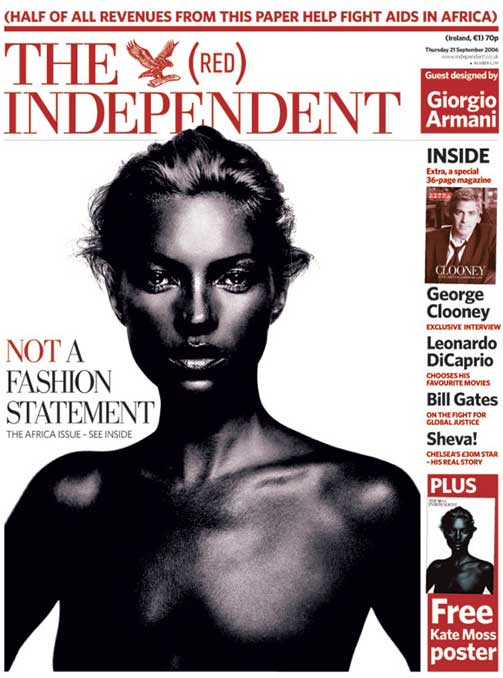
The Guardian's Hannah Pool is hacked off by Kate Moss's "blacking up" on the cover of Thursday's Independent (see picture). Basically, Ms Moss is supposed to be representing Africa, so she puts on some make-up, and takes a few photos. Et voila, a Moor emerges.

Even though I'm black, I've never been able to build up enough bilious rage to be upset by people blacking up. Either it's not offensive at all, or it's one of those latent forms of racism which some black people ( I have been one in the past) don't realise is being targetted at them. Nevertheless, Hannah Pool puts up a robust argument about why she finds blacking up despicable:
Have you ever wondered what Kate Moss would look like as a black woman? No, me neither, but for those of you who have - well now we know, thanks to a picture taken by Nick Knight for yesterday's Africa issue of the Independent newspaper.

You can just imagine the meeting. "Let's do an Africa issue," says Well Meaning Executive Number 1. "Great, who shall we get on the cover? Iman? Naomi?" asks WME 2. "Nah ... too obvious. I know, how about Kate Moss? Let's make her look African!" Cue much back-slapping at their own cleverness, followed by, perhaps, a lunch of jollof rice and curried goat to seal the deal. Read on...

There's also a history of blacking up to accompany Hannah Pool's piece.

Strife in Jigawa

"Religious" strife in Jigawa state after someone apparently insulted the Prophet Mohammad. Religious violence exists in Nigeria, but one can't understate the ability of jobless louts to seize the insulting of a religious figure to loot, slash, and burn. Or even using the situation for political ends, with elections coming up and all that.
Burned Catholic church in Tulkarm in the West Bank
Anybody with access to a radio, television, newspapers, or internet, would know the consequences of bandying the Prophet Mohammad's name willy-nilly. And the rioters would know that burning churches is so last week in the West Bank (pictured), rather passƩ . What Jigawa needs is not arrests, but internet. It would solve all the ignorance problems.

Thursday, September 21, 2006

Babaginda is a twit.

The misspelling of Ibrahim Badamosi Babangida's name is intentional. In the 1980s and '90s when I used to go to Cameroon on holiday, a friend of mine, used to call him "Babaginda". We were about seven-years-old at the time, so he could be forgiven for his oversight. It always makes me laugh when I remember it, because at the time, I thought it was just how Francophone people pronounced Nigerian names.

IBB is serious. After last month's report in the FT about him wanting to run for president in next year's general elections, he has now revealed his plans to the rest of Africa. He appeared on the BBC World Service programme, Network Africa, this morning; listen to the interview. I'm seething with rage. The irascible Jeremy Paxman once said that when he interviews politicians, he thinks, "why is this lying bastard lying to me?" That's how I think of Babangida. Why is this fat, lying, coup plotting, thieving general lying to me?

He never gave anyone the benefit of anything constitutional, and he now clings onto it for the chance to run for president. The constitution needs to be rewritten. Any constitution that can allow Babangida to run for president, within 13 years of him plunging Nigeria into the madness that was Abacha, deserves the paper shredder treatment. Barefaced cheek.

In 2000, the late Pierre Salinger, White House press secretary during JFK's administration, said that if Bush won, he'd leave the US. He made good on his promise, and moved to France, where he died in 2004. If IBB wins, consider me a Nigerian exile. I will not set foot on Nigerian soil so long as IBB is president.

If Nigeria votes IBB in, they deserve him and everything he does to them. After all, people get the governments they deserve. By far the worst IBB-related sentiment I've heard is the "na him spoil am, so make e come fix am" claptrap. Apparently, when a builder through shoddy workmanship, brings down your house, you should invite him once again to rebuild it. You're right, it doesn't make sense.

This is the part where I'm supposed to implore all right thinking Nigerians "not to vote for him, because I really love my country, and I really like visiting, and please don't make me stay away." Bollocks. Not voting for IBB should go without saying. Like nobody should have to tell an adult not to put their hand in fire, or not to smear dog poo on their face. It's common sense. No person with a brain would do these things, so why vote for IBB?

The same goes for Buhari, and all the other power hungry maximum military leaders. Stay in the bloody barracks.

Flame off.

Tuesday, September 19, 2006

Beginner's guide to bloodless coups

The Thai coup d'etat is pure text book. For anyone who doesn't know how to organise and execute a successful and bloodless coup, here are the steps:
  1. Wait until the president is playing the role of world statesman abroad. If you can help it, make sure he's gone to a gathering of his peers, such as the UN general assembly. In Africa in the 80s, the overthrown leader would likely have been military, and he would have been attending that most prestigious of khaki parades, the OAU. At such a gathering, one can assume that many of his bezzie mates would laughed at him - for getting his chair pulled from under him.
  2. Roll your tanks into the capital city and declare marshal law. Threatening to shoot anybody who moves an inch, oddly enough, gets you in the good books of the citizens.
  3. You must, must, shut down all media. If possible, play the kitsch patriotic military music, as this should remove the people's will to live, let alone stage a demonstration.
  4. Make sure you suspend the current constitution. After doing that, you need the coup de grace. Promise to restore democracy. The point of suspending the current rule of law is so that later, you can restore a new and improved military one.
  5. Even though this is not your doing, people will take to the streets. They will take pictures with tanks, celebrate with soldiers, welcome the new regime. Take credit for it, and say you're doing the will of the people.

The people will eventually get disillusioned with you. Then another military faction will take over. Repeat cycle until oil, terrorists, or communists are found in your country, at which point the US will invade.

Shimmer and Chinua

Chimamanda Ngozi Adichie piece in Satruday's Guardian. I'm beginning to feel like her friggin' publicist.

Monday, September 18, 2006

More on plane crash

OBJ cancels his speech to World Bank meeting after the deaths of several Nigerian army generals in a plane crash.

Humourous

You have to hand it to al-Qaeda in Iraq. They have nothing if not a sense of humour. The text comes from the AFP news agency.

"Al-Qaeda in Iraq said in response to remarks by Pope Benedict XVI linking Islam with violence, that it will wage jihad (holy war) until the West is defeated, in a statement posted on the Internet Monday."

That resolves everything...

Weekend reading

Paul Kennedy essay, on the reform of the UN to be discussed at in New York at forthcoming UN General Assembly.

Banning of emaciated waif skeletal fashion types at London Fashion Week.

David Oyelowo, of notorious Shoot the Messenger fame, on kids sticking with the Bard.

Launch of Tinubu backed party in Nigeria.

Crash of military aircraft in Nigeria.

Wednesday, September 13, 2006

World leader count: 1½

After my dalliance with Thabo Mbeki in Germany, I was close to upping my world leader count to 2 this past weekend. But I have to leave it at 1½, as I was in the same room as the world leader, but didn't have any direct contact with him. I saw Tony Blair deliver the Progress 10-year anniversary speech. Tony Blair is the king of the "worst week ever" tag. Too often it's been said he's reached the end, but the man walks on hot coals for sport.

Last week, junior members (Brownites presumably) of his government signed a letter asking him to step down, and seven resigned from the government as well. Hence Teflon Tony was forced to announce his departure date, within a year, or May 31 as the Sun reported.

The speech was set to be his first public appearance since being forced to make the announcement. I've seen Tony Blair on television. The man is a performer, and on that stage on Saturday, he performed. After a hearty, almost nostalgic welcome, his first sentence was, "and I haven't even gone yet." He was humorous, affable, statesmanlike even. None of the blows inflicted during the week appeared to have wounded him fatally. The man stood tall, addressed his faithful, oozing that Tony magic which brought in the first Labour government for 18-years in 1997. They don't call him Reagan's original moniker, the Great Communicator, for nothing.

He walked to the microphone, tieless, in a grey shirt and suit. The clapping and standing ovations began. I'm cynical about politics. I know how they work, and this was another chance for me, as a journalist, to sneer at them. A woman sitting almost directly in front of me must have been a strategic clapper. One of those instructed by the spin doctors to applaud at certain points during a speech, triggering other strategic clappers, and infecting the whole room. Try resisting to clap when the person next to you is trying to dislodge their hands with the ferocity of their applause. It is difficult. Or try remaining seated when everyone around you is giving the Prime Minister a standing ovation.

On his way out, walking through the aisle near where I was sitting, he shook hands and waved. Most people sitting on an aisle seat shooks hands with Bambi himself, most people wanted to. At the very back of the hall, a woman was standing with her hands by her side. And as Tony got to her, it was obvious she had no intention of shaking Tony's hand. But Tony, ever the baby kissing, people hugging statesman, grabbed the limply dangling hand and shook it with vigour. I laughed my head off. It wouldn't do his current credibility any good if he was seen to receive a snub from an audience packed with his faithful.

It felt like being present while history was being made. He had just announced that he was leaving, he was en route to being jeered at in Beirut, staged walk out at the TUC. It was probably the week that something fatal stuck to Tony's teflon. If he is forced to leave at Labour's annual conference, that would be the fatal blow, but it seems unlikely.

Such gatherings are attended by the media Ʃlite and politerati. Adam Boulton of Sky News stood with his camera team, and Steve Richards of the Indy sat on one of the back rows observing from a healthy distance. Brian Hanrahan walked around with a microphone and minidisc recorder, quizzing politicians.

The corridors of power had shrunk with so many politicians in one place. Former Bethnal Green and Bow MP, Oona King, dressed in her usual Hoxton chic way; Sadiq Khan and Dawn Butler, 2005 intake London MPs both, sat next to each other. Defence Secretary, Des Browne, arrived in his official Jag, all worthy and mighty. Hilary Benn spoke at one of the seminars, and one could see his zeal for International Development. He says he's "a Benn, not a Bennite", detaching himself from his father's radical legacy. Yup, he's no Bennite.

People have very strong feelings about Tony Blair. He has dominated the British political scene for more than a decade, straddling it like Major Kong riding on a bomb at the end of Dr Strangelove. British politics will not be the same without him, for better or worse.

Tuesday, September 12, 2006

Snoop Dogg in Lagos

One of the world's most famous "doggs" is going to be in Lagos. I can't help being cynical about these things, let's see if they pull it off.

Monday, September 11, 2006

Bad luck for Goodluck's wife

When DSP Alamaramalamadingdong (Nigeria's erstwhile female governor) got impeached last year, his deputy Goodluck Jonthan said, "I enjoined my fellow Bayelsans, and indeed all people of the south, not to be dampened by the sad events of the recent past. On the contrary, I urge old and young to use this incident to reposition the state for a better future." That was part his inauguration speech. He was obviously "repositioning" himself and his family.

Today, officials say they've seized $13.5m from Mr Jonathan's wife. Less than a year after he became governor, and his wife can afford to buy a learjet...

Sunday, September 10, 2006

Nigeria: "exciting" place to visit!

I got a call from a friend today, saying that the Sindy had a middle page spread on Nigeria. Alex Hannaford writes about how "exciting" it is to visit Nigeria. Of course Nigeria is exciting, in the same way visiting an asylum is exciting. You never know if someone will leap out at you from a cupboard, or if someone who is actually older than you will say you are their father. Firstly, he says Lagos is Africa's largest city, which is wrong. Cairo is. Where are the Sindy's fact checkers?

"If you can escape the crime, survive the "go slows" and the officiousness, and deal with poverty on an unimaginable scale, it's one of the most exciting, unpredictable places in the world." Well, good luck escaping all those things.

Friday, September 08, 2006

We all know one

The Guardian has an "Agony Aunt" column called Private Lives, where people send in their problems, and the readers act as the "aunt". This week's agony concerns a Christian babe who doesn't want to do the dirty before she gets married. This wouldn't be a problem except all her toasters are heathen, and of course, she doesn't want to be "unequally yolked". (I prefer using "yolked" to "yoked" - the contrast between omelettes and sunny side up is a constant reminder of the profundity of the commandment.)

Reading it reminds me of many young Nigerian women. Except that most of them wouldn't have a "diverse range of friends", and wouldn't be able to tell you when they became Christians. It's also amazing that the Guardian has so many Christians writing in, it must have been all five readers who responded. Read on, perhaps you would've had better advice.

Indy and another Nigerian

The Independent seems to have some kind of love affair with Nigerian women. The last time, it was effusive praise for Ngozi Okonji-Iweala, and this time it's Chimamanda Ngozi Adichie. The interviewer, Christina Patterson is a drooling, fawning fan, describing the writer as, "almond-eyed, dewy-skinned and with a perfectly proportioned, heart-shaped face." Pass the sick bucket, someone. Read more...

Wednesday, September 06, 2006

Back. ish...

I have a confession to make. I read City People. Regularly. There, I've said it. City People is a celebrity rag par excellence. Actually, forget the celebrity bit. City People, along with magazines such as Ovation, has helped to redefine the term "celebrity". Celebrities in Nigeria are no longer the people who are celebrated for their talent, good works, and blah da hoot. Celebrities have now become anyone who celebrates. If you attend a party to celebrate a couple's wedding, you are a celebrity.

Another wonderful term used in City People is "Big Boy", eg Lagos Big Boy or Abuja Big Boy. Yours truly would be a London Big Boy. This London Big Boy lives in New Cross, with close proximity to local amenities. He can be sometimes seen buying the best cuts of BOGOF chicken at the New Cross Sainsbury's. He also has access to some of the best in modern transport. He's often a guest of London Mayor, Ken Livingstone's TFL. There are even rumours that he once said, "My other car is a bus." No other London Big Boy can claim to own a whole bendy bus, much less the two (453 and 436) he has been spotted on. There are rumours that he's going out with a woman, but our sources would not divulge more.

Every so often, they put up advertisements looking for English graduates to work on the paper. If they indeed have any English graduates working on their staff, they should sack whoever is in charge of recruitment. That said, they've improved a bit recently.

I read City People because the magazine (or is it a newspaper) tells me both what I need to know, and what I don't need to know. Its politics coverage is very good, with politicians from the length and breadth of Nigeria touting themselves as the chosen one in its pages. As for what I don't need to know, and what is also often irresponsible journalism, I don't need people's personal details. In the past few weeks, I've seen people's vehicle licence plate numbers, and email addresses. Putting such information into the public domain compromises people's security - even if they claim to be Tuface Idibia's baby-mama.

The edition of August 23 had an interview with singer and actor, Onyeka Owenu. Her interview was fairly impressive. She is going to be running for the chairmanship of the Ideato North LGA in Imo State. City People sutpidly asked her if the position wasn't too low for her. "I think it's a very special position, because you're directly in contact with the people, and you can see were the shoe pinches, and you can begin to concentrate or lay emphasis on those things that are most important to them."

That, to me, is a someone who is passionate about her community. She doesn't want to be in the Senate, but close to where the action is. No pushing of pen and paper in the corridors of Aso Rock, but localism and humility about what can actually be achieved.

Take Gani Fawehinmi at the last elections. Gani is a people's champion, a political gadfly, gnawing away at the powers that be. But would he ever be president? No. He ran for a position he had no chance of winning. A smarter move would have been to run for the Senate, or governorship, but not president. He would have had a better chance of winning, and been in political office, helping to make changes. Alas, he lost his bid to be president, and would have been in the political wilderness for four years by next year's elections.

Anyhoo, I'm off to read this week's City People. Apparently, Ojukwu has some disease.

Monday, September 04, 2006

Wanting to blog...

I've just realised one of the most important components of blogging - joblessness. Yup, if you post a certain number of times a day (I won't say how many), you're jobless. I'm much busier now, so much to my chagrin, I can't blog as much. The thoughts simmer and bubble, but aren't allowed to burst their lid for tiredness and lack of time. I want to blog. I really want to blog.

Thursday, August 31, 2006

The Overwhelming

Yesterday, I saw the matinee of JT Rogers’s The Overwhelming at the National Theatre. It was the last day of production before they go on tour, and my last chance to see an old school friend who’s in the play (he’s also in the film, Severance). The play is about the Rwandan genocide. As I was typing that last sentence, I was going to say “the play is about Rwanda”, signifying how synonymous Rwanda and genocide have become.

Overall, I'd say that Clive Stafford Smith's Out of Joint team has done it again.The problem with watching any dramatised version of the 1994 genocide is that you know what’s coming up. However jolly things are, human blood will soon be spilled. And no amount of paranoia is excessive, heck, paranoia is a mild condition considering what actually happens. What matters is not how grisly the director can make the inevitable hacking scenes, but what comes before.

I’ve seen Hotel Rwanda and Shooting Dogs, and The Overwhelming is the best treatment of Kigali pre-genocide. JT Rogers squeezes in as much history and context as possible in a two and half hours. In Hotel Rwanda and Shooting Dogs, the idea of the RPF as a non-governmental destabilising force was never really explored. This is a difficult concept to accept – that a liberation force can be bad. Hezbollah, the ANC, the argument is universal.

It’s not about the Interahamwe being angels, but neither is it about the RPF being the Virgin Mary. One of the characters (I don’t remember which one) talks constantly about context, and that is what this play does. The Belgians have faced most of backlash on their colonial policy of separating what appeared to be a same people, and separating them, Hutu here, Tutsi there. The French diplomat, Jean Claude Buisson (played by Nick Fletcher, whose NGO worker is a scene-stealer), says to Linda White-Keeler (played by a delectable Tanya Moodie), “how do you save a Belgian from drowning?” “I don’t know,” she replies. Then an almost gleeful expression flashes across Buisson’s face, “Good.”

The main thrust of the story is the arrival of an American academic, Jack Exley, his son Geoffrey, and African-American wife, Linda White-Keeler (Geoffrey’s stepmother) in Kigali. They’re there to meet a doctor friend, Joseph Gasana, who, in the past, was imprisoned by the government, and subsequently passed on information to RPF rebels. They don’t find him, and it turns out that among other things, the AIDS doctor is accused of letting Hutu children die, so that the extra medicines can be given to Tutsi children.

In the build-up to the start of the genocide, the language is tinged with foreboding. 12 years on, we can tell. Back then it would have just been an ordinary conversation between people. Samuel Mizinga is a Hutu politician in the “broad-based transitional government”. Scarcely is it possible for a man to exude both charm and menace with equal truth as Danny Sapani manages.

Mizinga tells Linda, who comes increasingly under his spell, that, “we’re like the Swiss of Africa, or maybe it is they who are like us. We’re very efficient here, people take orders well.” And it is a genocide running with the efficiency of a Swiss watch that the militias were able to kill 800,000 people within a couple of months. Even the names of the militias point to efficiency. Interahamwe: those who fight together (some translate it as “those who hunt together”. Impuzamugambi: those who have the same goal.

People like Mizinga are the ones the world should be looking out for. The intellectual purveyors of evil, the ones that moderate people look to and see sense. The Joseph Goebbels of this world. The demagogues who seduce you with their charm and intellect. They read Balzac and Nietzsche and listen to classical music. Surely he must be saying the truth.

There’s so much more to write about this play, but I’m tired, and sleepy, and I don’t want to get fired. But think on this utterance by the Bangladeshi UN soldier, “A black African man. What is that in this world? Not even seen in the eyes of God.” If you look at the continent, you’ll see what he means.

Wednesday, August 30, 2006

Brain Gain

India has apparently been experiencing a great deal of "brain gain". People of Indian descent are returning to India to make a life for themselves. In Bangalore alone, 35,000 people have moved back. If Nigeria had half as many people move back, the change they could make would be tangible. I know that people are moving back to Nigeria in great numbers, many of them Naijabloggers. Nigeria isn't achieving the numbers needed to yank the country into development. I am by no means saying that disapora Nigerians will arrive like some commando force to wipe out all evils. But a greater diversity of experiences available to Nigeria will do her a lot of good.

Countries like China and India are leaping into the future, bypassing all the natural steps of development. It would be wonderful for Nigeria's development if it could be dragged kicking and screaming into the future. The country should bypass the extensive use of fossil fuels, and move straight to reneweable energy sources (all that blasted sunshine). What about the use of biofuels such as palm oil instead of crude oil based petrol and diesel? Take Norway, the country has as yet unexplored oil and gas reserves in the Arctic, yet it is hoping to create the world's first "hydrogen highway". Or better still, for a country where most people can't afford cars, make the roads bicycle friendly. Goodness knows village men and their bicycles are inseparable.

Leap from Nigeria's colonial Georgian railway system to the world of the TGV and the bullet train. The Cuban health system shows what can be done with precious few resources. Watch Newsnight's report on every communist's dream - a system that works. Cuba's health system is based on sickness prevention rather than sickness cure. Life expectancy in Cuba is 77 years, but in Nigeria it's 47 years.

Nigeria has the cumulative knowledge of the world at its disposal, it has to use it.

Monday, August 28, 2006

Rubbish weekend

It's been a rubbish weekend for Nigerian sport. Our U20 women, after dominating in the game against Brazil, threw it away in the last minute, literally. Rather disastrous. In the world basketball championships in Japan, Nigeria failed to make it out of the group stage. But guess how they lost it. They missed a last second shot... Obafemi Martins signs for Newcastle, and kisses goodbye to ever winning any club trophies. Wonderful. Then gets injured. Wonderfuller.

Friday, August 25, 2006

Apples and trees

There's apparently an article in the New Statesman this week, which claims to have been written by yours truly. We don't always claim responsibility for our actions, but I wrote it, I think:

Could hereditary political power be a more tenacious idea than we thought? Two centuries and more after republicanism supposedly set inherited authority on the slope to ruin, a surprising amount of power is still being wielded around the world by the sons of people who wielded it before them. Read more...

Brazil v Nigeria

"Soccer giants Brazil and Nigeria are to clash in the quarterfinals of the Women's U20 mundial, taking place in the land of the tsars, Russia." That's how a Nigerian newspaper would have put it. Yup, Nigeria play Brazil. Nigeria pummelled Finland 8-0 and look like being equal to the task of beating Brazil. The captain, Akudo Sabi is featured on the FIFA website. She seems like an affable young woman, who goes online and reads what's written about her team. So Akudo, if you're reading this, prends courage, and teach the Brasileiras a football lesson. You can watch it tomorrow (Saturday) at 3pm BST on Eurosport.

I watched a bit of USA against France yesterday, as you do... USA - which has always produced wonderful female players - looked much better than the men's team. It's amazing how the men of one country can be, more or less useless, while the women flourish. Of course this is partly cultural, as "soccer" has always been seen as a girl's sport in the US. So it's only natural that American women are more dominant worldwide than the men. There are some who believe that the US will only become a major world player when the inner city kids are unleashed upon the game. If this happens, we might see something akin to the European exodus undertaken by Africans and South Americans. "All of New Orleans will be watching this game as Kuwayne Griffiths, born in stark poverty in Lousiana, now wears the number 10 shirt for Real Madrid." Or something like that.

I was in San Francisco in 1999 when USA hosted the Women's World Cup. I remember everyone fervently supporting the Falcons, and hoping they'd do an Atlanta '96. It never came. Even though a rampant USA crushed us 7-1 in the group stage, we bowed out with pride. The team lost to Brazil 4-3 after extra time in the quarterfinals. Naturally, they did that most Nigerian of football tactics - went down 3-0, and then clawed their way back. That tournament also produced Brandi Chastain's black bra victory moment (pictured).

My respect for women's football started in 1998 during one summer holiday in Nigeria. There was a girl, whose name escapes me, who played with us regularly in the neighbourhood. She used to school the boys like little illiterate children. Nobody ever wanted to play against her for fear of being laughed at that a girl gave them "torros". Everyone wanted to be on her team so that they could benefit from her skill, vision, and strength, while pointing and scoffing at their oponents. The girl was good.

Thursday, August 24, 2006

Nuggets

Since Alex Last became the BBC's correspondent in Nigeria, he's been working really hard. This week alone, he's sent two wonderful despatches which show he's immersing himself in Nigerian culture. Earlier this week, he sent a despatch on the resurgence of highlife music, interviewing Fatai Rolling Dollar, and speaking to young Nigerians. Today, on World Today, he hitches a ride on an Okada to discuss the nighttime ban on the deathtraps. BBC Newsonline has what is more or less a transcript of the report. But you can also listen to it as part of the World Today's podcast. If that doesn't work, try Newshour, which also ran the same report.

I've searched but can't find the highlife music report. However, I can assure you that it was what you can only be called "saliva radio" - it makes you drool. Music mostly marinated in nostalgia, and effusive characters; makes for radio so good you can almost literally touch it. In June, there was also a report on dwarfs in Nigerian films (watch here). The great thing about Alex Last is that there isn't an iota of condescension in his reporting, which can't be an easy thing to do when reporting from a country like Nigeria. I being presumptious here perhaps, but, my hope is that places like Nigeria aren't stepping stones for reporters to move on to "greater things", like say New York or Brussels. We need good correspondents in our own right, rather than people just passing through.

Wednesday, August 23, 2006

There are many ways...

There was some stuff in the news recently about the Canary Islands, where more than a thousand African immigrants arrived on its shores within a three-day period. They cried to the EU for help because they couldn't cope. It's a bit difficult to know what they want the EU to do. Perhaps the other EU countries can move their countries closer to the African continent, so that the destination for immigrants can be varied a little. A tectonic plate shift all in the name of balance of immigration.

The immigrants going to the Canary Islands would have arrived by boats. During the days of Sangatte, people tried to get to Britain through the Chunnel. But if you think that's desperate, try burrowing a tunnel under a border - with a shoehorn. People want to remove some of these immigrants from Europe, or stop them from coming in illegally. The key question is this: what drives a human being to do these things in search of a better life for himself?

Tuesday, August 22, 2006

"Watching the sport"

Imagine how much fun we had with this at work yesterday...

Sunday, August 20, 2006

St. John Coltrane

This is an intriguing proposition: a church formed with Jazz musician, John Coltrane (right), at its heart. I couldn't help wondering if it was blasphemous, or just an extreme manner of flower power Christianity. There's something perverse about going to a church for the novelty of its service. One would think that church services should be intimate experiences, not some freak show attracting the attention of voyeurs. But that is what non-Catholics do when they go to St. Peter's Basilica in Rome, or visit the Church of the Nativity in Bethlehem. There's something in the grandiose nature of those churches that make them seem like their awe and history is to be experienced by all. However, such thoughts are dispelled when it comes to pentecostal churches. It's almost as if only family members are allowed, which is why it appears peverse for the uninitiated to attend such a service. St. John Coltrane. Hmm...

Saturday, August 19, 2006

Stabbing update

The story of the stabbing is in today's Sun. Saw the owner of the sweet shop, who informs me that one of the perpetrators had been caught. The victim's family came to see him, he said. What a world we live in...

Friday, August 18, 2006

Airport closure

Port Harcourt airport is to close for three months. Not what you want when all your oil money comes out of the region. The repairs are essential, but planning has been non-existent. The authorities shouldn't have had to close down the whole airport to make improvements. But there we have it.

The times - has it come to this?

Man stabbed in broad daylight. At the bus stop. Stabbed four times. Once in the face. The policeman's words: vicious. Blue CSI shell suits. Kids on summer holiday. The average Londoner captured on film every five minutes. New Cross Road. The victim being operated on in hospital. CCTV camera facing somewhere else. In front of my oyster card shop. Onlookers gasp. Buses and cars diverted. Recent knife amnesty. Blood probably melded into red paint on bus stop. The city carries on. My neighbourhood...

Someone somewhere has something...

Peru's Ollanta Humala is facing prosecution for human rights abuses. I'm sure many of Nigeria's generals who want to be president have some skeletons in their closets. All that is needed is to wait for someone to reveal irrefutably damaging information on the wannabe presidents. Babangida has been present in Nigeria politics for a long time. If I remember rightly, he led a tank division that was involved in one of the coups of the mid-70s. Buhari could not have had an spotless record before he overthrew Shagari in 1983. Fall skeletons, fall.

Thursday, August 17, 2006

From Russia with love, from South Africa with...

Two of the Guardian's foreign correspondents have recently left their postings. Nick Paton Walsh left Russia, and ended up loving Vladimir Putin. This contrasts sharply with Rory Carroll, who left South Africa, feeling that his liberal credentials had been stretched to the limit. They both paint vivid pictures of their former homes, and both equally intriguing. Carroll expects to love South Africa, which never quite happens. Crime, race, and AIDS come together in an unfortunate mix to kill the liberal's spirits. The good thing with Nigeria is, I doubt if anybody goes there expecting to like it, let alone love it.

Wednesday, August 16, 2006

Me, Nasrallah, and the IDF.

Hassan Nasrallah had just finished giving his speech. So much guff about defying Israel, but everyone was in thrall to the guff. The speech crescendoed, and then tapered off at the end, the fire in his rhetoric doused. It's difficult to keep that kind of fire burning for long, nature happens, and bodies burn themselves out.

As soon as he walked out of the door, I a had funny feeling in my stomach. There was no doubt that the IDF would attack the building. Hezbollah's terrorist-in-chief had just been there. They would have tried to get him while he was there, or they would attack after he had left, hoping his hot air was still rising in the building.

The flat was modest, and I remember very few details about the building. The inside was gutted. No pillars, no structures of balance, just a hollow shell. It was obviously designed with demagoguery in mind. Every man must see Nasrallah, without pillars blocking the listener's line of sight to the man defying the IDF. Did they build the flat with Nasrallah in mind? How did they know he would one day speak there, and that everyone must see him?

There are annoying pillars at some lower league football stadiums, and people buy their tickets based on which side of the pillar will give them the littlest amount of obstruction. You can miss some detail in lower league football, but not where the demagogues are concerned. Everyone sitting in the room must see every detail clearly. The raising of the fist. The jabbing of the finger. The two-hand gestures. Every slight movement counted and registered in the listener's mind. I was there the day Nasrallah spoke at the flat, they would say. Then they would pause briefly, and ask themselves if, strictly speaking, it actually was a flat. Then they'd carry on with their fireplace story. It was one hot afternoon.

I saw the IDF drone from the balcony, one of many I'd seen over the past few days. This was a funny looking drone. It looked like a prop from a 1960s spy film. A miniature streamlined zepellin with an antenna jutting out from the top. And another thin piercing rod attached to the front. In a more benign world, you would find such a thing at the Gadget Shop. A novelty radio with short-wave, receiving stations from the other side of the world.

"Good morning Antartica! You're listening to the coolest station on the planet. Literally. Due a freak heating malfunction, our legwarmers are frozen on the outside, but toasty warm on the inside. It's like wearing freshly laundered clothes, except that they're not. The weather today is much the same as yesterday, and the day before. Come to think of it, the weather hasn't changed for years. It will be somewhere between minus 90 degrees and minus 60 degrees. Dress for minus 90. To wake you up, we start the day with one of Franz Liszt's Hungarian Rhapsodies: No. 15 in A minor - Rakoczy March."

Which is the point where you realise how novel indeed the radio is. The drone soon disappeared into the clouds. It was difficult not to be paraoid. I kept looking out of the balcony, not sure what I was hoping to see. And so it happened. It didn't happen as I thought it would. Missiles are fast moving angels of death. They project at speeds only imaginable on physics lessons videos. This missile was moving in slow motion. The front was painted with concentric red circles, like an archery target. But the missile wasn't the target, our building was the target. Sheikh Hassan had brought us to our ends.

As the missile made a curve in its trajectory, calculating the satelite coordinates, I looked on. Slowly it appeared to be towards our building, but this was no slow mssile. I was standing on the balcony of the top floor. Based on quick calculations, I judged that the missile would hit the roof just above my head, and fall somewhere in the middle of the flat. It would score. So as it approached the building, just before it hit the roof above my head, I leapt like a goalkeeper. Suspended in the air for what felt like an age, I stuck my palm out and tipped the missile over the roof. I could feel Lev Yashin looking down on me with glee.

It landed at the back of the building. But didn't explode. immediately And then it did. By then, me and the other people in the building were crouching defensively waiting for the explosion. And when it came, I woke up.

4 am this morning... I think I survived...

Monday, August 14, 2006

Milk & Chocolate


Yesterday's Observer had an article about BBC correspondents abroad being too milky white (like Fergal Keane, pictured above left), not having enough chocolatey brown (like Rageh Omaar, pictured above right). As according to the former BBC director general, Greg Dyke, the BBC is still hideously white. Mary Fitzpatrick is the newly crowned queen of diversity, whose job it is to make black people swap sides at the check out tills in BBC canteens. Being served rather than serving. At "Auntie", the South Americans do the cleaning, and for some strange reason, Ghanaians do the canteens.

I see what Mary Fitzpatrick is saying, but I disagree with her. The dynamics of foreign reporting are too arbitary and nebulous to think that someone who "understands the culture" is necessarily a better deal than someone who is simply a good reporter. Where foreign correspondents are concerned, news organisations try to keep the perspective as fresh as possible.

War reporters tend not to stay in their bombed out locations for too long for several reasons. They need to go away and be energised, in order to return. But more importantly, the longer you stay in a certain kind of scenario, the quicker odd things begin to seem normal. A striking example would be if a reporter was embedded with an infantry unit in a battlezone. After a month of seeing members of that infantry unit maimed and killed, the next injury on day 32 will hardly matter. After all, the reporter has seen so many soldiers' deaths before, so it's hardly newsworthy. To the people watching the news, and to the editors waiting for correspondents to file reports, the fallen soldier on day 32 is newsworthy. But routine can dull the senses of even the most experienced reporters.

Consider undercover policemen who have spent long periods of time living among criminals so as to catch out some drug baron. It is only a matter of time, before the policeman becomes compromised when he commits what he barely deems a crime, because of the length of time he's keeping with certain company. The lines get blurred, and as a policeman, you can't cross that line between legal and illegal. (If you haven't seen the film Donnie Brasco, see it.)

I use the policeman analogy to illustrate what happens when a reporter is "familiar with the culture". A Nigerian journalist going to the passport office will see nothing wrong with offering a "bribe" to get his passport renewed. For him, it's par for the coure. A British journalist would see that as tantamount to selling his soul the devil. The experience is the same, but their cultural backgrounds elicit differing responses.

Bribery is a stark example to use, as it is illegal everywhere in the world. But imagine more nuanced topics like corporal punishment or polygamy. If a reporter is working for a British news organisation, he must make the viewer feel that they would react the same way if they were in his shoes. The reporter is the eyes and the ears of the viewer, explaining this strange land to them. I have no doubt that there would be local reporters capable of bringing fresh perspective to a foreign audience, but as I've said, it isn't as straighforward as replacing white faces with brown.

On to the next potential pitfall for having colour coordinated foreign correspondents. The issue of race. Martin Jacques wrote an in-depth and disturbing analysis of the global hierarchy of race. And many African countries subscribe wholeheartedly to some of these unwritten rules. Many people in government in Africa would sooner talk to a white BBC reporter than a black one. The spirit of colonial subservience still ives in the minds of many. And instead of treating a white expatriate as an equal, they quite often want to suck their toes, lick their knees, looking up at them as they wait for crumbs of glory to fall upon them. A black journalist is unlikely to be given such red carpet treatment. These issues become important when matters of access arise. You want your reporter to talk to the ordinary man on the street, but also to have access to those that make the decisions.

However, where race causes a white journalist to be treated well, it could also prove to be the factor that becomes his undoing. Some people will not talk to a white "neo-colonialist" journalist, but would happily talk to "one of our own". It depends on which country a reporter is in. In Zimbabwe, the BBC is banned, and any reporter, green or pink, would be pummelled by the security services. In an area where kidnapping occurs, a white journalist investigating or reporting a story might seem like an early Christmas present as they bundle him and his camera into the back of a pick-up truck. The black reporter blends in. In a war zone, the warring factions are more likely to execute one of their own, than they are to kill a foreign journalist. The last thing they want is the SAS knocking on the door to their hideout.

Finally, there's the issue of the "sonofabitch". Basically, he might be a sonofabitch, but he's our sonofabitch. This relates to the sensitivity of a story, and who's telling the story. Nigerians sometimes seem prepared to listen to a Nigerian telling them that their government is full of dirty rotten scoundrels. If a white man tells them the very same thing, he is said to be regressing to the days when Lugard lorded it over the British Protectorate of Nigeria. Cheeky colonialists coming back for a second try. But the story is no less true whoever says it.

I once went to a screening of Sorious Samura's harrowing documentary, Living with Aids. After the screening, he expressed sadness that if a white person had made the film, they might have been seen as condescending. He doesn't care who tells the stories, so long as they get told, and told with sensitivity. The series Unreported World has said that it hopes to be able to send reporters of whatever colour to any part of the world to cover a story. The only thing that should count is that the stories get told. I agree.

It is understandable that Mary Fitzpatrick wants a Richard Of York Goes Battling In Vain range of correspondents, but I'm not so sure that ghettoising them in stories that only fit their colour is such a good idea. A good reporter tells a good story, be they brown, yellow, Puerto Rican, Or Haitian. Period.

Friday, August 11, 2006

... and yet she loves Nigeria

Oversight on my part. I should have put this up ages ago. Chimamanda Ngozi Adichie writing in Tueday's Guardian:

The signboard near the international airport in Lagos reads "Welcome to Nigeria, the Happiest Country in the World". I drive past it often during the first few days after my return from the US because I am waiting for my luggage; British Airways doesn't know where it is. I borrow clothes from my sister and see how fatly complacent BA is. I can't help thinking that it doesn't make an effort at customer service because it is certain that Nigerians will continue to patronise them. Our Big Men and Big Women - the ones who say a plane is "full" because first and business are sold out - are particular about British Airways. A colonial hang-up, no doubt, the word "British" must make it something to covet. My luggage arrives after two whole days. As I am driven away from the airport, I swear I will never fly with British Airways again. I will stick to Virgin: its staff are more civil to economy passengers and the food is better. Read more...

Engineering, Accounting, Medicine


Some figures were released a few days ago showing the disparity between the job choices of students from different races. I looked at the black students and instantly recognised the choices. The BBC is the top choice for most races, but I don't understand why it's also top choice for black people. I reckon many people think it'll be "nice" to work for the BBC, but not on the same level as people "waiting for that Shell job". Which is probably why the BBC is top of the list.

No doubt that Shell is there because of oil obsessed Nigerians. If worshiping Shell wasn't so blatantly blasphemous, many a Nigerian would be burning incense at the foot oil rigs in the Delta. Shell satisfies the wannabe engineers, since they can drill (destroy) the land, and accountants for fiscal responsibility (cookbooking). The parents jump for joy.

I haven't the foggiest idea where the Foreign and Commonwealth Office come in. I can only assume it is skewed by Caribbean blacks. And perhaps also the Red Cross. It has never been the desire of Nigerians to work for the state, or to work for charity. Yes I know there are many Nigerian charities in existence, and that's the point. They don't want to work for other people's charities such as Oxfam, Christian Aid etc, but to start their own charities. Egotism. And as far as the FCO is concerned, the days when Nigerians wanted to work for government are long gone. They want contracts with the government, they want commissioner positions, they want ministerial posts, but not to be a lowly civil servant. Nigerians, being the Americans of Africa, are insular, and generally don't speak foreign languages. I know I'll be slated for saying that, but tis true.

NHS needs no explanation. "My daughter is a medical doctor," and "my daughter is saw-jion." Nurses would also turn up in the NHS, which is over-represented when it comes to ethnic minorities.

Accenture, PWC, and JP Morgan all fall into the accountant category. I can never understand why people going into accounting. I have many accountant friends, bless their hearts, but I just don't geddit. The most boring girl I ever met was an accountant:

Me (in lothario mode): So what do you do?

Her (bored): I'm an accountant.

Me (making conversation): Really? That's interesting (trying hard to make sure my growing nose doesn't show, Pinocchio style). Why accounting? (like I care)

Her (still bored): I don't know. It's okay.

Me (getting infected by her boredom): You don't know why you like accounting? (genuinely astonished)

Her (ridiculously bored): I don't know. It's okay.

Me: Oh my goodness, is that X? I haven't seen him in such a long time, I'll go and say hi. Don't go anywhere, I'll be back. (Will I heck?)

I'm not the most irresistible on man in the planet (okay, I lie. I am), but if there's one thing I can do, it's talk. Note that I'm not saying that I'm good at making conversation, but for someone to be bored enough to make me not want to talk... After some enquiries about said girl, it turned out that she was just generally a boring person, and bored everyone. Yep, men gossip too. But that's accountants for you. The ones who didn't make it into sciences get shoved into the nothingness of otherness.

Microsoft fits into the IT/engineering mould of Nigerian graduates. BA and Virgin must have been recent additions. If you travel on those airlines all the time to go back home, why not work for them? You'll be the envy of all your friends. Lagos today, Dubai tomorrow, Buenos Aires another time. Look at the Luis Vuitton suitcase I brought from a mall in Tokyo. Might even bring home some exotic looking Spaniard named Emilio Corazon de la PiƱata Oruzco. Aspirational.

In all honesty, the immigrants are largely the same. Banking, engineering, medicine, accounting. Heaven forfend that a brown person works for the government. White people want to work for the BBC, FCO, MOD, Environment Agency, NHS, Civil Service, Cabinet Office, Teach First. Nearly all are public service organisations.

I have a couple of theories for this. One is simple, which is that the immigrants still don't feel any affinity to their host nation, and therefore no obligation to serve that community by working for the government. The second - and this relates more to Nigerians - is that Nigerians do not believe in government. The government has never done anything for them, so why would they work for it? It has never educated them, never given them water, never given them roads, never given them healthcare. So why would they work in the public sector when as far as they can see, it doesn't exist? It is also partly the reason that many Nigerians are politically conservative. Social conservatism helps, but the government has never done anything for them, so they have no reason to believe in government.

Tuesday, August 08, 2006

Words that grate

Nigerians are world leaders when it comes to mutilating the English langauge. Yesterday, I watched a Nollywood film (under duress), and it was littered with the misuse of too many words.

I cannot, I repeat cannot stand "waterproof". Waterproof what? Waterproof basket? Waterproof shirt? Waterproof is an adjective, not a noun. You can't just say waterproof and expect me to know that you mean plastic bag.

Flit. This is slightly more forgivable, because it's an example of how Nigeria has adapted the language to its own needs. Flit, which used to be a brand of insecticide, is now the catch-all noun for any kind of insecticide, and is also the verb for spraying the insecticide in a room e.g. "I've just finished flitting the room" or, "Go and buy flit." Except that "Flit" isn't even sold in Nigeria anymore. I have never seen a can of Flit in my life. What is sold instead is Raid, Mobil, and sundry other stuff. The English also do it - with hoover. No, hoover is not a verb, it was the make of the original vacuum cleaner.

The one which made me pull out my hair, leaving clumps across my scalp, is "ice block." You want ice block? Oh really? Well, excuse me while I go to the north pole and carve out a block of ice for you so that you can have a cool glass of coke. Sorry? Oh, no need to go through all that trouble? But you want a block of ice, don't you? Or did you mean ice cubes? There's a difference you know?

"Ghana must go". To where? In fact, I think it's more Nigerians who are going to Ghana than Ghanaians going to Ghana. What was a Ghana-must-go bag called before 1983, when more than a million Ghanaians were evicted from Nigeria for doing what immigrants do best - working hard? They had a name then, and since Ghanaians are not going anymore, we should revert to that name. I understand that the names of the bags are an intriguing piece of Nigeria's (and Ghana's) history, but is there no better term to use? "Ghana must go" is just tacky. I believe they are called laundry bags. So we should call them that.

Sunday, August 06, 2006

Non-conforming conformists

There are two types of "cool". (To be honest, if you have to use the word "cool" to describe cool, then you're probably not cool). There’s the “I do popular things, so I’m cool,” and also the “I’m cool because I don’t do popular things.” These are known in the au-fait circles as the conformists, and the non-conforming conformists (NCCs) respectively. And the latter despise the former; no marks for guessing to which camp I like to deceive myself that I belong.

The NCCs occupy the moral high ground, especially in typical scenarios such as when a conformist confesses to being a fan of OutKast (note the expertly capitalised k) and their single “Hey Ya!” Depending on the level of bile building up in the NCC’s stomach, the reply would likely be, “oh really? So where the bloody hell were you in 1994 when I was smuggling Southernplayalisticadillacmuzik out of Our Price?”

The NCCs are cool because they know the specialist fringe non-consumer consumer products, made cool by fringe people that hardly anyone knows about. People's reaction to my taste in music ranges from, "is that even music?" to my favourite, "are you promoting your German cousin's album?" And when these unpopular things become popular by way of mainstream appropriation, they have to find another kind of cool. Nothing grates an NCC like when one of their own cool bunch becomes, well, cool in the popular sense. This anger lies in the fact that an effort has to be made to be an NCC, because the mainstream does not cater for them. And to see their hard work splattered on billboards, television and in ipods is anathema to them. These things belong in their raffia pouches and smoked out basement gigs for their own personal consumption.

Recently, there have been some prime examples of conformist appropriation of non-conformist cool. Converse trainers. When I graduated from university a few years ago, I bought a pair of red low-top Converse All Stars for £30. Incredibly versatile and classic shoes for next to no money, style on the cheap. We all know who the arbiters of taste are in today's world, the 16 to 34 age group. I wore the trainers to my aunt's house, a house full of fashion concsious teenagers. They weren't at that age bracket yet, but they aspired, and felt they could pass judgment on my choice of footwear.

When children mock, they mock as pack. They're like piranhas to an isolated catfish - they eat you alive. The first one called his brother and sister, and they all started pointing and laughing at my ol' skool shoes. Ha ha, very funny, I thought. Fast forward to late last year. "Nkem, can you please buy me a pair of Converse trainers, they're only £30," cried the little bratlings. At that point, I wanted to see how far I could stretch the law of "reasonable chastisement", but somehow I was sure I'd end up stretching the laws of GBH instead. As if my little cousins wasn't bad enough, David Cameron now wears them. Should we keep wearing them?, the masses ask.

The conformists see the NCCs as an obscure cult who are odd precisely because they don’t fit into the mainstream of things. Sadly, they both need each other to survive. The conformists always eventually have to steal their cool from the NCCs, while the NCCs define themselves against the conformists. A perfect but grudging example of symbiosis if ever there was one.

ps. How cool is that guy's back? Men should applaud him for even going through the pain of getting that figure etched on his back. And women should be happy he attempted some form of grooming, albeit stylish. Rock on, dude!

Thursday, August 03, 2006

Military brutality

At the risk of seeming like the Biafran ambassador to New Cross, there's been some Massob news. They accuse the army, at the behest of OBJ, of extra-judicial killings. Interestingly, Narto, which stands for National Association of Road Transport Owners, is the co-accuser. It is probably the Igbo people who run the not-so-luxurious national coach service who have joined their tribesmen in solidarity.

This is not just a Massob issue, though. In the Niger Delta, the army has been accused of carrying out attacks, razing villages to the ground. Foremost is the Odi massacre. A democratically elected president using the army against his own people as a tool of fear?

Wednesday, August 02, 2006

Slavery and Lagos slums

OBJ is working hard to be Africa's foremost statesman. Yesterday in Abuja, for Emancipation Day, he commented on how slavery and colonialism are to blame for Africa's current deplorable state. A president is only as good as his advisers. I'm desperate to meet the people who have moulded him into the statesman he has become. And now that he will leave without "tenure extension", he leaves bathed in even more glorious sunlight. How did it come to this?

On financial remittances, Lagos has received a loan of $200m to fix up the slums, make them look sharp. However, Ghana, the West African neighbours Nigeria loves to bully, gets a grant of $547m. For good governance. Nigeria gets the money with strict conditions, USA dashes* Ghana the money. All fingers are not equal.

*dashes is Nigerian slang for a gift.

Tuesday, August 01, 2006

Crime, politics, and books

Some brilliant radio links today. The BBC World Service broadcast part one of Inter-continental Cops yesterday.

On the Today programme, the last two items were wonderful. In the first, research has shown that people who have a particular political position zone out anything anithetical to that position. So a Democrat would automatically shut out George Dubya, while a Republican would shut out John "flip-flop" Kerry.

The second item was about books acting as a badge and what they say about the person carrying them. I know someone who has carried Tolstoy's War and Peace, not just because it was a good read, but the kind of man it could attract. Apparently newspapers and magazines don't count, because they don't require the same commitment books do. Rules out a voracious magazine and newspaper reader like me.

Man spots ancient Greek classic poking out of handbag of woman.

Man: Oooo, The Iliad. I like a bit of ancient Greek myself

Woman: Really? Well this is nothing, you haven't seen my Aristophanes yet

Man: If you show me your Aristophanes, I'll show you my Sword of Damocles

Woman: Grrr!

Man: Grrr!

Man and Woman interlock arms and run off.

Nigeria to go nuclear

I almost choked on my ogbono last night when I heard Obasanjo say Nigeria was going nuclear. He was giving a speech where he said that the country had major energy needs, and he intended that Nigeria would be supplied by nuclear energy by 2010. In four years time. The problem with Nigeria has never been a shortage of ideas and grand projects, but the maintenance of those projects. Ajaokuta Steel Plant, National Theatre, and this blue waste disposal plant I used to see from Eko Bridge.

National Theatre barely functions, and the others became wastelands. I believe the OBJ has tried to rescue Ajaokuta, which was left in a state of disrepair for many years. Imagine a nuclear wasteland in Nigeria. I'm not one of those who believe we should walk before we fly. I've argued before that it is possible to have great technological advancement, even when some of the basics haven't been met. Nuclear energy, though, is a grand plan too far.

None of the regulatory bodies work well enough in Nigeria. NAFDAC may have been dominated by Dora Akunyili, but the aviation industry has no such doyen, hence last year's crashes. With certain industries, a slight lapse may be acceptable. In the nuclear industry, one cannot afford to lapse, even once. The Chernobyl disaster happened in Ukraine, but affected sheep in Wales (which are still being monitored, 20 years later).

One of the main issues in nuclear energy is disposal of nuclear waste - how do you get rid of it? These are some of the questions the governments of the developed nations ask. Nigerian cannot get rid of its domestic waste, how will it manage nuclear? Any error and the whole of Nigeria would be rendered inhabitable. I don't trust the Nigerian government to keep the country safe.

There are some things that Nigeria's is not just ready for. I'd have to wait and see how they propose to regulate the industry, but for now, my instinct is to say no.