The South African white supremacist, Eugene Terreblanche, is one of the most repulsive people on earth. On Monday evening, More4 showed a repeat of Nick Broomfield's His Big White Self. I first came across Terreblanche in one of Louis Theroux's Weird Weekend documentaries. HBWS is about Broomfield's return to the subjects of an earlier documentary he made in 1991. I've put up a clip from HBWS which is just astonishing. It shows JP, who used to be Terreblanche's driver, and his new wife. After watching this little section, it was difficult to say how I felt. It wasn't outrage, or even sadness. I'm still not sure what it was. I know I felt pity for JP's wife. How can someone hold such abhorrent views so strongly? The clip needs no context, but if you want context, then get the DVD when it's released. Not for the weak of heart.
Friday, March 31, 2006


Wednesday, March 29, 2006
Nigeria - Monrovia - Freetown
Charles Taylor's next flight route, he's just been arrested while trying to cross the border into Cameroon. Perhaps Africa is learning to deal with its murderous leaders, with many leaders during the Rwandan genocide arrested and convicted. Note Nigeria's point of principle though, not to send him to Sierra Leone where he is being charged, but to his home country Liberia. If he had any sense, he would have repented and become a born again Christian, Prince Yormie Johnson style. Johnson cut of president Samuel Doe's ear on film, in a tape that made the rounds in West Africa. He subsequently fled to Nigeria where he became an ordained minister, and all was forgiven. Nigeria loves a good convert.
ps. The BBC's Alex Last must be the hardest working correspondent outside Baghdad. Since he started late last year, there have been huge stories of global significance: cartoon killings, Niger Delta kidnappings, oil pipeline explosions, bird flu, census (global because of counting Africa's largest country), and now Charles Taylor. I hope he's being paid in accordance.
ps. The BBC's Alex Last must be the hardest working correspondent outside Baghdad. Since he started late last year, there have been huge stories of global significance: cartoon killings, Niger Delta kidnappings, oil pipeline explosions, bird flu, census (global because of counting Africa's largest country), and now Charles Taylor. I hope he's being paid in accordance.
Little Bush
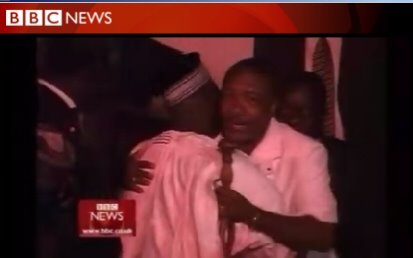 During the first walkover phase of the Iraq war, Comical Ali lit up screens around the world. He would outdo Alistair Campbell and Karl Rove combined in the spin stakes. As a mark of disrespect he called George W Bush, Little Bush. The context was unclear, but Little Bush makes sense if you compare Dubya's behaviour to childishness. The White House's threat not to see OBJ because of Charles Taylor is petulant. Do they really think Taylor would have left Liberia if he going to face war crimes charges later on? Look at the picture (right) of when Taylor arrived in Nigeria. Taylor is hugging OBJ and has just gotten off the plane with Ghanaian president, John Kufuor (on the left, white collar, patch of grey hair) . That is not the kind of reception presidents give a wanted war criminal. The US knew the terms of his exile, and I can bet my bottom sterling they didn't include arrest and trial. No doubt Nigeria probably looked the other way while Taylor escaped, or they might even be keeping him. After all they wouldn't let the US backed mercenaries take himby force in 2003, but surely they'd budge to a legitimate court? I'm no Taylor apologist, but the US is being hypocritical by penalising Nigeria for Taylor's disappearance.
Falling Sky
 Does anyone remember Goscinny and Uderzo's comic book characters, lil' Asterix, and the rotund Obelix? They were the magic potion addled Gauls, valiant warriors, protecting their village against Julius Caesar and his marauding Roman army. These Gauls were fearless, but only two things were guaranteed to grind them into submission. First was the singing of Cacofonix the bard. You can tell from his name that his voice grated the ears of the longsuffering villagers. The solution was simple. Tie him up and gag him at any public gathering. Harsh right? But don't you wish you could do the same to that aunty, or that uncle, without being arrested? The second threat though, was just pure superstition - they were scared of the sky falling on their heads.
Looking at the Nigerian government's reponse today's solar eclipse, one can see that superstition of fictional proportions is part of the Nigerian fabric. I came across the eclipse last year after missing (I think I slept through it) Britain's annular solar eclipse. I was going to traipse to some nether region of the world so that I could get my eclipse fix and a holiday. As soon as I saw that Nigeria would be covered by the eclipse, I despaired. There was no way a country were people attach socks to their penises was going to survive an eclipse. People might think that the sky had fallen because they hadn't sacrificed their grandmother's big toes on the eighth hour of the sixth month, of the ninth year, under an iroko tree. They might burn their twins at the stake, or worse still, think that this was the rapture, and await Jesus Christ astride a white horse to take them to paradise, hell, or possibly even worse, Butlins in Bognor.
In case you're wondering, here goes the penis and sock story. There were rumours in Lagos that people were stealing penises and using them in ritual sacrifice. Some men and boys with big egos felt their penises were too valuable, that their harems would suffer if their manhood disappeared in a puff of smoke to appease Sango. In this modern era, the humble colonial sock was to be the tool for safeguarding man's manhood. Attach the sock to the penis, and if someone brushes past you in Tejuosho market, don't bat an eyelid. But if the the sock falls, it means it has been detached, and the "bits" are no more. If this happens, you have three options. 1) Consult your own juju priest who'll give you the tools to steal one of your own. 2) Go to your nearest church. The pastor will either tell you that God has "ordained" celibacy for you, or one will be magicked into being for you again. Beware though, you will forever be sitting in the "cured ailments" section of the church holding a placard saying "regrow pennis" (sic). 3) Go to Modupe Ozolua's clinic for a John Wayne Bobbitt job.
The stories of superstition in Nigeria are legion. In my secondary school a whole family were ostracised because someone deemed them grandmasters in an evil coven of witches. When Arthur Miller wrote the Crucible in 1952, he'd never have thought that real witch hunts would still be taking place forty years later. Ella* is eating garri, groundnuts, and sugar. A friend, Stella*, asks to have some. Stella takes a spoonful, and as she is about to put it her mouth, there's a power cut. Amidst the chaos of darkness, the spoon and bowl of garium sulphate, are knocked down. The power comes back on immediately, and everyone gathers round the spilled food with open mouths. There isn't just garri and groundnuts on the floor, but a dead bird, feathers, beak and all. The group's conclusion? One was trying to bewitch the other. If Ella can convince the group that she's no witch, but a victim, Stella becomes the witch. If Stella has the greater force of character, Ella is the witch, and she is the almost bewitched. Positions are then set in dormitory concrete, labels stick, superstitions abound, childhoods are ruined.
There was also a time when some madman in the Far East supposedly predicted the exact date that the world would end. We were young and foolish, so we believed. It wasn't so much the Far Eastern madman we believed but the local Christians recruiting for God's army. If I smoked, I'd have given it up my nicotine fixes. If I drank, I'd have given up the evil liqour. If womanised, I'd have given up my many concubines, and sewed my monastic cloth. But I was eleven, and barely had any vices. I still didn't want to end up hell, so I read my Bible, and prayed everyday. Surely heaven would accept me now.
On The Day The World Is Going To End, I get ready for school as normal, confident that everything will soon be no more. First lesson ends, nothing. Bell rings for lunch, usual scrum. I'm tempted to say "pah! you fight over scraps, I'll be tucking into a heavenly buffet later today." However, they serve egusi, which I love. Figure I can eat that and still have room for a heavenly feast. Go back to classes, nothing. Final bell of the day, still nothing. Look, stop rushing God, He has until midnight to put an end to this misery. Next up, games. Hmph. This might be a convenient time to be taken into the sky, Elijah style. I'm ready for Mr Moody's laps round the 400m track. Thirty minutes later, I'm lying down in the middle the track, half dead. Ah I geddit, God doesn't want to do all the work, I should contribute something to my ascent into paradise. Since I'm half dead, He'll meet me halfway. I'm close. I lie on the track as Mr Moody shouts at me, threatening to cane me. Moody's still 50m away, I'll ascend before he gets here. Damn, he's now 5m away. Better run. Tired to death. I've done most of God's work for him, where the hell is He? Take a bath, lie on my bed. 2359hrs. Nothing. 0000hrs. You know what? I'm going to the pub, and then a rendezvous with my dealer, and then pulling over on the street corner. Okay, I was eleven, but you catch my drift. Haven't looked back since....
The eclipse should be used as way to enthuse school children, to make them fall in love with sciences. Nigeria wants a space programme, but yet its citizens cower when the sun retreats for a few minutes. Eclipse in Nigeria? Heaven helps us.
*made up names
Tuesday, March 28, 2006
Taylor vanishes
Former Liberian rebel leader and president Charles Taylor has disappeared. Quite frankly, this comes as no surprise. Taylor is a powerful man, and was said to be interfering in Liberian affairs even while in exile in Nigeria. And one can also understand Nigeria's reluctance to give him up. The conditions of his exile were for Liberia to make a fresh start. He wouldn't have agreed to go into exile if he knew he'd be charged for alleged war crimes, and Nigeria would not have wanted to be the country known for arresting suspected African war criminals. A real muddle.
Monday, March 27, 2006
This way up

The most endearing feauture of the Melbourne Commonwealth Games was the closing ceremony. It wasn't the usual line-up of clichés about "even though we wiped out the indigenous community, we're now amicably multicultural" that caught my attention. Nor was it grating cat squeals masquerading as "the best of Aussie music" that pricked my ears. Rather, it was the upside down globe of the world displayed, with Australia at the top, and Europe and North America at the bottom. It reminded me that I still want one these maps on my wall.
I first came across the concept of the upside-down map in 2003, when reading an article by world renowned arch-atheist humanist to the point of religiosity, Richard Dawkins. He was quoting a science-fiction novel where one of the voyaging astronauts said, "Just to think, it's springtime back on Earth!" This, he posited, was a parochial arrogance about one's part of the world being not just the centre of the universe, but the universe itself. Of course it wouldn't be spring for people who lived in a different hemisphere. The term would even be an alien concept for people who lived in the Tropics where there are only wet and and dry seasons.
In the distant unforeseeable future when I have little sprogs gnawing at my ankles and being sick on my expensive Savile Row tailored suit, I'll put up one of these maps in their rooms. Hopefully, they'll grow up with an inquisitive mind, not soaking in orthodoxies like a rancid sponge. An upside-down map lets the world know that not everything is absolute, but that many things are constructs of man. And these constructs become conventions, which in turn become gospel. We accept things as they are and ask no questions.
For as long as European explorers have "discovered" other parts of the planet, Europe has been atop the map of the world. These explorers had gone "south" to the dark continent, and the East Indies via the Cape of Good Hope. As far as the were concerned, they were going to the bottom of the world. These conventions have stuck, and we now all have to abide by them. If you fly planes for a living, or captain trawlers, it might be a good idea not to rebel against the status quo just yet. I doubt your passengers will accept "challenging orthodoxies" as a valid excuse for flying them to Andes, instead of the Rockies. But be aware, be very aware.
ps People in Britain should watch Dispatches on Channel 4 this evening. Sorious Samura becomes an "illegal alien" in Living with Illegals. Guaranteed to be harrowing viewing.
Thursday, March 23, 2006
Nollywood in the Guardian
There's a huge feature on Nollywood in today's Guardian. Read it here. And before you get upset at the stereotyping (but let's be honest, they're rather hideous), read the whole thing.
Tuesday, March 21, 2006
Desconocidos
 I saw this in the Sunday Times Magazine. It's something everyone should read, something every Nigerian must read. I got the image from the BBC website, but the one in the magazine was even more harrowing. There was a couple sitting on a beach. They had laid out their towel, had their drinks in a cooler, all underneath a tacky flowery parasol. Nothing strange there, it could be a seen from any beach in the world. In the background though, lying on the beach was the body of a dead washed up immigrant. The couple didn't seem to care, almost as if it's everyday a body washes up on their beach - which perhaps it is. But the lack of respect shown to the dead man, relaxing under what must have been a clear blue sky, oblivious of the dead man. Nothing should get in the way of our fun, dammit.
The Sunday Times ,
Authors in the Front Line: Ali Smith
Immigrants last resort
Morocco is heaven for tourists, but hell for the migrants trapped at its border. Unless they can escape into
Take a few everyday words, words we think we know the meanings of. Like tomorrow, or doctor. Or trainers, ferry, fence, or mobile. How about football stadium, or network? Or water bottle, or pregnant, or ladder, or view? What about the word
INSIGHT
The English couple sitting next to me on the Casablanca plane have the word insight all over their hand luggage. Insight Vacations. It’s less than four hours from Heathrow to Casablanca, and for two hours I’ve been joking with the man about how he’s taking up all of our shared armrest. At the same time I’m looking at the book of images that Tom, the MSF photographer, has brought to show me.
It’s the work of a Dutch photographer who spent years taking pictures of the places around the world that people with no passport try to cross to get into other countries. The pictures of Morocco and Spain show people washed up on beaches, battered people huddled in blankets, bloated from being in water too long, people dead on the shore. There’s a barbed-wire fence that looks like a sci-fi vision of a totalitarian hell. What text there is says that in the year 2000, 15,000 immigrants were picked up on the Andalusian coast trying to get into Spain from Morocco. It says that, along with the three-metre-high barbed wire, the infrared cameras and the searchlights, the officials in the town of Ceuta, the Spanish enclave at the northern tip of Morocco, have put bars on all the sewer outlets. The identifiable bodies are returned home at their family’s cost, and there’s a cemetery in Algeciras full of stones marked with just the letter D for desconocido. Unknown.
Tom, Polly from the MSF press office and I are going to Morocco to visit the MSF team working with illegal sub-Saharan immigrants in the north. Because of a tightening of rules, it’s currently a small but vulnerable group. This vulnerability was pointed up in October 2005, when the Moroccan authorities rounded up 1,200 immigrants – many pregnant women and people with TB, people too ill to be summarily dropped back at the Algerian border as usual (it’s against Moroccan law to expel or deny treatment to a sick or pregnant person) – and dumped them in no man’s land below Bouarfa, in the desert, miles from anywhere, with no food, water or shelter.
Our plane food arrives. The man from Insight Vacations jogs my arm for more room.
LADDER
In the MSF office in Rabat the notice board is covered with press cuttings from Spanish newspapers about the immigrant situation. In all the portraits the faces are blurred. Dr Javier Gabaldon, head of the MSF mission in Morocco, explains that it might be difficult to photograph people – those who have had attention drawn to them in the past by the international media have been jailed.
The first illegal sub-Saharan immigrant we meet has a very gentle face. He wants to be called Pascal in this article. He’s an unofficial liaison for MSF with the immigrant communities in Rabat; before he came to the city he’d been a translator, lay doctor and an MSF contact in the northern immigrant camps in the bush. A microbiologist, he left Cameroon in 2003 because of a “family problem, a social problem”, about which he looks panicked. “If I go back my life will be in danger.” He hitched and trekked without a passport to the international migrant junction Agades, in Niger. There was a lorry leaving that day for Libya. He spent two weeks in the lorry in the desert, one of 80 people. They had little food, just enough water. He tells me of the men in a car with no water for over a week, who survived by drinking their own urine. “The desert – the most beautiful place I have ever seen, and the most dangerous. We passed corpses.”
It wasn’t a dream of Europe for Pascal. “I had a job. I just wanted to go far from my country.” But religious intolerance in Libya drove him to try for “Europe in Africa”, as he calls the northern Spanish enclaves. So he trekked 130 kilometres in the dark, off-road, sleeping in the snow, to reach Gourougou, an immigrant camp outside Melilla. Five hundred people – Nigerian, Malian, Senegalese, 50 people from Cameroon – lived there in tents made from blankets and plastic supplied by MSF, all keen to “jump the fence” – only the start of dodging the police on the way to breaking into the Spanish refugee camp, where, if you get in unnoticed, you’ll be given expulsion papers that guarantee your passage to the Spanish mainland. If they catch you outside, they bar you.
“The first thing they say to you when you arrive is, can you make a ladder? Your passport is your ladder! You need two ladders. One for each side of the fence,” he laughs. “I made many ladders. I entered many times.” This slight man has done what in a week’s time, when I’ve seen the fences and patrols, I’ll know is close to superhuman: he’s broken in and been ejected six times, surviving finally in a quarry for 11 days, fed by registered Algerian refugees who shared their rations with him, before giving himself up out of desperation. After this, he trekked 437 kilometres to Ceuta, and tried to swim round the notorious fence there, only to be turned back twice.
“When you don’t have papers, you’re nothing,” he says. “Your first time in Africa?” he asks, adding: “This isn’t Africa! This is Europe!” He laughs loud and long, hilarious and sad. Pascal, a man with so much presence and so little permission to have it, says it clearly: “Morocco is a trap.”
NETWORK
Dr Gabaldon came here after stints in, among other places, Burundi and Rwanda at the time of the massacres. “Immigration,” he says, “is a long process with a long resolution. Every situation is different, every immigrant group is different, every individual profile is different.” What these all share is vulnerability to institutional and mafia bullying. The immigrants have access to two networks for help. One is MSF, the only provider of aid to illegal immigrants in the north of Morocco. The other is the sinister “Nigerian Network”, which has made a huge difference in the immigration situation over the past two years. Human trafficking is big money. It costs from £3,500 to £5,500 to get as far as Morocco.
“You pay the bill. High interest. Women will most often pay in sex work.” MSF often ends up looking after people abandoned by the network.
At the moment, though, most violence against immigrants comes from the Moroccan security forces. Last summer, all the inhabitants of camps in Bel Younech and Mariwari in the north mass-rushed the fence in an “organised” rebellion to try to enter Ceuta and Melilla. Few succeeded; 15 people died of injuries sustained after the security forces shot and beat them. It’s possible to see the “mistake”, as the security forces call it, of dumping the 1,200 people in the desert, as a bit of institutional vengeance in the wake of this.
Gabaldon is handling the aftermath of media excitement about it all; some news networks described a “genocide”, causing more local and government resentment. Gabaldon is angry too. “It isn’t genocide, and to call it what it isn’t endangers what we’re doing.” In two years, MSF has held 9,350 medical consultations in Morocco. A number of these were owing to violence against the immigrants. Of the most serious cases of violence, about 10% is carried out by the network, but 67% is from the actions of the Spanish and Moroccan security forces, with the Moroccan forces answerable for 52%.
Most immigrants in Morocco, about 2,000, are almost totally abandoned, with no way out and no way home. Morocco has stopped repatriating; the remaining groups are without embassies. Most live in the poor areas of the rich city of Rabat.
Read the rest on the Sunday Times website.
Monday, March 20, 2006
Toriola, our great leader.
 Forget about OBJ's third term bid, forget about Atiku's plotting for the top job, forget about Okonji-Iweala breezing into the PDP nomination - I nominate Segun Moses Toriola for president of the Federal Republic of Nigeria. He's at the Commonwealth Games in Melbourne, representing Nigeria in table tennis, where he's defending the singles title he won in 2002. It was just so encouraging to see a Nigerian doing well at the games considering the thrashing our women's hockey and men's basketball teams got, 12-0 and 103-53, respectively. Granted Toriola was playing against a Welshman for the bronze medal position in the men's team event, but perhaps it was playing Wales that made the caning the sweeter. Listen, I live in England. The idea is to let the Scots think you're on a par with each other, and then thrash them, but with the Welsh, forget about parity, just thrash them.
On the track, Nigeria is well represented, with veterans like Deji Aliu, Uchenna Emedolu, and relative newcomers like Soji Fasuba. But everywhere else, Nigeria is non-existent. I like the fact that Toriola is doing well because of the place table tennis has in the hearts of Nigerians. I used to be amazed when boys in old my manor (Three Bridges*), would play on a tiny bench and place a plank in the middle to stand in as the net. The skill on those benches was baffling. Proper full size tables existed, but they weren't the norm. Whenever I see people making a living out of sports such as table tennis, I think to myself, "if only they had facilities and resources". Toriola must have been one those table tennis boys in his youth. His parents probably crushed his "egg" a few times for playing with it instead of learning his times tables.
Toriola is currently ranked 111th in the world, which is not high by any stretch of the mathematical imagination. However, he is on the playing circuit, even though I doubt that he makes a proper living as a player. It's always painful to see talented individuals waste away because the Nigerian governments have no will to help athletes. Every Nigerian athlete that has become successful in the last fifteen years has done so out of their own pockets. So it shouldn't be any wonder when people like Francis Obikwelu and Gloria Alozie run off and compete for European countries. The stories of why they jumped ship are rather heart-breaking, and are typical of what Nigerian sportsmen and sportswomen at all levels of sport have to deal with.
Nigeria hasn't been been performing as well in track and field, as they did in the eighties and nineties. Back then, the Ezinwa brothers, Innocent Egbunike, and Chidi Imoh competed ably against the Linford Christies and drug addled Ben Johnsons of that era. It is simply because the level of professionalism now is such that an athlete cannot afford any mess-ups. It isn't just their personal coaches that have to be good, but the support from their national sporting authorities has to be unwavering. But will we get that in Nigeria? I doubt it. The blasted men in suits and agbadas will want to line their pockets with money meant for hard working athletes. What Nigeria needs is athletes to compete in the shooting events. That way when the the powers that be get Dick Cheneyed by a stray bullet, they can always claim it was an accident. Honest m'Lawd.
*Three Bridges aka Ebute Metta
Friday, March 17, 2006
Panic stations
 This was a conversation that took place between me and a friend today. As you read, it'll help to note that I've only played football once since the summer of 2003. That said, the last time I played was in Egypt. I played in midfield, spraying balls like Steven Gerrard with a hosepipe, even making the assist for our team's goal. The game was the Nigerian and Ghanaian press corps against the Local Organising Committee. Yours truly went on in the second half when we were 1-0 down, a kind of talismanic Kanu to turn things around. We drew the game 1-1, and I was slightly feted afterwards.
After a three year hiatus of piling on the pounds, and generally plummeting fitness levels, I was ready for a moment in the limelight. I ignored the fact that just before I went to Egypt, a Nigerian nurse at my doctor's surgery had told me that I was overweight. When she asked me if I ate vegetables, I said, "well, if you count egusi and efo-". "What is the matter with you Nigerians?", she bellowed, "you take a few vegetables and soak it in palm oil, and you think you've eaten healthily? Anyway you have to lose weight, come back and see me in a month." This was about two months ago, I haven't booked my return appointment. Heaven help me tomorrow morning.
The Mixtape Bully says:
African Shirts got u playing Gallas 2morro
The Mixtape Bully says:
or even Terry
African Shirts says:
you have me in D?
The Mixtape Bully says:
aight
The Mixtape Bully says:
defence aint it?
African Shirts says:
I havent played defence since 98, but it's all good
The Mixtape Bully says:
lol
The Mixtape Bully says:
where do u play
The Mixtape Bully says:
glory hunter
African Shirts says:
lol
The Mixtape Bully says:
everybody na attacker
African Shirts says:
when I used to play defence I was good, so I'm hoping to relight some of my skills
The Mixtape Bully says:
thats the thing
The Mixtape Bully says:
even i might have to play defence
African Shirts says:
lol
The Mixtape Bully says:
when i know my asset is my pace
African Shirts says:
homie what kinda people did you get to play?
The Mixtape Bully says:
cos everybody claiming midfield/ attack
The Mixtape Bully says:
but obviously on the day we’ll have to sort it out
The Mixtape Bully says:
some south london team
The Mixtape Bully says:
will be tough
The Mixtape Bully says:
cos they ex-pros
African Shirts says:
kai! (roughly translates as "bloody hell!!")
The Mixtape Bully says:
released by their clubs
The Mixtape Bully says:
divs 1 and 2
The Mixtape Bully says:
i didnt want to tell u
African Shirts says:
damn!!!
The Mixtape Bully says:
cos told one or two peeps and they fazed by it
The Mixtape Bully says:
its not good to start match with that mentality
The Mixtape Bully says:
cos u go dey fear
The Mixtape Bully says:
so not tellin anyone else
African Shirts says:
its all good, we just wont tell anybody the score
The Mixtape Bully says:
lol
The Mixtape Bully says:
men we'll have them. as far as im concerned they're not pro cos their clubs released them
African Shirts says:
that's the spirit
The Mixtape Bully says:
jus hold ur own. ur big and u have presence jus assert it from the start
The Mixtape Bully says:
cos u one of people I’m really relying on to hold that back line
African Shirts says:
no shaking
Wednesday, March 15, 2006
Colourful pieces of cloth
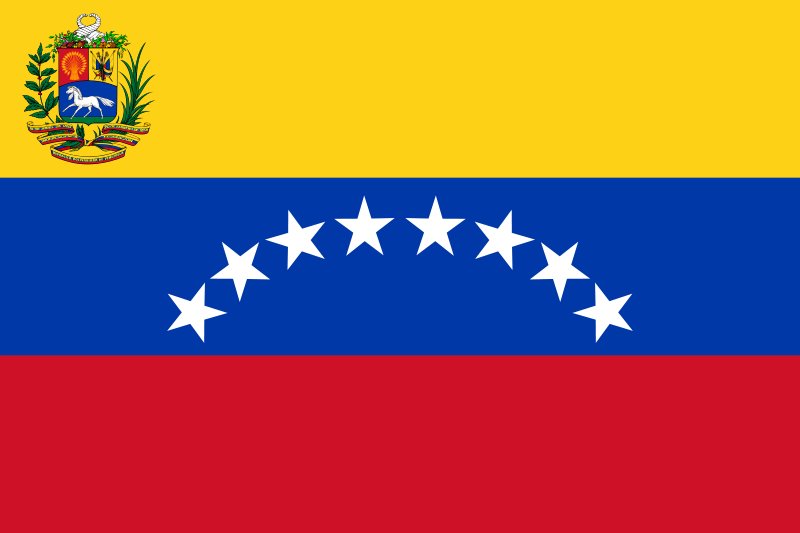 The new Venezuelan flag (left) annoys me. I have no business with Venezuela, except that President Hugo Chavez is a fellow traveller. He can count me as an admirer simply for his left leaning politics, and antipathy to US foreign policy, including most recently, his threat to ban US airlines from flying to Caracas. So you can imagine how upset I was when he decided to change the Venezuelan flag, and from what I gather, without much public consultation.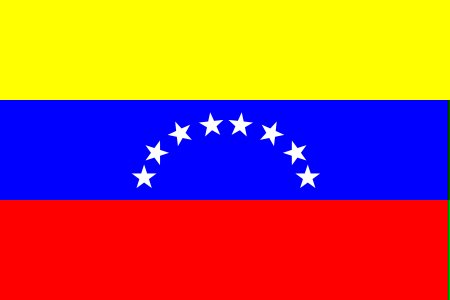
 It is wrong to go around changing peoples flags, even if you're president. Changing a flag is equivalent to rewriting history, which is what Chavez desires to do with this flag. He's added another star, supposedly representing freedom fighter Simón Bolívar. This eighth star also represents the eighth Venezuelan province which hadn't been founded at the time of the now old flag (left). As Venezuela is a Bolívarian country, it's understandable that they'd want him to be represented on national iconography, but it smells af if Chavez hijacked the whole process. It's like George the Younger being allowed to put a thorny headed Jesus Christ on Old Glory. After all, Bush is a fan, and Jesus was involved in the founding of America (founding fathers left Europe in search of religious freedom). That said, Bolívar is forgiveable.
Most upsetting is the coat of arms, which have been there since 1930. Coat of arms are militant. Coats of arms are only relevant for matters of the official state, e.g. military insignia (in defence of the state), and official documents (property of the state). The state is not the people. The state might undertake actions that provide services for the people, but it is still separate from the people.
To cap it all, the Chupacabra de Caracas made one of the horses on the coat of arms to face left, instead of its original right-facing position. Mr Chavez says the horse has been "freed". Claptrap. Freed from what? He obviously knows the power of symbolism, and has chosen to imprint his personal politics on the people's symbol, the flag. The horse is now facing left because the country is now left-leaning, politically speaking. Or at least the president is left-leaning. However, he shouldn't foist his politics on everyone in the country by default. Is the next right wing president supposed to change the direction the horse is facing? And what happens when a centrist president takes over? I'd like to see an artist draw that.
 A country can be represented by a flag if the flag represents ideals universal to is people. Take the Nigerian flag (left). It is the drabbest flag on the African continent. The continent's flags are so bright and colourful, from South Africa's rainbow nation, to Ghana's black star. Nigeria's is green-white-green. It was designed by a student, Michael Taiwo Akinwunmi, who must have been smoking something strong when he designed it. However, the green stands for forests (must have been the stuff he was puffing), and the white stands for peace. No sane person can argue with that., peace and forests. Put in a hammer and a sickle, a crucifix, or a moon and star, and you're asking for trouble.
 If you look around the world you can see the importance of flags. As soon as you hear "death to America" in the so-called Arab street, the next thing that follows is the US flag in flames. When I was in Nigeria a couple of years ago, I went to visit my dad in the east of Nigeria. And flying all over Awka (capital of Anambra state) were Biafran flags (left), fluttering blatantly in the dry harmattan wind. So it came as no surprise when the Nigerian government arrested Ralph Uwazurike, the Biafran separatist leader. During the recent spells of civil unrest in the East, reports spoke about graffiti with the words, "this is Biafra, rejoice". People need to wake and see what the symbols are saying. I have the Biafran flag up as my msn messenger picture. I didn't do it because I support the break up of Nigeria, but because I believe that the issues which resulted in the Biafran Civil War still exist, and still threaten our "one Nigeria". I have the flag up as a reminder. But do people care? Do they heck.
 Something I support, oddly enough, is the "Union Black" (left). This a reworking of the British Union Flag by Reflag, to have the colour black added to it. The black is supposed to represent the ethnic minority contribution to British society. While I wouldn't ordinarily agree with rewriting history in the form of reworking such an emotive flag (represents three of four British countries), I appreciate that British history has been whitewashed of the black contribution and expression. Mary Seacole in the Crimea, Olaudah Equiano during anti-slavery, and many more. On this principle, I support it. But the more convincing reason, is that I think it looks good.
 We might harp on about the symbolism of flags, but every day they are reduced to fashion items. I have been known to wear a Black Star flag in my time. A drunk girl from Oz said I was a traitor, and I told her it was just a cloth which looked good, nothing more. Geri Halliwell wore that Cool Britannia dress (left) that showed her bloomers. I also see that the Brazilian flag is very popular, even with people who know diddly squat about football.
Flag waving is not my thing, in the sense that the ultra-nationalism it tends to provoke is anathema to me. But people's attachment to flags is rooted in human history, and her relationship with symbols. That is one of the unique things about being human, thinking beyond ourselves, and almost giving credence, or even life to an inanimate object. Which animal can do that? But to the fashionistas out there, flags are just colourful pieces of cloth. Perhpas they're right.
Sunday, March 12, 2006
Slobo made us whole
 Former Serbian president, Slobodan Milosevic, died on Saturday. The general feeling is that his death has denied Yugoslavia justice, a feeling which always follows the death of such a notorious figure. Augusto Pinochet being deemed too ill to stand trial ticked off people who wanted justice, even though the Chilean courts subsequently ruled that he was well enough. Just as Saddam Hussein dying a painless, unjudged death will annoy Kurds and all those who suffered at his hands.
For me, one of the most enduring memories of the Balkans War was the downing and rescue of US Air Force pilot Scott O'Grady (later immortalised in the film Behind Enemy Lines). I remember sitting in the school library, being rivetted by the Newsweek and Time accounts of the story. It was a Rambo film writ large and true, a boyhood adventure story. Those were the days when names like Slobodan Milosevic and Radovan Karadzic became familiar to me.
What Slobodan Milosevic did however, was humanise Africans. This is a sickening analogy to make but after the Rwandan genocide, only another such atrocity would have humanised Africans. The question on people's minds was: why are these Africans so barbaric? Civilised North Americans and Europeans must have thought that genocide couldn't happen after Hitler's concentration camps and gas chambers during World War II. But Africans would prove them wrong. Africa still had the capacity for such a scale of hate as to try and rid the world of a particular race.
As all the other wars were taking place around Africa - Liberia, Angola, Namibia, Sierra Leone, the world washed its hands off the continent. "It's the African way, what can we do?", they cied. Milosevic changed all that. White Europeans could also hate, and the extremes of human behaviour weren't just confined to the dark continent.
The Rwandan genocide was supposedly unique because of the way neighbour killed neighbour, husband killed wife, priest killed congregation. People used machetes, the slaughter was very intimate and personal, almost medieval. In Slavenka Drakulic's book, They Would Never Hurt a Fly, she talks about the way ordinary citizens become mass murderers, almost on whimsy.
The capacity for evil is just part of the human condition, we're all capable of extreme evil. We just need the right conditions to tip us into maniacal despotism. Recent film depictions of Hitler, notably Downfall, showed the Führer in a human light. Well, he was human. He might have become an artist rather than a mass murderer.
Human beings around the world have equal capacity for tears, for sex, for sweat, for blood. At a time when savagery was being relegated as an African disease, Milosevic came back and claimed it back for humanity. Like I said before, it seems callous to draw such analogies, but human beings are as much characterised by their ability for good as for their affinity for evil. It's a reality we have to live with.
ps. The picture is of Carle del Ponte, prosecutor extraordinaire, straddling Milosevic. Her chance to do so is now gone, as I'm sure Milosevic's wife, Mirjana Marković, wouldn't be too chuffed.
Thursday, March 09, 2006
Jimi was a rock star
 Sometime in the eighties, my uncle gave the household (or to be honest, game my mum) this funky Aiwa stereo system. About time too, as we could barely hear the “Radio Nigeria 2, AM FM stereo” jingle on the crumbling Marantz system in the living room. Mama was always quick to remind me that the decrepit thing was older than me, and that if well looked after, might outlive me as well. Not if I get my way and clone many mini-mes, it won’t.
The new stereo could do everything, play records, tapes, and those new thingies – compact discs. The remote control would work even if you were in another room, and you could record everything to tape. But by far the best feature was the “toilet seat messenger” (as I like to call it). Basically, if you were doing a number two, and you suddenly realised that the toilet had run out of loo roll, the stereo would go to the pantry and could fetch a new bouncy soft one. It was that good, you can ask my mum. Or maybe I dreamt it.
My uncle was very thoughtful. Since he knew the Thomas the Tank Engine sing-a-long tapes didn’t really count as music, he also brought us some eighties soul records, and The Police: Greatest Hits. It was love at first listen. I’d sing Roxanne in the bathroom, bop my head to Walking on the Moon, dream of Message(s) in a Bottle(s) literally floating on the Lagos lagoons.
This was before the days of worldwide MTV, and Nigerian television didn’t show very much reggae-influenced rock. So imagine my surprise when I found out many years later that Sting was a white man! I could have bet six weeks of my pocket money that he was Jamaican. Even if he wasn’t Jamaican, he must have been black. Alas he wasn’t. The man was from Newcastle, Wallsend to be precise, not exactly heaving with curried goat and meat patty shops.
It was only surprising that Sting was white because I thought he made black music.
After I gone and got myself a edumacation, I realised that rock music was invented by the black man. Once again the white man he-devil done gone ‘n’ stole our culture. He ain’t just stole it, he packaged it and sold it like the black man never had nuthin to do with it. Did you know Elvis was a black man? He was a black man! Do you know who else is black? Eminem is a black man! Don’t let that no melanin ass fool y’all! Prince is a black man! Condoleeza Rice is a black woman! Do you hear what I’m saying, my bru-tha?
Excuse me while I exorcise some demons… Exorcised.
Right now, I’m listening to the Arctic Monkeys and the White Stripes. These are artists for the Kerrang and XFm demographic, not moi. I play with MTV Base and Vibe, Touch and Channel U. What am I doing with the Artic Monkeys on repeat? I have finally accepted and understood that yes, rock and roll could have been invented by black musicians. Some ethnomusicologist would probably say it’s the driving rhythms, the bass, melodies, the call and response. It’s all black.
You’ve got to understand that this is a huge turnaround for me. My musical tastes are as eclectic as they come – within the black music sphere. With the noted exception of house music, that’s just pushing it. Rock was always what my white roommates forced me to listen to, and only if they could nail my earlobes to the speakers. So imagine my guilty pleasure when I find myself listening to “white” music, and enjoying it.
Something I always find interesting is the fact that friends in Nigeria tend to have more all-encompassing tastes than I do. This is the fault of MTV Europe. Before MTV Base and Channel O, there was MTV Europe, spitting out Iggy Pop and Aerosmith. Music was music and they listened to everything, and they liked anything that was good. Moi, on the other hand, had my musical tastes stratified as soon I got off the boat. If you were black, you ran up you ran up your parents phone bill calling the Box and requesting Nuthing But a G Thang, and staying up late every night because you never knew which ungodly hour MTV had shunted Yo! MTV Raps to.
In England, you could choose not to listen to the “white” stuff, therefore not appreciate it. With MTV Europe blaring across Africa, there was no choice, so you couldn’t playa hate, you had to appreci-ate. Don’t cringe, you know you saw it coming.
Maybe all these theories are a load of jazz, and one of my white genes is just manifesting itself. My grandmother’s family name was Yoko, a fact which always gains me free access to exclusive sushi bars. Can claiming to be Japanese pass for white? The Artic Monkeys say it can.
Friday, March 03, 2006
Lost or abandoned
 I speak to my mother nearly everyday. Now this wouldn’t be such a big deal if she had one of those new fangled call any-number-at-any-time-of-the-day-for-half-a-penny-an-hour telephone deals. But she doesn’t; and she lives in Nigeria which has seen a huge boost in mobile phone usage in recent years. I’m a mama’s boy, and I’m glad I speak to her quite often, even though I sometimes wonder if she’s just showing motherly love, or keeping tabs on me.
A few weeks ago she called me to remind me of an episode on one of our many holidays together. When I was four, on a trip to France, I went missing while we were shopping in Paris. I was gone for over thirty minutes, and being her only child, she was sick with worry. The kind of worry only a mother could understand. She eventually found me in a little corner in the shop. It turns out that I hadn’t disappeared due to some quirk of Parisian boutique geography, but was in hiding because I wanted to have my picture displayed on screens across the city, with the caption, “il a perdu” – he is missing.
My mum remembered the story because of my recent appearance on primetime television. My desire to have my mug plastered on television screens across the country has finally been realised, even though it was under less frivolous terms than my toddler self searching for the proverbial fifteen minutes of fame. My recent appearance was Question Time. Okay, so I was commenting on Liberal Democrat skulduggery in ousting Charles Kennedy, it is still not that frivolous.
The story reminded me of other instances of me going missing, or going off the radar when an adult should have been with me. While on holiday with my uncle I went missing for a few hours in London, aged six. I remember sitting on a park bench crying, and an elderly woman sitting beside me trying to find out what the problem was. I was eventually rescued by a PC who’d been briefed on the police radio about my disappearance, and whisked me back to my uncle’s house. A bank of squad cars were parked outside, and as I walked in everyone was sitting down in solemn contemplation, probably pondering on how to explain to my mother that they’d misplaced her only child.
By the time I was 8, I had started travelling on my own. My “unaccompanied minor badges” were always a source of pride, which I was later told by my friends wasn’t a cool thing for a youngster to wear. On another holiday, I was supposed to leave my holiday camp in Nantes in France to spend a few weeks with family in London, with a day in transit in Paris. I should have been picked up by my mother’s friend at Orly airport, but he’d abdicated the responsibility of picking me to one of the sultry secretaries he always had around the office.
Needless to say, nobody picked me up, nobody could be reached. To make matters worse, snow globes of Mont Saint Michel which in my generosity I’d bought for my mother, had not arrived, along with the rest of my luggage. There was just my hand luggage, which for some odd reason, had my pyjamas in it, and thankfully some telephone numbers for family in London. British Airways helped make calls to London, where I flew straightaway. So there wouldn’t be any baguettes for breakfast, no crepes on the Champs Elysees. The uncle who should have been my host in London had chosen that particular time to go away to Nigeria (whence I’d just come) on holiday. Thank God for a huge family, an aunt in London was happy to receive me, slapping fish and chips on the menu the next day.
The last incident of me going AWOL was age twelve. It came after a month in Cameroon, having several adventures which included me always on the run from a dog called Fido, but that’s a story for another time. I went by coach from Yaoundé to Douala, from where I was due to fly back to Nigeria. Yours truly should have been picked up from the coach station by another friend of the family, who would then ferry me to the airport. Except that once again there was nobody to pick me up.
Being the travel veteran that I’d become by then, I caught a taxi to the airport, checked in, and waited to board my flight. Apparently my picker upper had reported to Yaoundé that the package never arrived, that young African Shirts was missing, to which he was told to “va cherche le seul fils de B” – which translates as, you better go and find B’s only son. He was also advised, rather helpfully, to check the airport given my travel experience. He did find me at the airport. As my mother later relayed the story to me, there I was, checked in and sitting down, “et lisait son journal” – reading his newspaper.
I seemed to be always misplaced on French speaking soil. I’m sure when I got lost in London, it must have been in a patisserie. Now that I’ve been on television and radio, perhaps I won’t go missing, I’m too old anyway to disappear in transit. Perhaps if my children start hiding under beds, and ducking behind pillars, I might recognise the symptoms and take action. What action? If only I knew, if only my mother knew. Perhaps she does have reason to keep tabs…
Wednesday, March 01, 2006
To hell with borders
International borders are a scourge on the modern world. Just like war, what are borders good for? Absolutely nothing. In the unlikely event that I become Prime Minister of the World, I would get rid of all borders and allow people to roam as freely as the wind carries them. Some see this as a recipe for disaster, but fear not brethren, there's a method to the madness. I've thought about this concept for a long time, but I found the idea very well articulated in a Guardian interview yesterday. I'll also paste the text of the interview below for those who can't be bothered to click on the link. Roberto Unger has just reached hero status for me, and I'll be sure to buy his book.
The ideas interview: Roberto Unger
He wants to be president of Brazil, and he believes in the human right to live anywhere. By John Sutherland
Tuesday February 28, 2006
The Guardian
The ideas interview: Roberto Unger
He wants to be president of Brazil, and he believes in the human right to live anywhere. By John Sutherland
Tuesday February 28, 2006
The Guardian
Talking to Roberto Mangabeira Unger for an hour is like waltzing with a very articulate cement mixer. Being slippery in his intellectual formulations is a matter of perverse pride to him. When the London Review of Books rejected an article of his on the grounds that it was somewhat lacking in "conversational" tone, Unger retorted that he was never conversational; even in conversation.
That elusiveness means it is not always easy to grasp his thinking. He prescribes a moral and spiritual revival in socialism, something that will enable it, as a force, to escape its current "dictatorship of no alternatives". Unger is labelled a "preposterous romantic" by his critics. The term is turned around by admirers such as the philosopher Michael Rorty, who writes that Unger "may someday make possible a new national romance".
One of the ways in which this new national romance will be achieved is a radical revision of what is implied by the term "immigration". Unger sees current immigration controls as deeply and offensively paradoxical.
"One of the striking features of the form of globalisation that has now been established," he argues, "is that it is based on the premise that goods and even capital should be free to roam but labour must remain imprisoned within the nation state. The truth is that one has every reason to suppose that the more freedom for movement of all the factors of production including labour that we have, the better things will be."
How, though, would Unger deal with the xenophobia that such a programme as his would engender?
"It's obvious that it will be impossible instantaneously to establish universal freedom of movement for people," he concedes. "But let's begin with the reasons it should be favoured. The first reason is economic. The more freedom to combine resources and people there is, the greater will be our chance to accelerate the logic of economic growth and innovation - the logic that promises to lift the incubus of poverty, infirmity and drudgery that weighs on human existence.
"The second reason," he goes on, in his anything but conversational fashion, "is social. No initiative would have a greater effect in diminishing human poverty than expansion of the freedom to move. It would dwarf all other policies that might be proposed to diminish inequality in the world."
And the third? "The third reason is moral and spiritual." These are not categories often found at the forefront of radical argument. What precisely does Unger mean?
"In a world of democracies, the most deserving basis of national differences is that the different states of the world should represent a form of moral specialisation within humanity. Humanity can develop its powers and possibilities only by developing them in different directions. But if this pluralism is to be compatible with the deepening of human freedom, it must have as one of its premises that a person born into one of these human worlds, but antipathetic to its special character, should be able to escape it. So for all these reasons, one should look to a world in which the freedom of movement is continuously but cautiously expanded."
Caution, it would seem, is the key. Unger is no utopian or blind enthusiast. "Pragmatism" is a recurrent term in his discourse, and his approach to national identity is reflected in his career. He is Brazilian by nationality, was educated in New York, is currently a Harvard professor, and has his sights on the presidency of his native country. He has already served as an adviser to Mexico's president, Vicente Fox. Given that background, his thinking on immigration is not all talk of moral and spiritual freedom, though it remains clear-cut in its radicalism.
As he says, "There are many objections and difficulties to be overcome. There are practical difficulties and there are objections in principle. The practical difficulties have to do with the idea that the expansion of this population movement would endanger the position of labour in the rich countries receiving the flows of people. But all these practical objections and others of the same nature invite the same kind of response - the generic name of that response is 'dosage'. That is, we cannot establish this freedom of movement instantaneously and universally but we can establish it in small cumulative steps."
An ideological reform is also required along with Unger's reforming dose: "Instead of having the idea that capital should be free to move and labour should be arrested within the nation state we should have the contrary idea that capital and labour acquire the freedom to move together in small steps in such a way, for example, that labour doesn't acquire full political and social rights straight off. It begins with work permits and it proceeds to a position of partial social rights and then only later to full entitlement. And in the sending countries the reverse would happen, a claim to some compensation for the investment in the education of the labour that they're losing."
So much for the practical difficulties. "Then there are," Unger continues, "objections in principle. All these objections of principle come down in the end to a quasi-tribal idea of the nation as a family writ large, based on a biological succession. In the end it boils down to the idea: 'We built this, it's ours. Who are you to come here and take it from us?' The answer to this objection of principle is the assertion of a counter-principle. In a world of democracies, in a world where the great projects that have set humanity on fire are the projects of the emancipation of individuals from entrenched social division and hierarchy; in such a world individuals must never be puppets or prisoners of the societies or cultures into which they have been born."
Nevertheless, Unger accepts the notion of unconstricted flows of population across national borders would be electoral poison for any party that espoused it. "I myself would never propose a programmatic discourse that centres on a single theme such as immigration. In my view, a political vision is not a grab-bag of discrete problems and solutions. It is the visionary anticipation of a direction. It makes no sense at all to favour an expansion of the right of people's movement in isolation. It makes sense to put forward such a proposal only in the context of a project that is focused on a generalisation of opportunities for empowerment, the enhancement of capabilities, unfettered access to the advanced sectors of production and learning, and a heightening of democracy, the creation of a kind of high-energy democracy".
· Roberto Mangabeira Unger's What Should the Left Propose? is published by Verso Books, price £15. A selection of his writing, and commentary on it, is available at www.robertounger.com
Monday, February 27, 2006
What Celebrity Big Brother taught me
 In Oxford on Saturday, a group called the Research Defence Society, took part in a march organised by Laurie Pycroft, 16. What struck me was, that finally, a group of people were standing up to the animal liberating, human annihilating Animal Liberation Front (ALF). It is good news that people are making their voices heard, coming out in support of animal testing. But despite their sometimes murderous intent, I still find myself on the side of the ALF’s arguments against carving up fluffy little bunnies for the advancement of science.
For the record, I am not a vegetarian, I am a carnivore, bloody fangs and all. No meal is complete without some kind of proper meat. I am not an animal-lover, I have killed chickens in the past, and own no pets. The only animals I have responsibility for are the rodents and cockroaches that sometimes invade my pantry, and trust me, I don’t treat them with an ounce of mercy. It’s just that I’m yet to hear a compelling reason as to why we should tolerate animal testing.
The biblical argument (see Genesis 1:28) about going out and having dominion over the "fowl of the air", and "every creeping thing that creepeth upon the earth" is a lazy argument. If we took everything the Good Book said at face value, then women would be forbidden from going to church between days 1 and 7 on the menstrual cycle. Then who’d look after the sprogs in the crèche? The argument is not just one of animal testing, but also of eating meat, and the general coercion of animals for human benefit. What right do we have to make a horse carry us through desert sands on its back?
The diet argument isn’t good enough either. I’m sure if roles were reversed, we wouldn’t like to be born and bred just to be slaughtered for someone’s full English breakfast. Is that the argument of a child? “Why did you kill that ant? Imagine if you were the ant and somebody stepped on you, would you like it?” Childish, yes. But it’s simply a “walk a mile in an ant’s shoe” argument, designed to make people empathetic to the struggle of the lowly ant.
If you subscribe to the premise that humans are glorified monkeys, just lucky to be better evolved, then we shouldn’t be treating fellow animals in this way. We treat fellow human beings with respect, surely we should do the same to animals. If you think that humans are not glorified monkeys, but a higher species, we still shouldn’t treat animals badly. If we’re more intelligent, and better philosophically evolved, it is our duty to protect lesser species.
The key to being human is apparently having a sense of self. I think, therefore, I am. Do animals have this? Who knows. Animals have shown themselves to be very intelligent, from politically scheming wild monkeys to tool making crows. It has also been suggested that animals might feel pain, but cannot anticipate it. Not true. When I lived in Nigeria, there were some stray dogs that would roam the street, doing nothing in particular. I was a paranoid (read scaredy cat) little boy, and I soon learnt that to get rid of the dogs, all one had to do was bend down, as if to pick up something. The dogs would run as if my doing that conjured up some kind of apparition. What the dogs knew was that human being bending down, usually meant stones and sand, which in turn meant pain in eyes and body.
However, there is the survival argument. During a very brief period watching the recent Celebrity Big Brother, I learnt a very important moral story. Don’t judge people who wear fur. The British audience were reliably informed by Gorgeous George Galloway, MP for Gallivanting East, that the Inuits in Greenland had to kill bear for their fur to keep warm. As simple as this sounds, it was an earth shattering moment for me in the animal welfare argument. What is one supposed to do when there is no other way of keeping warm? I suppose they could just buy a fleece from Gap or something.
It is unlikely that I'll ever be fully convinced either way, but in the meantime, arm yourselves with your arguments.
Wednesday, February 22, 2006
The beautiful ones are not yet born
 "The beautiful ones are not yet born" is the name of an email thread I participated in (passively) with friends today. People recounted their experiences of racism, some silly, some sad, some disgusting. I'll tell of my own experiences and then I'll do a cut and paste job of the emails in the thread.
Lancaster.
I did my A-levels at the Royal Grammar School in Lancaster, something which I'm strangely proud of. As someone who spent his early years in Nigerian schools, I know that where you're educated has much to do with the depth of your parents' pockets, the weight of contacts in the address book, or the smile of the gods. It seems almost pointless to be proud of where you were educated, it isn't necessarily of your own doing, even if it's a selective school . If you gained a scholarship, gloating might be slightly tolerated, but even the tutoring of children for entrance examinations also sometimes depends on the pockets of parents.
Anyway before swirling forces distracted me from the topic at hand (quote from Boris Johnson), I'm proud I went to LRGS. I went to a grammar, but got the standard of education of an independent school. It is a grant maintained school, so I only paid for boarding, and nothing for tuition. LRGS consistently ranks highly in the league tables, something I contributed nothing to (I didn't get all As, or all Bs, or all - you get the picture). It felt like I was making full use of the system, not being fleeced for my right - the right to be properly educated. But of course education is a privilege rather than a right, just go to the global south, or the geopolitical south, or the Third World, or the developing world, or (my personal favourite) the neo-colonial states and see what I mean.
I'm still digressing. Lancaster was a small town, no faces of colour, just history, bridges, rivers, a castle, and a university. Whenever I saw another black person, we'd hug like old friends, such was the excitement. My white friends who I'd abandoned for a quick platonic fumble with another "darkie" would ask, "so who was that?". And I'd reply with glee, "that guy? I've never seen him in my life." Clubbing was always fun, Born Slippy and Oasis. I was sixteen, and thanks to my puritanical Nigerian past, always sober. The bouncers would always gimme a "sup bruv?" look when I stepped to the door, while my mate Al would be stopped and asked for ID. I'd stand behind the bouncer and make faces at Al. We were both illegal (pre-eighteen), but I would get through by virtue of being a potentially "double 'ard" black man, while Al could never be as 'ard as me, the poor white fella (well three-quarters white, if you can quantify these things) would have to brandish his "Brighton University Student's Union" ID.
In school, I had no problems. I was one of four black boys at the school of over a thousand boys. Actually, I lie. At our peek, we were five. Oddly enough, we were all of Nigerian origin, only the sixth formers being "fresh from yard". Some silly little boys would do mock Jamaican accents when talking to me. And I'd just shrug, "that's Jamaican, I'm Nigerian. Get it right..." Some people thought that because I was black, I was stud muffin. They were right, I was a stud muffin. But at the time I didn't show it, and sadly the restraint was involuntary. My mojo was a little dead (like being half pregnant) for those two years. The bottom line is I didn't experience any racism while I was there. I did have a ginger-haired friend who got teased a lot, and of course like the true lad that I am, I joined in. One day he called me "nigger". "That's racist", I said. "Well you called me 'ginga'". I didn't think he had a point, but I couldn't really argue with him. So I stopped calling him "ginga".
Sunderland
When I lived in Sunderland, my experiences of racial discrimination were real, but also fed my vanity. I tried out for the university football team, I didn't get in. Not even the 3rd XI reserves. This was before the my defining feature became my paunch, and when I was young and sprightly. I wanted to go with the Nigerian team to the Sydney Olympics, so I figured university football would help my chances. Don't laugh, I was serious. I was a defender, and anyone who knows anything about football knows that Nigeria do not have defenders. I was a cinch for Taribo West's jersey. It really upset me that I didn't get into the team, especially when I played very well at the trials. But, hey, c'est la vie.
Apart from being a failed footballer, I'm a retired wannabe actor. Oscars, Baftas, Césars, and maybe even Razzies, I would accept them all. I went for auditions at the local theatre when it was panto season. I put on an Oscar winning display, the Don Cheadle of Wearside. The best people would be given parts, and the others would be called back. Yours truly was called back, and I shouldn't have been. People I saw at the callback were surprised to see me. In the end I don't remember if I was offered the non-speaking part of "hind legs of cow" and turned it down, or if I was offered the role at all. Had to be racism.
Brum
I've only ever had proper racial abuse once. It was Birmingham, summer 2000. The summer of Big Brother 1, summer of two-step garage and the song "Summer of Love", the summer of Wyclef Jean at Notting Hill carnival. I was "summering" with my uncle in Mosley, Birmingham. Mosley is an upmarket area of Brum, down the road from Edgbaston, a village strewn with parks, lakes, detached houses.
One evening, I was on my way home, skipping gaily with a beautiful summer sunset behind me, when I heard the words "nigger" shouted out of a moving vehicle. A group of lads in a small car speeding past me. In the distance, the car started to slow down. The car pulled over, and one of the boys came down and the car sped off again. Wonderful, I thought. He didn't look that big, I could probably take him one-on-one. My steps quickened so that I could get to him. Adrenalin began to swirl in my bloodstream, fight or flight had come to the surface. I wasn't flying anywhere, I would stand fight. I probably thought, "he's white, I'm black. How strong could he be?" But I was too slow, he had already gone in. I saw the house and paused for a bit. I could either report the stupid kid to his mother, or I could firebomb the place as soon I'd done an internet search for instructions. In the end, I did nothing. I very much regret doing nothing about it, at least I could made sure the cars parked outside had suspiciously failing brakes. But that is the sum of my racism experience.
If you're not yet bored, read the thread stuff below. I haven't got permission so I should steel my lawyer for the writs. The first story is poignant, poignant because of the extremity of the action, and the age of the perpetrators. They haven't been edited, only names have been removed, and some spelling.
Number 1
ok, i wish i could start your day on a lighter discussion but during dinner with my aunt and uncle last night i heard the most disturbing story.
their son had gotten into a couple of fights because he was being teased in school about being black, so we started discussing the racism issue here. my aunt works in the british school and said that what her son went through was nothing and recounted an incident that took place during break time in her school:
a boy had used a skipping rope to tie up one of the black girls in the school (by tie up i mean he wound the rope around her upper body), and was screaming at her "this is what we do to slaves, my daddy told me you are my slave and so you have to do whatever i say, you're a dirty slave...". (please bear in mind that these kids are like 6year olds) he kept saying it over and over. when my aunt saw what was happening she went over and asked him what he was doing. the kid then says "i'm not wrong, my daddy told me she's my slave, he showed me on the video and i read it as well. so she has to do what i say". my aunt at this point tried to talk sense into him but of course she couldnt get anywhere. so she gave up and told him to go and apologise to the girl as he had hurt her feelings. she reported the incident to the head teacher. the school called the parents and spoke with them and that was it.
imagine, i was disgusted to say the least when i heard this story. perhaps i have been naive in thinking that things were getting better. but then what am i saying? when i stayed with my sister in cambridge and was taking my nephew to school (he is the only black kid there), i couldnt help noticing that the only kid that really ever wanted to play with him had a mixed father.
one thing is for sure - kids can be cruel - if it isnt your colour, it's your glasses, it's that you're fat, or you're skinny etc etc. they have too much to deal with already without having the added burden of dealing with racism at such a young age dont they? i am even more convinced that i'm right in wanting my kids to spend their early life in Naija.
Number 2
Racist at 6 and fully armed with such surety because the very people who areNumber 3
supposed to lead him right are the very ones miseducating him.
I went to high school and A Levels outside London. I was one of two black kids in the
entire school and bar the silly bint who asked if we lived in trees in Africa and do we have cereal in Naija, I cant think of anything totally bad that happened.
In that little town of Surrey, it was actually cool to be black, the Asians loved you and the oyinbo's let you be. I guess that in itself is rather racist considering they didn't bother me coz they figured I knew some black gangster who would take them out. This was in the days of 2Pac and early years of cable tv and widespread mtv nation fever. People would constantly ask me for a dealer and I wasnt bullied either- so what if it's coz they thought my drug supplier would come with his Brixton massives and take them out.
Oh and I was always put on track field even though I cant run to save my life. But
hey! Number 2 is black, she MUST be a fantastic runner. I think they got the message eventually when I lost a major inter school relay.
Besides all that randomness, I was never really bothered, people just thought it was "cool" to be friends with a black kid and to be black, so I'd have people come up to me and say stupid things like "yo" , wassup "dawg" and whatever else it is they picked up from last night's re-run of Seinfeld.
The real talk of racism actually came when I moved into London. My nephew who was about 6 at the time, had to move schools because he was constantly being picked on by teacher as well as pupils. If anything went wrong, it had to be the black kid. He started doing badly at school too because he wasnt participating, started to feel really withdrawn and even his usual happy go lucky attitude.
Racism sucks. Makes me wanna cry sometimes. Used to think I could just shrug it off and just charge it to ignorance, but when it hits you out of the blue, then the sh*t hurts.
My Story:
Was walking friend's house in Marble Arch (DJ "Air Miles") a couple of months back, just to say hello to his peeps as they were leaving for Naija for soon. Now Mr. and Mrs. Ignoramus had just come back from shopping and were off-loading their the goods into the house. As I was walking into the Mews that same faithful night (see exhibit A) (due to technical difficulties exhibit could not be uploaded), Mrs. Ignoramus, noticed her husband had left the door open behind him and beckoned to him to close the door. As he turned round to do so, he saw me and I kid you not, dude looked like he had just seen a ghost. Old and frail as he was, he ran down the hallway, damn near fell on his wrinkly a** to quickly slam the door. He was terrified and I couldnt understand it. Who would be terrified of lil 'ol me. I cried that day!! Well not really, but I was pained, cause I didnt expect it.
Number 4
welcome to the north of the equator.........i worked in the admissions office last yr to make some extra quid while finishing my masters o...and everytime a black person with good grades who lookedlike aa prospective admit came in ..my oga introduced them to me with a bright smile........i no kuku get why....until she told me that its good that they see that "people like you can excel"!........not only that they wanted me to give a talk to underachieving high school students.....and i told them i knew nothing of childpsychologyy...they told me..its okay..what they did not say of cos is that .."its okay..you are black..most underachievers are black..so they need to hear you talk"..Of cos there are only like 10 black law students in the entire University
of Toronto......
Number 5
yesterday i was trying to cross the road on my daily walk to school. i had crossed the first half of the road when the light changed, so i stood at the divider. this woman was driving an suv was filtering into the road from my left, and so she had to drive right past me. as she she approached me, i noticed her fidgeting in her seat, and i thought it was a tad curious until i noticed that she was locking her door as she drove past me. she couldnt speed, because it was a corner, but she slowed down just so that she could be sure her door was locked as she drove past me. it made me feel really bad, standing there, over-educated lawyer on his way to school where he's working on a phd. im not even big, and all she saw was black man on the road. i thought i had put it behind me until i read Number 3's email. its brought back all the pain i felt yesterday.
i cant imagine how that would affect that little girl as she grows older.
What does the title of the thread mean anyway?
Tuesday, February 21, 2006
Ignore Nigeria at your peril
 I wrote an article a couple of years ago titled, "Ignore Nigeria at your peril". It was meant to be an alarmist cry to the West to forget not Nigeria simply because she now had a civilian government, or at least one that didn't wear military garb. Fears had been raised over Nigeria having a Pakistan assisted nuclear programme of some sort, and also talking to Axis of Evil state North Korea about nuclear weapons. I thought it was a very well written article, one which would have sat beautifully on the pages of the Daily Telegraph, the Economist, or some such highbrow publication. The Economist wouldn't print it because they said the nuclear programme accusations were unfounded and far-fetched. So I qualified it with a sort of "rumour has it", but that wasn't enough. They were obviously fobbing me off, but that's not why I'm writing this.
Over the weekend, Nigeria hit the international headlines for all the wrong reasons. Mend militants kidnapped more oil workers and attacked oil infrastructure, just as cartoons protests turned sour in Maiduguri, killing up to sixteen people. These stories are making headlines here in Britain, but not for any altruistic reasons. Lord Palmerston was the one who said that a country has no permanent friends or permanent enemies, only permanent interests. And right now, the interests and fortunes of Nigeria are as intertwined with the West's as Hansel's fate is tied to Gretel's. In the nineties, when Abacha was raping the country, the West couldn't give two hoots. Nigeria was just another failed state, known for advance fee fraud, Hakeem Olajuwon, and Daniel Amokachi. But one man changed all that. Nope, not OBJ, but the mighty Osama bin Laden.
In the years BO (before Osama), House of Saud and House of Bush were cosy, oil was guaranteed. House of Saud could sponsor Wahhabism in Kano or Aden, so long as the black stuff kept flowing and, nobody attacked US interests. When the mulitnational (though mainly Saudi) nineteen brought down the Twin Towers*, the US figured out two crucial things: 1) the US cannot rely on Saudi Arabia for strategic partnership in the Middle East, especially oil, 2) the US has to fight Islamist terrorism wherever it may or may not rear its head.
These two positions forced the US to invade Iraq. You couldn't have some of the world's largest oil reserves being sat on by a despot like Saddam Hussein, especially when Iraq's neighbour Saudi Arabia wasn't such a great partner anymore. The US's objective has been to reduce reliance on Middle East oil, and this is where Nigeria comes in. Why rely on the mad mullahs of Iraq, Iran, and Saudi Arabia, when you have pliant Nigeria, and Venezuela? Except that even Nostradamus couldn't have forseen the impact of Hugo Chavez, and Mend, leaving the US State department up a Delta state creek without a paddle.
When the Twin Towers went down*, there was a spike in the number of children named Osama in northern Nigeria. I have thought since then that Osama bin Laden is hiding somewhere in Kano state, but people laugh. Yesterday, someone who was in Jos around 2001, told me that motorcycles (okadas) had pictures of Osama on them. Some riders would say, "he's a good man, he helps us". Potential Islamist bombers don't just come from the Middle East, they come from Morocco, Indonesia, Leeds, Nigeria, and so the US has taken a special interest in Nigeria, and the Sahel region.
Mend attacks Shell facilities, and world oil prices spike. People protest against Danish cartoons (a few weeks after everyone else) in Maiduguri, and people die - potential recruting ground for terrorists. The West can't ignore Nigeria anymore, because Nigeria will bite them in the arse, hard. I only wish I could find that article.
ps. There's also bird flu, but I reckon Nigerians will eat all the chickens before any WHO or Minsitry of Health official dares knock on their door.
*I hate using the term "9/11", it turns the event into a brand. Not cool.
Friday, February 17, 2006
Players and followers: followers.
In the world of football journalism, there are two categories of people: footballers and the rest. This categories are even more defined in African football where some of the players earn in one month what the whole press corps earn collectively in one year. In Egypt, there was a siege mentality among the players, a feeling that everyone who spoke to them was trying to suck them dry, literally and figuratively. Granted, I was always trying to get something from them, but it was merely a story I wanted, not coppers falling out of their wallets. The Nigerian press corps were "looked after" by the Nigeria FA, which meant they received sports jackets (which shielded against the cold), jerseys, shorts, etc.
Some of the items were perfectly harmless, souvenirs picked up like one would pens and pencils at a trade fair. However towards the end of the competition, a list of Nigerian journalists was drawn up for the Minister of Sport, Saidu Sambawa (the same one with bird flu on his farm). The lucky hacks on the list would get one thousand Egyptian pounds (LE1000), which is about £100. The journalists would have picked up this money on or about the 7th/8th of February, a couple of days before the final. I have no idea what services were performed by the journos to receive this money, but it seemed inappropriate to me.
I'm not part of the "old guard", nor was did anybody really know me, so my name wasn't on the list. I was the one who was constantly mistaken for being Ghanaian, prompting cries of, "oh, you're Nigerian sef. I thought you were one of the charley boys." The money was seen as a "gift" from the ministry, probably some excess left over after win bonuses weren't given out for Nigeria's loss to Cote d'Ivoire. There were some journalists who refused to accept the money, saying it was only journalists who had "sold their souls" that accepted such. I told the story of Jack McConnell's holiday in Kirsty Wark's Spanish villa, and how that had caused such a furore. But apparently, the rules for sports journalism are different.
Small Man spoke about how he had accepted gifts of money from some Ghanaian players, some of whom he's been friends with since childhood when they played keepy uppy with eaten oranges. He said there was no shame in it and when he interviewed them, they'd complain, "look at the relationship we have, and yet you were asking me those kinds of questions." This, Small Man felt, was a sign of his impartiality, maintaining his ability to do the job regardless of personal friendships.
In a country like Nigeria where all lines of propriety are blurred, it can be difficult to determine what is an actual taboo, and what isn't. One could argue that the journalists are underpaid and undervalued, financial help (a subsidy perhaps) from the ministry shouldn't be judged harshly. The question though is whether the Sports Minitry's records will show that money was given to certain journalists. I doubt that it will, and that is the big problem for me. Hiding that kind of information undermines the journalists, and could hamper their ability to write articles that are critical of the ministry. The Sports Minister apparently has a habit of summoning reporters whenever he choses a platform from which to spin his yarn. How can a journalist resist a minister's overtures when he is seemingly in the minister's pocket?
Some of the items were perfectly harmless, souvenirs picked up like one would pens and pencils at a trade fair. However towards the end of the competition, a list of Nigerian journalists was drawn up for the Minister of Sport, Saidu Sambawa (the same one with bird flu on his farm). The lucky hacks on the list would get one thousand Egyptian pounds (LE1000), which is about £100. The journalists would have picked up this money on or about the 7th/8th of February, a couple of days before the final. I have no idea what services were performed by the journos to receive this money, but it seemed inappropriate to me.
I'm not part of the "old guard", nor was did anybody really know me, so my name wasn't on the list. I was the one who was constantly mistaken for being Ghanaian, prompting cries of, "oh, you're Nigerian sef. I thought you were one of the charley boys." The money was seen as a "gift" from the ministry, probably some excess left over after win bonuses weren't given out for Nigeria's loss to Cote d'Ivoire. There were some journalists who refused to accept the money, saying it was only journalists who had "sold their souls" that accepted such. I told the story of Jack McConnell's holiday in Kirsty Wark's Spanish villa, and how that had caused such a furore. But apparently, the rules for sports journalism are different.
Small Man spoke about how he had accepted gifts of money from some Ghanaian players, some of whom he's been friends with since childhood when they played keepy uppy with eaten oranges. He said there was no shame in it and when he interviewed them, they'd complain, "look at the relationship we have, and yet you were asking me those kinds of questions." This, Small Man felt, was a sign of his impartiality, maintaining his ability to do the job regardless of personal friendships.
In a country like Nigeria where all lines of propriety are blurred, it can be difficult to determine what is an actual taboo, and what isn't. One could argue that the journalists are underpaid and undervalued, financial help (a subsidy perhaps) from the ministry shouldn't be judged harshly. The question though is whether the Sports Minitry's records will show that money was given to certain journalists. I doubt that it will, and that is the big problem for me. Hiding that kind of information undermines the journalists, and could hamper their ability to write articles that are critical of the ministry. The Sports Minister apparently has a habit of summoning reporters whenever he choses a platform from which to spin his yarn. How can a journalist resist a minister's overtures when he is seemingly in the minister's pocket?
Tuesday, February 14, 2006
Tales of love, or something.
Since it's St. Valentine's Day, I'd thought it'd be good to tell a romantic story, romantic of sorts. I had a telephone stalker in Egypt. She was calling me all the way from Italy to talk to me. On the first night she called, I told her that I had no idea who she was. It seemed a bit odd that someone would be calling a wrong number all the way from Itay, and what's more, she was Nigerian. Very often in London, whenever my phone rings on a wrong number, the person turns out to be Nigerian. But the chances of a random Nigerian in Italy calling another Nigerian who is temporarily in Egypt?
Someone had given her my number, and I could just about guess who gave it to her. Even though we'd never met, she knew sketchy details about why I was in Egypt. The next time she call, I realised she was mistaken. She had this misconstrued idea that I was a Nigerian footballer. "I just finished watching your match. How come I didn't see you?" Erm, I'm a journalist. I'm here covering the Nigerian team, not playing with them. "But you're with them sha?" Maybe what I said didn't make sense. I was tempted to say, "well you see this coach guy, he's jealous of me, so he doesn't want to pick me to play." But I thought the better option was to hold my tongue, literally, feign choking and spluttering. Which I did. "You'll call me sometime, won't you? This is my number." In my haste to leave, I think I might have said "yes, I'll call."
Never tell anybody you have no intention of calling that you'll call them back. She called again the next day, complaining that I hadn't called her. I came up with the "it's been hectic around here" cliché. For the sake of common courtesy I stupidly said again that I'd call her. The next day, the phone rang. I recognised the number, so I passed the phone to Small Man, who was only too happy to entertain her. She and Small Man had a long conversation about goodness knows what. I think in the end Small Man even gave her his telephone number in Ghana. Now that is what I call industry. I think she called again once before I left, but as usual, Small Man was on hand to entertain her with cartwheels and juggling miniature pyramids. I'm back in London now, surely this is too far for her.
Someone had given her my number, and I could just about guess who gave it to her. Even though we'd never met, she knew sketchy details about why I was in Egypt. The next time she call, I realised she was mistaken. She had this misconstrued idea that I was a Nigerian footballer. "I just finished watching your match. How come I didn't see you?" Erm, I'm a journalist. I'm here covering the Nigerian team, not playing with them. "But you're with them sha?" Maybe what I said didn't make sense. I was tempted to say, "well you see this coach guy, he's jealous of me, so he doesn't want to pick me to play." But I thought the better option was to hold my tongue, literally, feign choking and spluttering. Which I did. "You'll call me sometime, won't you? This is my number." In my haste to leave, I think I might have said "yes, I'll call."
Never tell anybody you have no intention of calling that you'll call them back. She called again the next day, complaining that I hadn't called her. I came up with the "it's been hectic around here" cliché. For the sake of common courtesy I stupidly said again that I'd call her. The next day, the phone rang. I recognised the number, so I passed the phone to Small Man, who was only too happy to entertain her. She and Small Man had a long conversation about goodness knows what. I think in the end Small Man even gave her his telephone number in Ghana. Now that is what I call industry. I think she called again once before I left, but as usual, Small Man was on hand to entertain her with cartwheels and juggling miniature pyramids. I'm back in London now, surely this is too far for her.
Subscribe to:
Posts (Atom)