Tuesday, January 17, 2006

Youth Service

The Chancellor’s Fabian Society speech at the weekend echoed a similar speech David Cameron gave in August. Since July 7, the idea of how to give young people a sense of belonging and civic duty has been high on the national agenda. Muslims from Beeston who feel British will not blow up tube trains, so goes the argument. Feral youth from Brixton, Toxteth, and Moss Side who have a sense of civic duty will not happy slap the bus driver, is the thinking.

Community service is seen as one way to foster national cohesion. Such schemes are used in various countries, which include both voluntary and involuntary participation. The unifying factor, however, is that community service is introduced in times of great national upheaval. The US Peace Corps, which Gordon Brown mentioned, was a Cold War creation of President Kennedy to evangelise for democracy against the communist missionaries from China and the Soviet Union. The Third World was the ideological battleground, and the volunteers were the foot soldiers.

In Germany, where military conscription still exists for men between the ages of eighteen and twenty-three, “civilian service” is used as an alternative to military training. Instead of running around the Black Forest wielding weapons of war, young Germans can opt to drive ambulances or read bedtime stories in old people’s homes. The German army has relied on conscription since the Allies allowed the newly sovereign country to have an army in 1955. As the country seeks to end conscription, community service is also under threat. Charitable organisations fear the loss of up to 90,000 men, which civilian service has provided since the Cold War.

The Nigerian youth service corps was introduced after an ethnicity charged civil war had killed more than one million people. The military president at the time said it was established “with a view to the proper encouragement and development of common ties among the youths of Nigeria and the promotion of national unity.”

Young people from the mainly Christian urban south are thrust into village life in rural Muslim north, vice versa, and everything in between. It is the Atticus Finch philosophy of walking a mile in another’s shoes writ on a national scale. A northern “youth corper” on being sent south said, “I thought they were cannibals in that part of the country, and they thought we were cannibals in my part of the country. It turns out none of us eat people.” This might appear as a piece of trivia among noble savages, but breaking myths is an important way of nurturing understanding between estranged people.

David Cameron and Gordon Brown must believe that British society is facing an identity crisis similar to a country recovering from war. And perhaps the bombings on July 7 was the tipping point. Where both men might learn from Nigeria is the relationship between youth service and political office. One is barred from political office if they haven’t done youth service. Where would that leave both men?

Saturday, January 14, 2006

Money laundering in Nigeria

Michael Buchanan goes to Nigeria for the BBC World Service in Dirty Money. He talks money laundering to Finance Minister Ngozi Okonji-Iweala, Nuhu Ribadu, and briefly to Alamieyeseigha. Nigeria's go to intellectual, Pat Utomi (taking a break from his drab television show) is also there.

Wednesday, January 11, 2006

Respect

I listened to Tony Blair’s speech on Respect, with a grin on my face and laughter in my belly. It was funny, not because most of the measures are amusingly unworkable (which they are), but because it has parallels to the Nigerian military regime of the early 1980s. The Prime Minister has been accused of being many things, being presidential, and even being a Tory, but one suspects he’s never been likened to a military dictator.

When Generals Buhari and Idiagbon seized power in a coup d’etat in 1983, they set to rooting out corruption and indiscipline from Nigerian civil society. Civil servants were lazy, members of the public were disorderly, and so the military government thought up a military solution to the problem. In similar rhetoric and fervour to the war on terror, and the war on drugs, they coined the phrase War Against Indiscipline (WAI).

During the days of WAI, mobile courts dispensed summary justice on the streets of Nigeria. Commuters who’d ordinarily rush for the few buses available had to mimic their former colonial masters, the British, and queue. If you didn’t queue, there was a policeman toting a whip itching for the chance to use it. If you dropped litter on the streets, you were pulled aside, and given a lot more than just a fine. Civil servants who turned up late for work (a very Nigerian disease), were forced to do frog-jumps. For those not public school educated, Sandhurst trained, or bullied by the PE teacher, frog-jumps entail grabbing your ears, squatting, and jumping repeatedly. Painful. Imagine Whitehall mandarins frog-jumping down the Mall for being delayed by the Northern line tube.

In a country where “reasonable chastisement”, and the “spare the rod” mentality is not just legal but encouraged, WAI was essentially corporal punishment for errant adults. People are born naughty and rude, and politeness and courtesy have to be beaten into them was the mantra. People died of heart attacks when made to do frog-jumps, and the well meaning discipline agenda eventually descended into detaining journalists and the serious curtailing of civil rights. Despite this, some Nigerians today look upon those days as the golden age of discipline in their society, much like Blair looks to Victorian England for his cue on etiquette and manners. In fact, some measures enacted then still exist.

Flogging people and making them do frog jumps would never be allowed here. This is a civilised liberal democracy, apparently, but something tells me the Prime Minister hankers after the kind of power military men have. A few years ago, President Obasanjo (former general, but now in civvies and democratically elected) took a cane from a policeman and began to whip him with it. The policeman’s offence? Caning members of the public while trying to restore order, after the president’s arrival had caused chaos. What wouldn’t Blair give to be able to do that? If only he could avoid getting an ASBO…

Friday, January 06, 2006

Prison works

One of my most enduring memories of the former Tory leader Michael Howard when he was Home Secretary in John Major's government. His mantra was "prison works." It's an understandably right-wing position to take. If criminals encroach on a citizen's right to peaceful existence, the state secludes those criminals from society using punitive measures. The commission of the crime means that the criminal forfeits the right to be in civilised society and is held responsible for their actions. None of that lefty pinko liberal "blame it on society" claptrap.

Interesting then that Nigeria apparently has a smaller prison population than those incarcerated at Her Majesty's pleasure. The Nigerian government is set to release more than half of its prison population. The report says that Nigeria has 40,444 inmates in 227 prisons. This tallies closely with Home Office's World Prison figures of 2003 which put it at 39,368. The Home Office report of July 2005 put the UK's prison population at 76,266. This works out at 34 inmates per 100,000 of national population, with the UK on a whopping 139 per 100,000.

Call me biased against Nigeria, but I'd never have expected this to be the case. I still think of Nigeria as a country where people get arrested and subsequently disappear forever, like Houdini gone wrong. The figures also allude that Nigerians are more law abiding and less prone to commit crimes for which one can be imprisoned. This is rubbish. Lagos is probably the most crime-ridden and unsafe place in the world, except for Baghdad (which is in a war zone, so it doesn't count). Given the amount of crime in Lagos, its prison population alone should be 40,000. I suspect that Nigeria ranks lower than the UK because the Nigerian justice system grinds slowly, if at all.

People can bribe their way out of jail sentences, law enforcement are reluctant to do their jobs, and the courts don't have the desire to rule on cases where they won't earn much money. I'm encouraged by the move as most of the inmates appear to have been held in violation of the number one right of the imprisoned - habeas corpus. This shows that the Nigerian government is, shock horror, interested in the rights of its citizens. When OBJ came into power, I remember there was a suspension of the death sentence pending review. They planned to have a national consultation about it, presumably with the government leaning towards abolition. The government should not consult the people on this issue. It will be the one thing along with football that Nigerians will unite for.

The prison population in the UK has risen under Labour, not what one would expect of a centre-left party. I'm sure David Cameron's policy wonks are thinking of a novel addition to their list of new voter-friendly policies. "Prison works, in the Scilly Isles. Holiday with your fellow purse borrowers (bag snatchers), life deprivers (murderers), and unwanted inseminators (rapists). A compassionately conseravtive Euro Disney/Butlins fusion island. Voyagers should voluntarily report to their local police station. No handcuffs will be used."

ps. The Guardian has a special report on prisons.

Thursday, January 05, 2006

Nigeria in 2006

It would be downright stupid to say that this is going to be an interesting year for Nigeria. Every year in a country's life is interesting on some level. Besides, as former British PM Harold Macmillan said when asked about the most difficult thing in politics, "events dear boy, events". Events govern everything. Events such as the Nigerian Congress introducing same-sex civil partnerships, or Babangida explicitly saying he isn't running for president. These are events which would render any possible predictions obsolete. If any country had three tragic plane crashes and the death of a first lady in one year, it would be their annus horribilis, but not in Nigeria. The potential for dramatic events never dissipates.

Some things to look out for:

Politics
This could be a wonderful year for Nigerian politics. Since elections at all tiers of government are due in April 2007, politicians will set out their stalls early. The overarching question is if OBJ will run for a third term. The constitution doesn't allow it - unless two-thirds of Congress vote to change it. One never knows how the lawmakers are thinking. their position on the matter sways as the wind blows. One thing is for certain, there are enough people against it to cause the PDP to split. This would be a wonderful thing, not because I have something against the PDP, but because they have too much power.

When one party in a "nascent democracy" (I couldn't resist) like Nigeria has so much power, it ends up consolidating its power, and the country sleepwalks into a de facto one-party state and president-for-life ethos. It's happened all over Africa before, Kenya being the most recent country to break out of it with Mwai Kibaki, and Yoweri Museveni is hoping to sustain it in Uganda's March elections. If the party has too much power, it can afford not to deliver reforms for the electorate because there's little threat of being swept from power.

If OBJ doesn't want to become a president for life but wants to see his work continued, then he should endorse a successor á la Clinton/Gore (which succeeded if you really count the votes), or Arap Moi/Kenyatta (which failed) in Kenya. The successor will most likely be judged on the performance of the predecessor, and if the people like what OBJ has done, they will trust his judgement as to who should continue his good work.

There is a slight threat that if the PDP breaks up, it will fractionalise into tribal groups. Most of OBJ's opponents want him to stand down because they want the presidency to go to their geopolitical zones - North North, South South, South West etc. This may well be true but the nature of the constitution means that any party that wins the election has to be truly national on some level. To win, the president must have, and I quote from the constitution "not less than one-quarter of the votes cast at the election each of at least two-thirds of all the States in the Federation,"* in addition to having the most votes cast for them. Any party that wants to put forward a winning president has to be fairly national, as former secessionist warlord Ojukwu and his APGA found to their cost, in 2003. Any party with serious aspirations has to be national.

A weakened PDP will mean government by coalition which might seem like diluted government to some, but will definitely mean a better spread of power.

Security and Unity
How will Nigeria treat its militants? MASSOB's Ralph Uwazurike is to stand trial for treason, and so is Mujahid Dokubo Asari of the IYC. Secession/militancy is not just an eastern or South South region preoccupation, Frederick Fasehun and Gani Adams of OPC are in court as well. While there is some evidence that some of these people have committed treasonable offences, their grievances are genuinely held.

Talk of Biafra is laughed at outside the east, but the last time I went to Nigeria (Christmas 2004) there were Biafra flags flying all over Awka, capital of Anambra state. Within a few minutes of talking to a young Igbo man, he said to me, "the youth are agitating for a Biafran state". People feel genuinely let down by the Nigerian government and feel that only self-determination will solve their various problems. What becomes of these groups depends on how their leaders' trials go, and crucially what the government does to address their grievances. The powder keg is there, all it needs is for a bumbling politican to light it.

Health
The December announcement that the government is to offer free treatment a boon to Nigeria's four milion AIDS sufferers. Add the revitalsed polio eradication drive and you have a government showing a genuine desire to improve healthcare in Nigeria.

Culture
Nigeria is set to join the world's pantheon of voyeurs as Endemol Nigeria produces Big Brother Nigeria. I wonder what the house will say about modern Nigeria. Will the contestants spend their days in the house praying and fasting? Or will they just use dodgy slang like "bons" and "sturves".

MTV Europe Award winner Tuface Idibia has signed with big four record label EMI in South Africa. How far will his star rise?

Another multiplex cinema is set to open in Lekki. What impact will this have on Nollywood?


*Nigerian 1999 Constitution Chapter VI, Part 1A.

Monday, January 02, 2006

Only in South London


The 453 bus between Deptford and Marylebone has got to be the most eventful bus route in London. The last time I was on it, a woman had her mobile phone snatched as she was sending a text message, or playing snake, who knows. The hooded fellow grabbed the phone and ran out, just when the bus was at a stop and had its doors open. In a true display of London community spirit, nobody as much as yelled, "stop, thief", or gave chase, or gave succour to the damsel in distress. Everyone kept listening to their ipods, playing Su Doku, or just plain staring blankly at the poor woman. I was tempted to get up and go after him, and recreate Clint Eastwood's "Do I feel lucky, punk"* scene. Alas, I don't own a gun, and the damsel in so-called distress chuckled at the fact that someone had just robbed her. Somehow I didn't see the need to chase down a mugger who was brave enough to mug someone on a crowded bus, especially if the victim herself thought the event was funny. Besides, I was too chicken.

Today on the 453, a man walked onto the bus shouting and spewing forth obscenities. I'll show you a smidgen of what he said. The language is not for the faint of heart, and I merely paraphrase - "What's up to all my niggas, fuck all white people. White people tried to kill me. They put me in jail. I've been to New York, white people put me in jail in Rikers Island. I don't give a fuck. I'm a Christian, but fuck it I know I'm swearing. But God will forgive me. I'm not a church nigga. Fuck white people, I hate white people. I'm gonna be rich." I'm sure you get the message. This went on for the duration of the fifteen minute bus journey. In any other part of London, or civilised British society, passengers would have gotten off the bus with discomfiture and waited for another. Not in south London. Encouragingly or alarmingly (depending on your viewpoint) the people on the bus began to talk to him and engage with him. They were obviously laughing at him rather than with him, but nonetheless they were talking to the man, and probably helping him loosen a few more screws.

Another south London incident. I was waiting in the queue at a petrol station in Peckham, when a man suddenly ran out carrying three crates of Coca Cola. He didn't get very far, dropping it just outside the sliding doors. The attendant looked up and told us that he had seen him hanging around the station all morning and had been a bit suspicious. What got me though, was his motives for stealing. Was he hungry? Thirsty perhaps? What kind of thief who steals out of necessity steals Coca Cola? He didn't steal the sandwiches (which he'd have gotten away with), or the loose bottles of drinks in the fridge. Maybe he wasn't particularly hungry but had invited a few too many people to a dinner party at his house that evening, and thought he'd pop out for emergency supplies.

The petrol station incident reminds me of a joke by east London (via Ghana) comedian Kojo. Whenever a beggar says to him, "I haven't eaten all day, bruv. I need 50p to get some food." Kojo tells them, "What? You know a place where you can eat for 50p? I'm coming with you, bruv. You've got to take me there!"

*In Dirty Harry, Clint Eastwood plays cop Harry Callahan. He's pointing a gun at a baddie after a shoot out, not sure if he's run out of bullets, or if there's one more left:
I know what you're thinking. "Did he fire six shots or only five?" Well, to tell you the truth, in all this excitement I kind of lost track myself. But being as this is a .44 Magnum, the most powerful handgun in the world, and would blow your head clean off, you've got to ask yourself a question: Do I feel lucky? Well, do ya, punk?

Sunday, January 01, 2006

Predictions for Her Majesty's Realm in 2006

I shall gaze into my crystal ball, and give free advice to those who want to make a killing at Ladbrokes, or some illegal betting ring. These are the tips for 2006:

1. Tony Blair steps down as PM, but Labour skip a generation, leaving Brown as the greatest nearly man since Roy Jenkins. Douglas Alexander is crowned leader.

2. Tony Blair confesses to really being a Tory and crosses the floor.

3. Heterosexual partnerships are made illegal. All people must find same sex partners or face being forced to use the Northern Line for all their travels. Robbie Williams and Gary Barlow are the first to pair up.

4. The Queen abdicates, but Charles and William are passed over. Harry becomes king. The coronation takes place in a Walkabout pub, and the new King's Guards wear Nazi Stormtrooper uniforms.

5. Lord Lucan is revealed to be alive. His true identity is revealed to be _____ (fill in the blank)

6. Beagle 2 is found in a Tesco trolley in a rubbish tip outside Slough. It apparently never left the Earth's atmosphere.

7. Super reality show is invented - Celebrity wife swapping with pop idols faking it who want to be the weakest millionaire in the Big Brother house invaders.

8. Nobody watches super reality show. Sold to North Korea, where the show pacifies Kim Jong-il. The maximum leader allows Mcdonalds and Starbucks into Pyongyang. "Make chicken nuggets, not war", is his message to mankind.

9. England win the World Cup. They play Germany in the final, and the fans don't riot. Or mention the War. Or mention 1966. Or sing the theme tune from the Great Escape.

10. Following the events mentioned in 9, hell starts to freeze as pigs are seen flying over Loch Ness.

Go forth and conquer. You have no excuse not to bet your house on all these things happening. If they happen and you haven't bet your soon-to-disappear pension on it, you'll be kicking yourself.

Friday, December 30, 2005

Blizzards and droughts

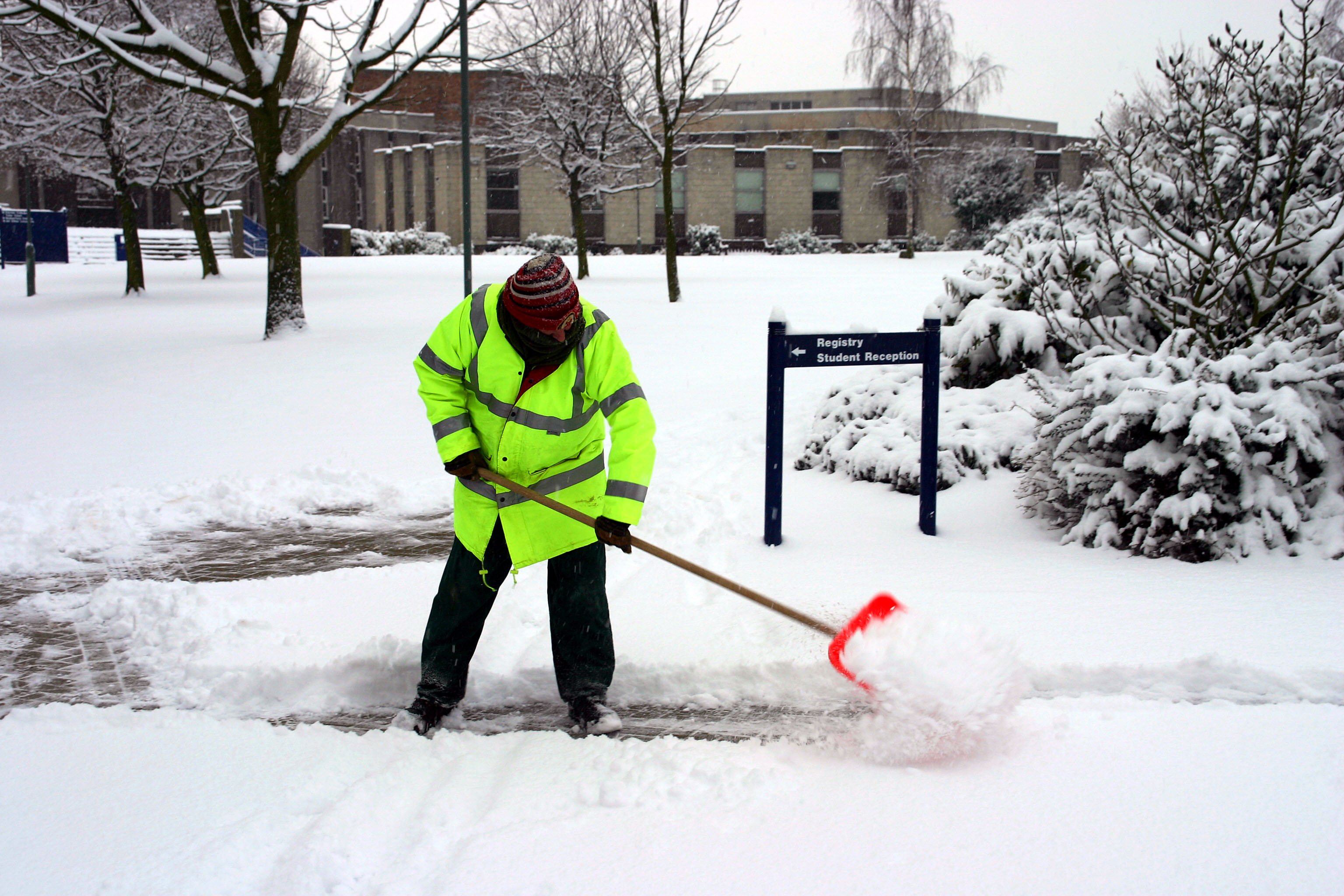
It's amazing how the tiniest of things can shake the resolve of the British. If Al-Qaeda wants to rile British people they might have realised by now that bombs are futile. In the wake of the bombings of July 7, the phrase "blitz spirit" became a ridiculous cliche, or the "we lived through the IRA" braggadocio. This posturing, if there is modicum of bravery attached to it, is no bad thing. When people put up a fight against Al-Qaeda but cower when a bit of white fluff falls from the sky, the fight or flight genes definitely have a defect.

The media is partly to blame for this. There is no such thing as good news. All news is more or less bad. ITV News has an "and finally" slot which doesn't necessarily report good news, but reports quirky stories from around the globe - the idiosycracies of life. When it comes to weather, snow is always bad news. Imagine if Michael Fish took one last post-retirement job as a weatherman in Siberia (come on Michael, for ol' times sake), the viewers would be getting bad news everyday. "That cold front from the last Ice Age which has long finished everywhere else in the world is expected to continue tonight here in Siberia," he would say.

Some snow falls, and all hell breaks lose. Why is such a fuss made because the snow is hampering people's movements? Because people can't bear for their twenty-four hour consumer lifestyles to be halted for one minute. How is the Tesco delivery man supposed to drop off my latest supply of Appalachian mountain lettuce if there's snow on the road? How am I supposed to meet the boss's target of clocking two hundred office hours in a seven day week if the trains are delayed? How am I supposed to get to Harrods at 3am and have a chinwag with the security guard while I wait for the sales to start? You're not going to do any of those things, so take a chill pill. Any pill. Just relax. Snow is what happens when, "water vapour undergoes deposition high in the atmosphere at a temperature of less than 0°C," or at least that's what Wikipedia tells me. It is a naturally occurring phenomenon, not a freak incident.

I'm working at a building and the good residents run out of water, something to do with the pumps not working. So they call concierge to complain about it. One of them tells me that this is the third time the water machine has packed up this year, quelle horreur, "it's like living in a third world country". I wanted to say, "actually, it isn't sir. In the third world you would have run out of water a long time ago, because there was a power cut and the pumps can't be powered. You could try using the electricity generator, but there is a fuel shortage, after the Buncefield oil depot lit up the Hertfordshire sky and all that good stuff. There is however a stream called the Thames, luckily for you, not too far from where you live. Although to be honest, I wouldn't trust its potability. If you do have a bucket, you could come downstairs and fetch some from the tap here. Bizzarely, the water down here is running. Third world country? Are you kidding?"

Saturday, December 24, 2005

Memories...

I went home to Nigeria on holiday last year Christmas. It was a kind of boy done good, went-to-university-in-Britain-and-now-has-a-degree homecoming. I was looking forward to seeing family and friends that I hadn’t seen in four years. My mum had gotten emotional about the fact that I had paid for the trip myself, talking about how much her son had grown that she didn’t have to pay for his ticket. Great contrast to this year - stark broke and in London. It was also a chance for me to assess how far down the road of development Nigeria had come in her newfound democracy.

One evening, we were heading back to our house in a suburb in Lagos, my mum was driving, and we had a guest sitting at the back. Perhaps I should have been driving, but I wasn’t about to reacquaint myself with a left hand drive car on the streets of Lagos. I’d heard enough stories of newcomers driving on the wrong side of the road, and trying to change gears with their left hand, but finding the door handle instead.

Approaching a bit of a traffic snarl, locally known as “go slow”, a tall man brandishing a machete leapt in front of the car, shouting “gimme the set, gimme the set”, demanding our mobile phones. He started to walk round the car towards the driver’s side, machete in tow, menace in his eyes. So my mum started winding her window up, after which we heard a smash, and a squeal of tyres, as she found a gap in the traffic and sped off.

As we drove away in a panic, in the opposite direction to our destination, we assessed the damage. The driver side window had been smashed, with shards of glass scattered on my mum’s clothes, and me clutching my chest for fear of my heart popping out of its cavity. Yes, it was beating that fast! We drove past a military barracks and up ahead was a police checkpoint, which we knew well since it had been there for years. We got there only to find two other cars suffering from driver-side-window-smashed-in syndrome, and another two cars behind us.

The sheer brazenness of a machete wielding robber operating so close to Nigeria’s fine police force! The officer in charge of manning the checkpoint was informed of what had transpired, and was determined to do his bit to protect and serve. So he shouted, “corporal, cock your gun, let’s go!” Yippee, the guy who had just traumatised us was going to get his comeuppance. But the policemen weren’t going to head to a dangerous spot in a squad car with blaring sirens, they were going to go there in a more surreptitious manner, in our car!

So I got into the back seat, sitting beside the corporal loading bullets into his gun, while the officer in charge rode shotgun – pun intended. Being robbed is not really a big deal, I can think of places in Britain where I wouldn’t venture after a certain hour. However, one’s car being used a de facto operational centre with a view to attacking a machete wielding robber is in a different realm of reality. I couldn’t figure out which I was more scared of, the man who had just emotionally scarred me for life, or the click clacking of the law enforcement man sitting next to me loading his gun with shiny bullets.

It wasn’t exactly the time to protest that we had neither been trained in body to drive as policemen, nor in mind, to deal with deadly weapons within such proximity to our bodies. All five cars drove in a convoy against traffic, hazard lights flashing, and my mum the police squad car driver at the head of the queue. In case you’re wondering, driving against traffic with hazards flashing isn’t at all an oddity in Nigeria. We got closer to the spot where Machete Man had attacked us, and all the cars started to slow down, before our protector said to my mum, “Ah madam, this is not our jurisdiction. It is the responsibility of...”

There I was warming to the idea of a real life cops and robbers shoot out, no phoney toy guns, no slumping on the ground in false agony, no fake scorekeeping and cheating by the boys from the other street. What I get instead, is a policeman who chickens out when I have just overcome the twin traumas of being attacked by a machete, and become a conscripted member of a gun toting police checkpoint unit.

Maybe next time. Everyone we told the story had something along these lines to say, “That spot, yes. It’s notorious between 7pm and 9pm. I never go there at that time.” Well thanks for the information. I should write a petition to the city council asking them to put up a note of warning alongside the road signs – city centre, 10kilometres, armed robbers, 2kilometres.

Thursday, December 22, 2005

Lies, damn lies, and statistics.

The former British Prime Minister Benjamin Disraeli said, "there are three types of lies - lies, damn lies, and statistics". Apply this to people who give feedback on failed job applications. In the past, I used to receive standard rejection letters, "after careful consideration, we regret to inform you...", blah, blah. The letters were more annoying than disappointing. I tend to rip open the envelope and scan the page for the word "unfortunately"; it's a always a good indicator of whether to bin it straightaway. Those letters were lies, because if they had considered the applications as carefully as they claimed they did, they would have conspired for their managing director to meet an unfortunate event and crowned me as supreme leader and messiah of the company. They didn't do any of the above, so I assume they lied about their supposed careful consideration. Liars.

Recently, I've been receiving more subtle rejection letters. They couch the rejection letter in reassuring words, "we were very impressed with your background and achievements, but this position isn't quite for you...", blah, blah. Too many of these types of rejections have landed on my doormat and in my inbox for it to be true. Which makes them damn lies. How many times can they actually be impressed with my CV (and say so) without actually giving me a job? It must a kind of New Labour ploy not to offend me. Instead of saying a child failed their exams, they say the child's success is deferred. Deferred? Until when? So the parents should be happy because their little sprog might perhaps maybe sometime in the unseen unpredictable future get a good grade, or make something of their life. Maybe. Damn liars.

The last kind of rejection has got to be statistics. Not because they are statistics, but because lies and damn lies have already been used. I've been to interviews for print media, and I get the excuse that I'm "too broadcast". But I've also been to interviews for broadcast media, and they tell me that I'm "too print". Sorry, have I missed something? How can I be both at once? I'm either one or the other. I can't be Superman and Clark Kent at the same time. Or can I? Maybe I can. Statisticians.

Tuesday, December 20, 2005

Transport For London

Today, I received a very exciting letter in the post. At first I thought it was a red letter telling me that the helicopter hovering above was actually the bailiffs training in on my house. Such a letter would've been much lighter, whereas this envelope was heavy. So I opened it, lo and behold, it was a letter from Almex, with 90p in the form of a 50p, and two 20p coins. These were the words of the letter:

Dear Mr Nkem,

Thank you for contacting us about a problem you experienced with a Roadside Ticket Machine recently. Please accept my apologies for any inconvenience this may have caused you.

I enclose a refund of £0.90 in respect of the money you lost.

Thank you for bringing this matter to our attention and I apologise once again for the inconvenience caused.

Yours sincerely,
Kim...

All 90p! In cash! Who says there's no customer service in Britain? Last Thursday I was on Whitehall trying to get a bus ticket from the roadside machine, and as is usually the way with all roadside machines (especially the parking ones) it swallowed 90p of my hard-earned unemployment benefit, not a ticket in sight. So I did my civic duty by kicking it and shaking it until an alarm sounded, threatening to embarrass me. But I was going to let a little siren and a flashing red light from the machine stop me trying to get my money back. Luckily there was a telephone number one could call to report the thievery of money by TFL bus ticket machines. I called the number, said my spiel, and told them how much I had lost. I forgot all about it, only to see the letter this morning. They are a very generous lot, aren't they? In retrospect I should probably have told them £100 in coins were stolen by the machine, and given the excuse that I thought it was a fruit machine. Yes I know, it wouldn't have worked.

I was planning on writing a book tentatively titled, "Fare Dodging within the M25, and other saving tips", subtitled "stickin' it to da man". Bendy buses I hear you say? There's a lot more to fare dodging than bendy buses, trust me. Almex's honesty and generosity has caused me to rethink, maybe not all transport organisations are Mephistophelian money suckers. Perhaps they're really fluffy bunnies, and they only charge commuters because Red Ken threatened to drown other fluffy bunnies in the Thames if they didn't charge. Who knows?

Tuesday, December 13, 2005

Woman's Hour

I like Woman's Hour on Radio 4, hosted by Martha Kearney or Jenni Murray (pictured), who are quintessential Radio 4 female voices. For the record, the last time I checked, which wasn't too long ago, I am not a woman. I can't put my finger on why a programme about the female condition would interest me so. Perhaps to help my pulling power. Maybe not. I've already failed on that front. Anyway, it has gems (I don't use that word lightly) like Makosi expressing regret for not being a better role model while on Big Brother. The idea that people go on Big Brother think they'll become role models is a novel one, and only a programme like Woman's Hour can voice such an idea without sounding ridiculous. On Saturday's edition, Dora Akunyili, director of Nigeria's NAFDAC, talked about her experiences in her current position. She has had to dodge bullets, have her offices burnt, just so that ordinary Nigerians have faith in the medicines they use. Woman's Hour deals with issues affecting women, but the broader context is that of women in society. Unless you're an arch-Thatcherite, you'll agree that there is such a thing as society, and for better or worse we are part of it.

The Guardian was the first daily to have a woman's section in its pages, and it is always a good read. It appears only right that a section of society that has been ignored by a mainstream media run by old white men in suits is represented by specialist sections dedicated to those not catered for. This doesn't amount to misandry, but it is a balancing of centuries of prejudice and discrimination. Just like there is nothing wrong with forms of media aimed specifically at members of ethnic minorities.

I just found a host of columns I wrote years ago for my university newspaper, the Badger. Most of them are woeful, the rest however, are horrendous. And for those reasons , I will torment you with them:

BBC Radio's new digital radio station Asian Network was launched in late October, hot on the heels of BBC's 1Xtra. Asian Network is described as British Asian Radio, while 1Xtra is described as New Black Music. One of the first guests Asian Network had was Home Secretary, David Blunkett. He was blitzed by callers demanding whence he got the his audacity to comment on what language Asian families should speak in the privacy of their homes. More pressing I believe, is the actual legitimacy of the stations, 1Xtra and Asian Network, not their legality but their cultural legitimacy.

There is dissent in the media at the constant expansion of the BBC monolith, encroaching on independent broadcasting terrain, and overstepping the boundaries of its mandate. In the case of 1Xtra, there is the issue of definition of black music and the debate that black music is already mainstream, and the superfluity of a dedicated medium. From the names and descriptions of these stations, it appears that national radio is being divided along racial lines.


The issue of a black music station is somewhat easy to resolve. Having listened extensively to 1Xtra I can confirm that is indeed a black music station, which revolves around the cultures that surround hip-hop, garage, RnB etc. In no way is it exclusive to black people, as the artistes and listeners of music of black origin transcends racial barriers. There are programmes aimed at black communities, but the mainstream popularity of black music ensures that, non-black fans of black music will not feel left out.

Asian Network, however, is concerned with the Asian experience in Great Britain. This invariably excludes non-Asian listeners for several reasons. The station is not concerned with a particular niche of Asian culture that might have the mass appeal of black music. It is not concerned with the mass appeal of Bollywood or Eastern religions. The station is all encompassing, therefore, non-Asians might feel left out unless they have an explicit interest in the Asian experience, or they tune into a specialist show.

Asian Network has cultural legitimacy for one main reason, the ethnically polygenous Britain we live in. The ethnic minority communities generally have extremely strong ties to their ancestral homes, the languages are still spoken (as Mr. Blunkett noted), customs observed, religions practised. But, there is no doubt whatsoever that British culture has contributed to creating the people they are today. People describing themselves as British-Indian or British West Indian is commonplace, an acknowledgement of their Britishness and also a remembrance of their intercontinental roots. Mainstream media caters for the British branch of people's psyches but does relatively nothing for, say, the culture of Asians.

Now, the major gripe of opponents of stations such as Asian Network is this: If people are British, they should listen to British radio and not some foreign malarkey in some incomprehensible language. They perceive that these stations help with marginalising ethnic minority communities. By continually exposing them to something that isn't British, they lose touch with mainstream culture. And if they ignore mainstream culture, they become left out of a community of listeners, watchers and readers, that are predominantly white. This in turn leads to inhabitants of the same stretch of land that have no similarities in their view of the world, hence causing the extreme forms of misunderstanding that occurred in Oldham in the summer of 2001.

The counterarguments in favour of stations such as Asian Network, thwart all others. Human beings are not programmable machines that drop unwanted baggage when prompted. Were this the case, the minority of people who actually swear allegiance to Her Majesty on becoming British citizens would have to renounce old customs and cultures in the same oath. The Universal Declaration of Human Rights, Article 18 states, “Everyone has the right to freedom of thought, conscience and religion”. Denying people a forum to express thoughts relating to their culture is surely a breach of this right.

Mainstream media should make provision for fringe voices, but financial constraints prevent this, along with the possibility of sidelining the main demographics of a nation. This is where stations like Asian Network are useful, representing the minority life. As for creating a society out of touch with its surroundings, these stations perform the converse, strengthening ties with their immediate neighbours. The BBC have already said that there would be no need to asianise certain news items such as the fire brigade strikes, as I'm sure Asian skin burns in fire the way black, white and purple skin does. However, what Asian Network will do more than anything else, is be a mirror where British Asians can reflect on the Asian experience in Great Britain. And it this self reflection that aids greatly in dictating the manner in which people react to their habitat.

This article appeared in the 05/12/03 edition the Badger.

Friday, December 09, 2005

Alamaramalamadingdong arrested

As I write this, I have my hands and feet fettered with irons to stop me jumping for joy, too much. Alamieyeseigha aka Tina has been impeached and arrested. Who says the wheels of justice grind slowly? Let's see him escape Nigeria's jails dressed as a Benedictine monk with three breasts like in Total Recall. If he tries to use my recommended escape method, they won't get scientists to subject him to tests wondering what a human anomaly he/she/it is, but they'll probably burn him with tyres for being a witch. Jungle justice? You bet.

"World to drown in spit", say celebs and experts.

"Global warming is not only the number one environmental challenge we face today, but one of the most important issues facing all of humanity." Thus sayeth the Lord. Actually, thus sayeth Leonardo Decapitate his arse in relation to an eco-film, 11th Hour, which he's producing and narrating. Leo is no faux environmentalist, the man drives a hybrid Toyota Prius for crying out loud. In Hollywood it takes guts and disregard for one's street cred not to drive a gas guzzling SUV. The man is for real. What confuses me though is why global warming is the greatest threat to humanity. Earlier this week, I was watching the Daily Politics, when Damien Lewis came on to tell us about the lack of access to water in Bolivia being an evil. I also seem to remember the actress, Emma Thompson, say "AIDS is the greatest threat to face the human race ever."

This is whence the confusion stems. Will I die of AIDS after a stroll in the dark on Clapham Common? Will the hairs in my nostrils freeze over in the cold snap ironically caused by global warming. Will I die for lack of Evian from the French Alps? Will I die because my muslim neighbour comes into my house for a cuppa, and then squeezes the red button just as the toast pops up? What exactly is going to kill us all? Perhaps, I'm foolish for listening to celebrities. What the hell do they know? They might be the authority on if black is going to be the new pink in 2009, or if Neil Armstrong wore the wrong shade of white for the moon landings. But threats to humanity? Nah.

Well, the scaremongering endorsment (you can't just endorse Pepsi these days) isn't just a celebrity phenomenon, it is also the so-called intellectuals. The debate about what's going to kill is all is conducted in hyberbole, we're all going to die. Bjorn Lomborg says global warming, global shwarming, his opponents shout, "you lie". Nelson Mandela says AIDS is the real threat, Rumsfeld says it's the War on Terror. Economists say China is the greatest threat (but one we must embrace). Who should be believed?

Not to diminish the small matters of AIDS, and another ice age, but the greatest threat to the planet today is all that saliva coming out of the mouths of people talking about the greatest threat to the world today. We will surely drown in all that spittle. And we won't be able to build Waterworld á la Kevin Costner, not because it'll flop, but because spittle is too viscous, and one can't really swim in it. You don't believe me? Just look out of your window. Can you see that the streets have turned to saliva? Scared? You should be.

Thursday, December 08, 2005

Lest I bore you...

David Cameron's shadow cabinet reshuffle has missed a trick. There's the obvious emphasis on presentation, rather than substance. Malcolm Rifkind who only just came back into Parliament as the MP of the ultra-safe Tory seat of Kensington & Chelsea, has been vehemently against the Iraq war. William Hague, who's just replaced him as shadow Foreign Secretary, voted for the war. Iraq is still the major reason Labour shed so many votes at the last election, and DC (who voted for the war) could have had Malcom Rifkind hitting the government hard on the Iraq issue. But William Hague is a Tory favourite, Margaret Thatcher without the handbag and bouffant hair, in fact, Hague is bald. But having already given David Davis the shadow Home Secretary, and given his bessie mate, George Osborne, shadow chancellor, there was no way he'd have given Hague something vacuous like health or education. Rifkind would have been a good early attempt to put clear blue Tory water between him and Tony Blair.

Hague though, has not lost his Eurosceptic stripes. And this is probably the main reason DC has appointed him. Hague lost two elections on Euroscepticism, and here he is again, at the forefront of British anti-Europe. Same Tories, new clothes?

Tuesday, December 06, 2005

Breaking News: Old Etonian to lead Tories!

David Cameron has beaten David Davis to the Conservative party leadership as has been predicted since giving that speech at the conference. There hasn't been an old Etonian Tory leader since Alec Douglas-Home (pronounced Hume) in 1964. Before him there were two Old Etonians, Harold Macmillan, and Anthony Eden. Is the Tory leadership returning to its Etonocracy of old? During the run up to the announcement, the BBC was running some tapes of interviews with Tory grandees, Norman Lamont, Gyles Brandreth, and Nicholas Boles. While Nicholas Boles was being interviewed, Rishi Saha (pictured in background) was sitting in the background (again) "doing research" on a computer. Rishi Saha is the poster boy for Tory diversity and inclusionism. He's been close to the Cameron campaign, and I suspect he took DC to the North London community project where DC said the immortal words, "keep it real". I suspect they did with Rishi Saha what all the parties do to look diverse, a Sikh man in a turban standing at the front, a muslim woman in hijab standing to the right. If political parties could resurrect him, they'd probably have Sammy Davis, Jr*, doing handstands.

After the victory speech, DC was ushered by the head of broadcasting during the 2005 elections, Michael Salter. In the crowd were someone called Gabby who was part of the DC campaign team, and of course, Rishi Saha, who received a special handshake from DC. If Rishi Saha leaves his Brent South seat, he will get to run for a safe Tory seat in 2009/10, that is if he doesn't get a by-election before then. Mark my words, you heard it here first.

*Sammy Davis, Jr, was blind, black, and Jewish.

Monday, December 05, 2005

Cherie has a big bum

The Prime Minister's wife, Cherie Blair, has a big bum. Now, this is no bad thing. Big bums are in, I think... She's just spent one hour on our screens on a programme, Married to the Prime Minister. Channel 4 being the paragaon of tact, decency, and good taste, would have wanted to call it Shagging the PM, or the PM and his Hos, but Cherie probably laid down the law. And Dennis Thatcher being a man would not have helped the image of middle aged women dusting Number 10, wearing nothing but an apron, a pair of knee-high rubber boots, and a smile at the ready. The programme looked at all the PMs' partners since the war, and how terrible the scrutiny was and still is. During an interview, Harold Wilson's wife, Mary, was asked how on earth she could hope to organise regular meals, considering her husband's schedule was so irregular. Oh the travails of being married to the PM! It's a mark of how times have changed that, forty years on, nobody would dream of asking any PM's spouse such a question. They missed out a classic Dennis Thatcher quote: when he was asked by a journalist about who really wears the trousers in the house, "I do. I wear the trousers. And I wash and iron them, too," said he.

I can never understand why Cherie gets so much stick in the media. She appears to me to be perfectly charming, and I like her. Then again, I do like them slightly greying, skin slightly folding, a bag under an eye here, a hip replacement there. But I drift. If not for Cherie Blair, Tony would have privatised our breathing of air. He would have initiated some public private partnership where the right nostril is financed by the private sector, and the left nostril, by the public sector. Deep down inside Tony Blair is a Tory, his father being a Conservative. Cherie must have been his motivation for becoming Labour.

The Cherie/Tony dichotomy makes me think about people's politics and their relationships. Cherie is clearly leftist, and Tony is clearly rightist. Can a house politically divided against itself stand? Arnie married Maria Shriver, a Kennedy, a blue blood Democrat if ever there was one. Now he's the Governator, and she voted Republican during the California state elections. I dread to think that I might be in a union with someone of a different political hue. I have had a Tory girlfriend before, but she was on the left of the party. That's my excuse. I reckon that women will get the man they want regardless of political stripe, it's the men that make noise about politics and all that jazz. Who cares about politics, love conquers all. Right?

How ironic

I was pulled up a by a friend for plagiarising her idea. Idea (b) in the plagiarism post was entirely her idea. The fact that it was ironic that I stole her idea and put it in a post about plagiarism without citing her was entirely her thinking. This thief should be shot!

Sunday, December 04, 2005

Music to cry to

My tear ducts are dried up. The last time I cried, it had to do with matters of the heart. It felt like someone had ripped my heart out of its cavity, tossed it into a deep fat fryer, and then fed it to a scavenging fox. Okay, I was heartbroken. I hardly cried before then, nor have I cried since. My tear ducts are not dry because of some macho testosterone fueled resistance to being effete and crying like a good little girl. Au contraire, I'm almost but not quite metro, I'm very in touch with my sexuality. I'd cry at the drop of a hat if I could find reason to do so. But nothing in this world is ever serious enough for tears, except one. Music.

Some music is just so beautiful that it makes one want to bawl one's eyes out, overcome by emotion. I listen to "Ain't Sayin' Nothin' New" by the Roots, and I feel like crying. I listen to "Message in a Bottle" by the Police, and the desert that are my tear ducts threaten a deluge. I listen to "Memories Live" by Talib Kweli & Hi Tek, and I just want to lay my head down and let out little whimpers of joy. To quote Missy Elliott, "music makes me lose control".

These are lyrics from a Masta Ace song, "Black boy, black boy turn that shit down/ You know that America don't wanna hear the sound/ Of the bass drum jungle music go back to Africa/ Nigga I'll arrest ya if ya holdin up trafffic". Fine lyrics indeed, social commentary by what Chuck D called the black CNN, hip-hop music. The sentiment I agree with is the idea of black music being jungle music. Jazz used to be called jungle music when it was still in its ascendancy, and this was because it had infectious Africanesque rhythms. A lot of hip-hop has the same effect, infectious and rhythmic. The jungle element for me though, is the effect it induces in me. When I hear music like say, "Southern Hospitality" by Ludacris, it song makes me want to writhe like a jungle animal high on speed.

Music that makes me feel like an animal in a jungle, is jungle music.

Thursday, December 01, 2005

Ferris Wheel

Some people think that working in the creative industries is one of the greatest luxuries a person can have. Travel to the villa in Spain, sit by the pool, sip some sangria, fire off a chapter every few days, sip some more sangria, see fifty missed calls from your editor, reply with a text message saying, "the creative process cannot be rushed, dear boy". If this is what you imagine the creative industry to be, think again. I'm a journalist, and perhaps that is my problem, thinking that journalists work in the creative industry. We churn out copy like Ford churned out Model-Ts, you can have any colour so long as it's black.

I spend all my time trying to come with ideas that I reckon will work on television, radio, or print. Every week, the African Shirts Ideas Factory cranks out up to twelve distinct ideas for the media. How many get approved? I'll tell you when I get an approval. The key to getting work approved is to know the different media outlets very well. You need to know and understand them inside out. This gives you better insight into what to pitch to them, and how to pitch to them.